




A recruitment table can look polished and still be easy to walk past. The strongest university recruitment fair table display does more than carry a logo: it gives students a reason to stop, a quick way to understand your opportunities, and an inviting opening for conversation.
At a busy fair, employers compete for attention while students move quickly between tables. Recruiters need to share useful information without turning the tabletop into a crowded stack of brochures. A thoughtful setup makes your organization easier to recognize and your roles easier to scan, while keeping the focus on real conversations.
In this guide, you’ll learn how to create a distinctive, welcoming display that fits your recruiting goals and the event space. We’ll cover how to establish a strong visual identity, organize information for quick scanning, and choose practical elements you can reuse at campus events. A custom table cloth can create a cohesive foundation, while a banner stand can add visible messaging without taking over the tabletop. The result is a clear setup designed to help students notice, understand, and engage.
Key Takeaways
- Build your university recruitment fair table display around three clear messages: who you are, what opportunities you offer, and what students should do next.
- Choose display elements by purpose and event footprint. A table cloth, banner stand, or backwall can each contribute without requiring every format.
- Check the university’s display rules early, then plan artwork approval, production timing, transport, and on-site setup as separate checkpoints.
- Inspect the assembled display before students arrive to catch issues with visibility, legibility, or setup.
- Coordinated design and fabrication can help adapt branded event assets for campus recruiting.
What Makes a University Recruitment Fair Table Display Effective?
At a busy fair, recruiters have two jobs: earn a student’s attention and make the next step obvious. A striking setup may prompt a glance, but it won’t help students decide whether to stop if the opportunity is unclear. An effective university recruitment fair table display combines visual recognition with useful, easy-to-scan information, then makes approaching your team feel straightforward.
A recruitment table display is a branded, organized setup that helps students identify an employer, understand its opportunities, and begin a conversation. Its purpose isn’t simply to decorate a table. It should work as a visual introduction and a practical guide to what a student can do next.
A Job fair brings employers and job seekers together to discuss opportunities. At a campus event, students may be encountering your organization for the first time. Make the essentials clear without assuming they already know your industry, roles, or company culture.
What should students understand at a glance?
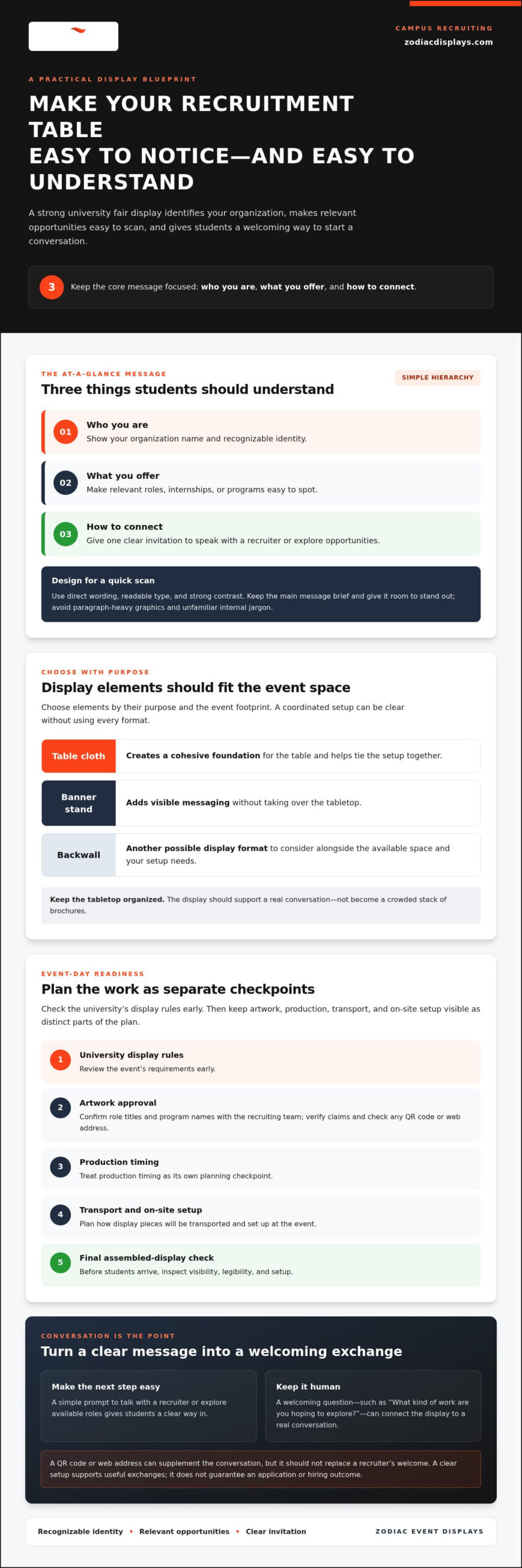
Give the display a simple information hierarchy: employer identity first, opportunity type second, and one invitation to engage third. A student should be able to spot your organization’s name, see whether you’re discussing internships or entry-level roles, and know whether to speak with a recruiter or explore open positions. Use direct wording and avoid internal jargon that may be unfamiliar to students.
Visual appeal gets attention; useful recruitment information gives that attention somewhere to go. Strong contrast between text and background, along with readable type, helps students scan your message from the aisle. Keep key wording brief and give it room to stand out. When a graphic presents several competing messages, even important details can be hard to find.
How does a display turn attention into conversation?
Once students recognize your organization and see a relevant opportunity, your team can make the interaction feel welcoming. A recruiter might open with a simple question such as, “What kind of work are you hoping to explore?” That invitation connects the display’s message to a real conversation without putting pressure on students to know exactly what they want.
Make the next step visible and easy to take. A short prompt to speak with a recruiter or explore available roles gives students a clear way in. Keep the tabletop organized enough to support that interaction, and make sure the display and recruiter’s opening work together. The goal is a useful exchange, not a guaranteed application or hiring outcome.
How to Plan the Message and Visual Hierarchy for a Campus Recruitment Table
A clear message gives your display direction before you choose colors, graphics, or supporting elements. Organize information into three levels: employer identity, opportunity message, and next step. This sequence helps a student identify your organization, see why it may be relevant, and understand how to engage.
Use this framework to shape the content, not as copy to print word for word:
- Who you are: Organization name and recognizable identity.
- What you offer: Relevant roles, internships, or programs.
- How to connect: A simple invitation to talk with a recruiter or explore opportunities.
A clear hierarchy reduces scanning effort. Students can find the employer name, relevant opportunity, and next action without sorting through a block of text. Keep the main message brief and legible from the aisle. Paragraph-heavy graphics tend to compete with the conversation instead of supporting it.
Which information belongs on the display?
Prioritize your organization’s name, the roles or programs relevant to the fair’s audience, and one clear conversation prompt. A QR code or web address can offer another route to details, but treat it as a supplement, not a replacement for a recruiter’s welcome. For practical advice on preparing for a campus event, see MIT’s Career Fair Advice for Employers.
Before artwork goes to production, check every detail. Confirm role titles and program names with the recruiting team, verify that claims are accurate, and test that each QR code or web address leads to the intended destination. A polished graphic can’t compensate for outdated information or a broken link.
How can brand visuals support the message?
Use approved logo files, established brand colors, and consistent typography across the display. Contrast and spacing matter as much as the graphics themselves. Give key words room to breathe, and make sure text stands apart from its background in a busy event setting. The goal is a cohesive look that catches the eye without crowding out the opportunity message.
For the university recruitment fair table display, consider how each element contributes to one visual system. A custom table cloth can establish a branded foundation, while a banner stand may carry a concise message above the tabletop. For broader custom trade show display planning, explore branded display options and consider how coordinated assets can carry your identity across events.
Which Recruitment Fair Table Display Elements Fit Your Campus Setup?
The right setup isn’t automatically the biggest one. A table cloth creates a cohesive base, a banner stand adds height, and a backwall provides a broader branded backdrop. Each has a different job. Choose according to the available space, sightlines, and message you need rather than assuming every university recruitment fair table display needs all three.
Use this comparison to narrow your options. Check each element against the event’s table size, traffic flow, organizer rules, and your transport plan. MIT’s career fair advice for employers also highlights display elements as part of a broader approach to branding and student engagement.
Custom table cloth
Use case: Establish a branded foundation on the recruitment table. Benefit: Creates a consistent, finished look without using additional floor space. Practical limitation: Provides less visibility above tabletop level. Best fit: Compact spaces or events where the table is the primary display area.
Banner stand
Use case: Give a concise message more height. Benefit: Adds visibility without taking over the tabletop. Practical limitation: Needs a suitable spot and must be allowed by the organizer. Best fit: Events where vertical messaging is useful and freestanding signage is permitted.
Backwall display
Use case: Create a larger branded backdrop behind the table. Benefit: Offers room for a more prominent visual identity. Practical limitation: Requires more setup space and transport planning than a table cloth alone. Best fit: An allocated footprint and event rules that support a larger structure.
When is a custom table cloth the right foundation?
A branded cloth can bring a standard recruitment table into your visual system and keep your organization’s identity visible at the center of the setup. Before choosing coverage or preparing artwork, confirm the table dimensions and any rules set by the university or fair organizer. Fit and placement affect how the design appears, so verify both before production.
When should you add a banner stand or backwall?
Add a banner stand when students need to see a key message above the table and the venue permits freestanding signage. Consider a backwall when the assigned area and setup rules can accommodate a larger backdrop. With either option, preserve clear sightlines and space for face-to-face interaction. Don’t let a display block neighboring tables or narrow a walkway.
Plan for reuse as well as the event itself. Consider whether each element can serve your other recruiting settings and whether it fits your transport arrangements. The strongest combination meets the venue’s requirements, supports your message, and feels easy for students to approach.
How to Prepare a Recruitment Fair Table Display for Event Day
A polished setup starts well before the fair opens. Work through the checkpoints in order so venue requirements shape the design and the finished display is ready to assemble. Confirm production timelines and shipping details for each project. Don’t assume they’ll be the same for every display or event.
What should recruiters confirm before artwork and production?
Start with the university or fair organizer. Check table dimensions, display height limits, setup and teardown windows, power access, and any restrictions on materials or structures. These details determine what can fit and how the display can be used. Record the requirements somewhere the recruiting, design, and production teams can all refer to them.
Next, gather approved logo files and confirm the exact messaging, role titles, QR codes, and web destinations. Name one person to give final artwork approval, then schedule time to review a proof before production. Check the text, confirm colors against your brand standards, and make sure supplied files are suitable for the intended display. Resolve errors at this stage, not while setting up at the venue.
How can teams make setup and reuse easier?
Separate the remaining work into clear checkpoints: approve artwork, confirm production timing, plan transport, and prepare for on-site setup. Ask about the dimensions, materials, lead times, and delivery details for the specific project. If the display format allows, test assembly before travel and assign setup roles so the team knows who handles each component.
A labeled packing list helps keep hardware, printed materials, and recruiter resources together. Consider reuse when selecting display elements and materials, but verify environmental claims for each product instead of assuming they apply across the board. For more sustainable display planning, consult an eco-friendly display guide and check that its recommendations fit the specific items and event requirements.
Use this event-day checklist before students arrive:
- Graphics: Confirm the artwork is correct, clean, and positioned as planned.
- Display hardware: Account for each component and check that the setup is secure and permitted.
- Handouts: Bring current materials and verify any QR codes or web addresses.
- Recruiter readiness: Make sure the team knows its roles, key talking points, and opening question.
Finally, step back and inspect the assembled university recruitment fair table display from the aisle. Check that key messaging is visible, the setup fits its assigned space, and students can approach without obstruction. Explore branded event display options as you plan a cohesive setup for campus recruiting.
Create a University Recruitment Fair Table Display with Zodiac Event Displays
Once you’ve clarified your message, chosen display elements, and checked the venue requirements, you can turn those decisions into a coordinated setup. Zodiac Event Displays is a Denver-based boutique branding agency with more than ten years of industry experience. The team designs, fabricates, and delivers branded event assets, including custom table cloths, banner stands, and backwall displays.
Each element can serve a distinct purpose. A custom table cloth provides a consistent branded foundation; a banner stand can carry a visible message without crowding the tabletop; and a backwall display can create a broader backdrop when the assigned footprint allows. The right mix depends on your recruiting goals, the venue’s rules, and how you plan to transport and reuse the display. For additional ideas on broader brand-display planning, visit Zodiac Event Displays’ event display website.
What can a design and fabrication partner help coordinate?
Collaborative planning can connect your visual direction to the practical requirements of production. Share the intended message, brand assets, event constraints, and preferred display components early. Design and fabrication can then be coordinated around the selected assets, with delivery details confirmed for the specific project. Review the artwork and verify dimensions, materials, lead times, and delivery plans before approving production.
What information should you share when requesting display support?
A focused project brief makes it easier to discuss a recruitment setup that fits the event. Gather the details your team has confirmed, and flag anything that still needs approval from the organizer.
- Event details: Date, venue, setup requirements, and applicable display rules.
- Space information: Table dimensions, allocated footprint, and any display-height restrictions.
- Display needs: Whether you’re considering a custom table cloth, banner stand, backwall display, or a smaller combination.
- Recruiting goals: The students or programs you want to reach and the conversation prompt you want the display to support.
- Brand materials: Approved logo files, colors, messaging, and any destination links for review.
With those details in hand, you can discuss a university recruitment fair table display that balances brand presence with event-day practicality. Bring your artwork, venue constraints, event requirements, and delivery plans to the discussion.
Make Your Campus Setup Ready to Connect
A memorable university recruitment fair table display brings three things together: a recognizable employer identity, a concise opportunity message, and an easy invitation to talk. Choose elements that suit the event footprint, then confirm venue requirements, artwork, production timing, and transport before the day. The result is a polished setup that supports meaningful conversations without asking the display to do all the work.
Zodiac Event Displays brings more than ten years of industry experience to the design, fabrication, and delivery of branded event assets. Custom table cloths can create a consistent foundation, while banner stands offer another way to make key messaging visible. The right combination depends on your goals and the space available.
Ready to shape your campus setup? Discuss a custom university recruitment display with Zodiac Event Displays, including your artwork, venue requirements, and delivery plans. Thoughtful preparation and a clear message can make your next fair feel welcoming, distinctive, and ready for conversation.
Frequently Asked Questions
What should I put on a university recruitment fair table?
Include your organization’s name, the roles or programs relevant to students, and one clear invitation to engage. For example, prompt students to speak with a recruiter or explore open positions. Keep the tabletop organized, with handouts or QR codes easy to find. A QR code can offer more details, but it shouldn’t replace a welcoming recruiter who can answer questions and start a conversation.
How do you make a recruitment fair table stand out to students?
Make your organization recognizable with consistent branding, then give students a concise reason to stop. Use readable type, strong contrast, and a short opportunity message instead of filling the display with paragraphs. Keep the next step obvious, such as speaking with a recruiter. A university recruitment fair table display is most useful when visual impact and practical information work together rather than competing for attention.
What size banner stand works for a university career fair?
There isn’t one ideal size for every fair. Choose a banner stand only after checking the organizer’s rules, your allocated space, and any height restrictions. Consider where it will sit, whether it could obstruct neighboring tables or walkways, and how it will fit into your transport plan. Confirm the stand’s actual dimensions and setup needs with the display provider before approving artwork or production.
Is a custom table cloth worth using at a campus recruitment fair?
A custom table cloth can be worthwhile if you want a consistent branded foundation for the table without adding a freestanding structure. It gives the setup a finished look while leaving the tabletop available for conversation and materials. Before ordering, confirm the table dimensions and fair requirements, then check how the planned artwork will appear across the cloth’s visible area.
Can I use a banner stand and table cloth together at a recruitment fair?
Yes, they can work together if the venue permits a banner stand and your allocated footprint has room. The table cloth can establish your brand at the table, while the stand places a concise message higher in view. Keep the combination balanced: preserve open sightlines, avoid blocking nearby exhibitors, and leave students room to approach and speak comfortably with your recruiters.
How do I prepare a recruitment table display for a university career fair?
Start by confirming the venue’s table dimensions, display restrictions, setup window, and other relevant requirements. Approve accurate logos, role details, messaging, and destination links before production, and confirm production timing and shipping details for your project. Pack display components and handouts using a checklist, assign setup roles, and inspect the assembled display at the venue for fit, visibility, and clear access.
What should I ask a display company before ordering a recruitment fair display?
Ask which display elements suit your table and venue, and confirm their dimensions, materials, artwork requirements, production timing, and delivery details. Clarify how proofs are reviewed and who should provide final approval. Share the event date, organizer rules, approved brand assets, and intended message so the design can reflect your recruiting goals. Check that the proposed components fit your transport and reuse plans.

 Previous reading