


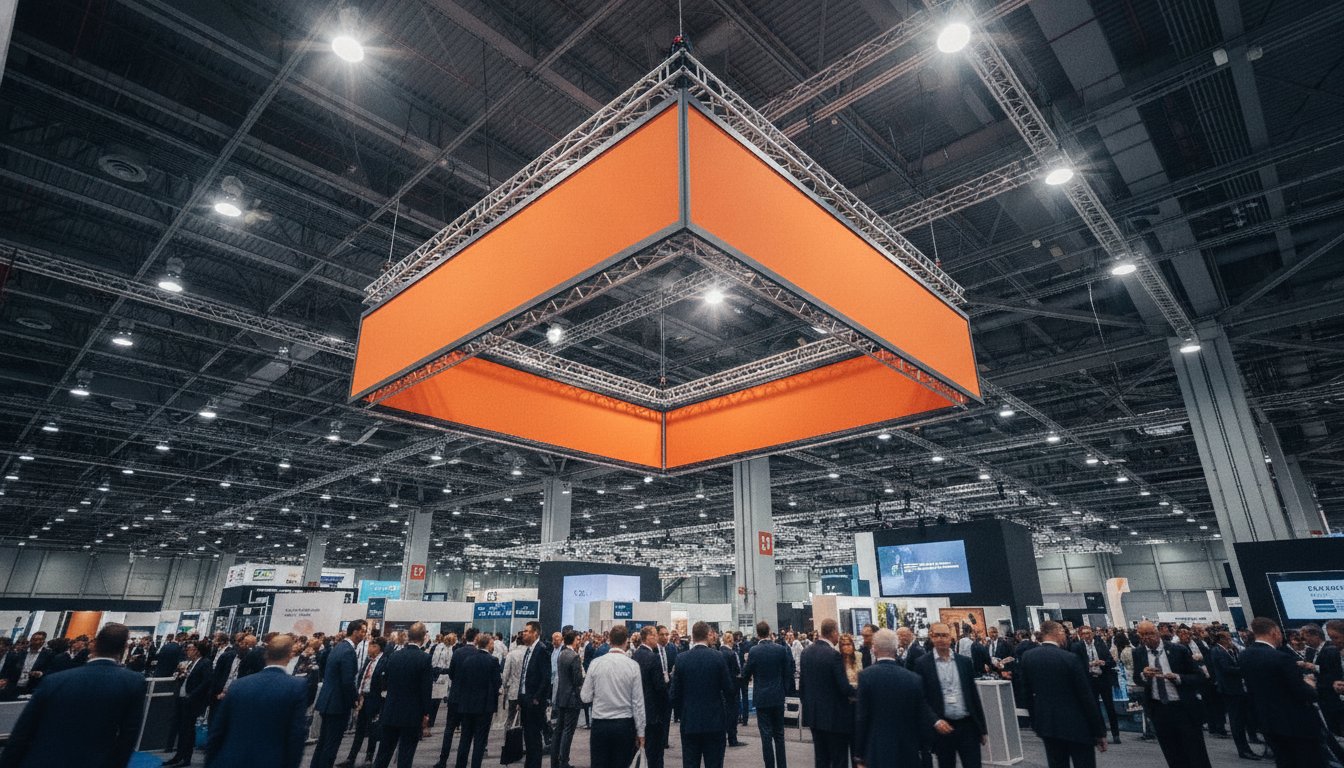
Imagine your team standing in a 20×20 island booth, watching as a Fire Marshal orders your custom hanging sign to be lowered and crated because it lacks a small NFPA 701 compliance tag. It’s a heart-sinking moment that costs more than just money; it costs you the visual dominance you planned for months. Understanding trade show hanging sign regulations shouldn’t feel like deciphering an ancient code, yet one missed rigging deadline or a height violation can ground even the most brilliant brand activation. You want your presence to be felt from across the hall, not sidelined by a technicality buried in the Exhibitor Service Manual.
We agree that the technicalities of overhead signage are often the most stressful part of event planning. This 2026 guide is designed to transform that anxiety into a strategic advantage, helping you master the complex world of overhead rules so your brand stands tall without costly violations. We’ll provide a clear checklist for compliance, from fire safety certifications to the specific height limits used in major venues. You’ll learn how to coordinate seamlessly with decorators and rigging crews to ensure your vision reaches its full, legal height with absolute precision and high-impact style.
Key Takeaways
- Learn how to secure your overhead presence by adhering to NFPA 701 fire safety standards and avoiding last-minute floor violations.
- Discover how to maximize your vertical impact by mastering the precise floor-to-top height and clearance measurements required for 2026 events.
- Streamline your approval process by learning how to decode the trade show hanging sign regulations found in your specific Exhibitor Service Manual.
- Reduce unexpected rigging and labor costs by selecting lightweight fabric structures that minimize the number of required ceiling connection points.
- Gain a strategic advantage by submitting technical drawings early to ensure your bespoke signage designs meet all venue-specific structural integrity rules.
Why Trade Show Hanging Sign Regulations Matter for Your Brand
Success on the exhibit floor begins long before the first attendee walks through the doors. It starts with a clear understanding of trade show hanging sign regulations, which are the specific safety and aesthetic standards established by show management and venue authorities. These rules aren’t meant to stifle your creativity. Instead, they provide a vital framework for maintaining clear sightlines, ensuring structural safety, and preventing fire hazards across the entire hall. When you understand what are trade shows in a professional context, you realize they are complex ecosystems where every overhead element must be accounted for to ensure the safety of thousands of visitors.
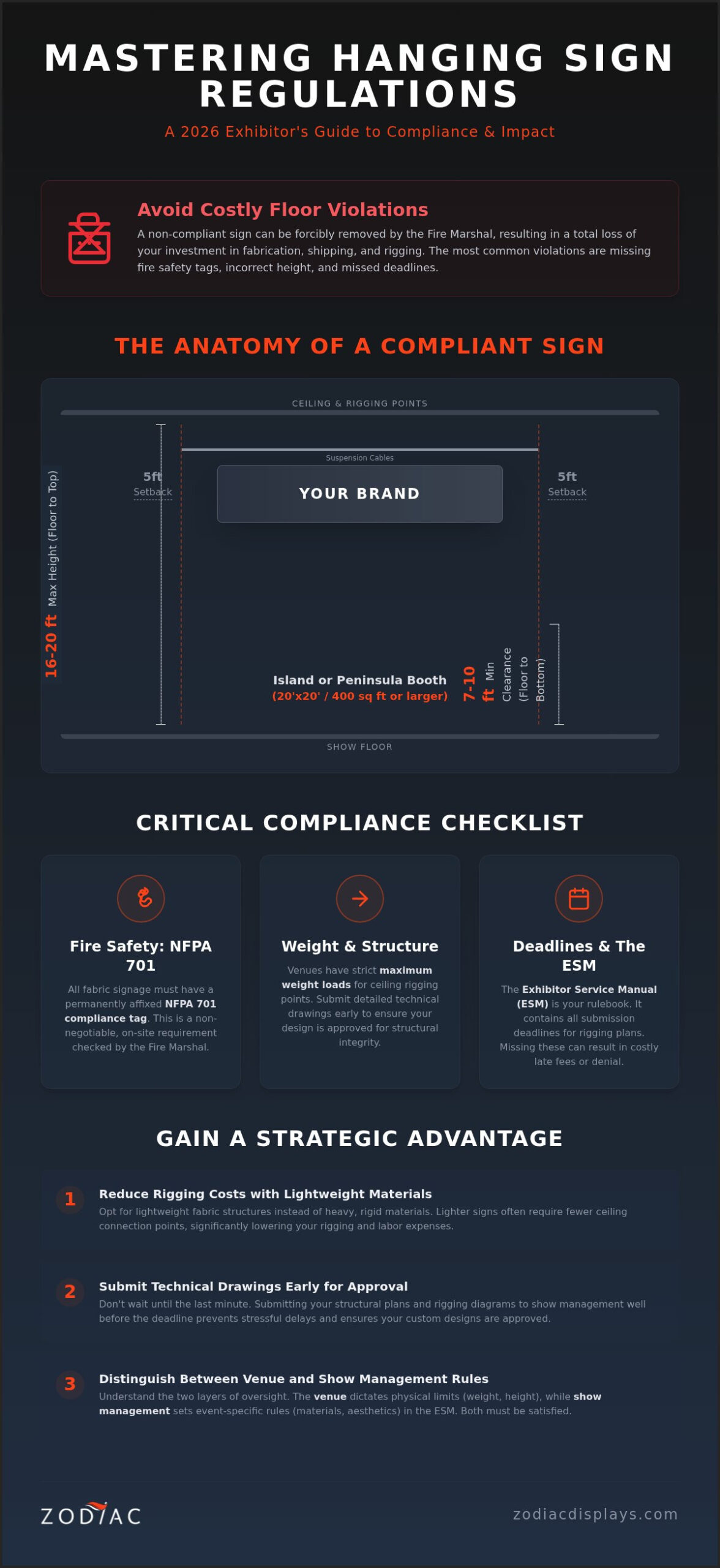
Ignoring these protocols leads to more than just a slap on the wrist. Non-compliance often results in the forced removal of your signage by show floor officials, hefty fines, and the total loss of your fabrication and shipping investment. Most venues only permit overhead displays for island or peninsula booths that are 20’x20′ or larger. If you’re in a linear or perimeter booth, these signs are generally prohibited to prevent a “tunnel effect” that would block smaller exhibitors. Mastering these rules ensures your brand stands tall without the risk of being grounded by the fire marshal.
Sightlines and the ‘Line of Sight’ Rule
Your brand deserves to be seen, but so does everyone else’s. The ‘Line of Sight’ rule is a fundamental part of trade show hanging sign regulations designed to protect the visibility of neighboring booths. In most major 2026 events, you’ll encounter a mandatory 5-foot setback rule. This means your hanging sign must be positioned at least five feet away from the edge of your booth space. By respecting these boundaries, you ensure that your high-altitude branding doesn’t obstruct the ground-level view of other participants. It’s about owning the air while remaining a collaborative partner on the show floor.
Venue vs. Show Management Rules
It’s vital to distinguish between permanent venue restrictions and temporary show-specific rules. The venue dictates the physical limits, such as ceiling height and maximum weight loads for rigging points. Meanwhile, show management sets the tone for the specific event, often introducing stricter material certifications for 2026 to align with updated safety trends. The Fire Marshal acts as the final authority, performing on-site inspections to verify NFPA 701 fire retardancy. Working with a strategist who understands these dual layers of oversight prevents technical delays and ensures a seamless, high-impact installation.
Universal Height and Placement Restrictions for Overhead Signs
Mastering trade show hanging sign regulations requires looking at two critical numbers: the maximum height and the minimum clearance. The maximum height, often capped between 16 and 20 feet, is measured from the floor to the very top of your sign. Equally vital is the clearance requirement, which mandates a gap of 7 to 10 feet from the floor to the bottom of the sign. This ensures safety and maintains a clear view through the hall. If your sign is too tall, you risk infringing on that mandatory air space; if it’s too short, you might fail to clear the heads of your attendees. Getting these dimensions right is the first step toward a successful, stress-free installation.
Hanging signs are almost exclusively reserved for island or peninsula booths 400 square feet or larger. In a standard 10×10 linear booth, you’re generally restricted to ground-level displays to avoid blocking neighbors. When planning your placement, don’t just aim for the center of your booth. You must align your vision with the venue’s physical rigging points. Technical safety is paramount, so ensure your hardware meets OSHA rigging equipment standards to avoid on-site delays. Strategic placement is a dance between marketing goals and structural reality. While centering your sign provides a balanced look, the ceiling’s rigging grid might dictate a slightly offset position. Identifying these constraints early prevents expensive on-site adjustments.
Calculating the ‘Sweet Spot’ for Visibility
The ideal height isn’t always the maximum allowed. Think of the ceiling height as the frame for your brand. In a massive convention center with 40-foot ceilings, a sign hung at the 20-foot limit can look ‘lost’ or disconnected from your booth. We recommend using custom trade show displays to create a visual anchor at ground level that draws the eye upward to your overhead branding. This creates a cohesive narrative from the floor to the rafters. A 10-foot tall sign hung at a 20-foot top-height creates a powerful vertical billboard. However, if the venue has a lower ceiling, you might need to reduce the sign’s vertical height to maintain that mandatory clearance. Balancing these dimensions ensures your message isn’t squeezed or obscured.
Encroachment and Perimeter Rules
Your brand’s reach has physical boundaries. Most trade show hanging sign regulations strictly forbid any part of your sign from extending past your booth’s footprint. In peninsula configurations, you may share ‘air space’ with adjacent booths, requiring careful coordination to avoid overlapping logos. Island booths offer the most freedom, but they also demand a 360-degree design approach. Since attendees will view your sign from every angle, your graphics must be vibrant and legible from all directions. If you’re unsure about your venue’s specific footprint limits, it’s wise to consult with a signage expert early in the design phase. This proactive step helps you own the air without stepping on your neighbors’ toes.
Safety and Structural Requirements: Rigging, Weight, and Fire Codes
Rigging an overhead asset is a feat of engineering that demands precision. While visual impact is your ultimate goal, the structural integrity of your frame is the foundation of a successful show. Venue officials strictly prohibit home-made or non-certified frames because they pose a significant safety risk to attendees. Professional-grade aluminum structures are the industry standard for a reason. You must also understand the “Rigging Point” system to manage your budget effectively. Venues charge for each individual ceiling connection, known as a point. A complex, heavy sign might require four or five points, while a lightweight fabric structure often only needs one or two. This distinction is where many exhibitors face unexpected costs during the move-in phase.
Labor is another non-negotiable factor in the hall. You simply cannot hang your own sign. Trade show hanging sign regulations mandate the use of venue-authorized rigging crews or an Exhibitor Appointed Contractor (EAC). These professionals ensure that every connection meets the specific load-bearing capacity of the venue’s truss system. If your sign exceeds the weight limit of a specific point, you’ll need to redesign the rig or pay for additional points to distribute the weight. It’s a technical dance that requires early coordination with the General Service Contractor (GSC) to avoid expensive on-site modifications.
Fire Safety and NFPA 701 Certification
Fire safety is the top priority for every Fire Marshal on the floor. Every fabric asset, including hanging signs and custom flag banners, must have an NFPA 701 flame-retardant certificate attached. This isn’t just a suggestion; it’s a legal requirement. If an inspector doubts your material, they may perform a “match test” on a small sample. Non-compliant materials are removed immediately without a refund. At Zodiac, we ensure every piece of soft signage we fabricate includes the necessary certification tags sewn directly into the hem. This proactive step protects your investment and ensures your booth remains compliant from the first minute of the show.
Rigging Hardware and Safety Cables
The hardware you provide is just as important as the sign itself. Every eye-bolt and carabiner must be “rated” for overhead lifting. Using generic hardware from a local home improvement store is a common mistake that leads to immediate installation delays. Additionally, trade show hanging sign regulations typically require safety cables as a secondary fail-safe. These ensure the sign stays secure even if a primary connection fails. By providing high-quality, rated hardware and coordinating with the GSC, you create a safe environment that lets your brand shine with confidence and professional flair.
Navigating the Exhibitor Service Manual (ESM) and Deadlines
The Exhibitor Service Manual (ESM) is the essential roadmap for every successful event activation. Within its dense pages, the specific section dedicated to trade show hanging sign regulations is arguably the most critical for brands aiming to dominate the skyline. You must identify these rules early. Show management requires a formal approval process that involves submitting detailed renderings and technical drawings. This isn’t a mere formality. They need to verify that your sign’s weight, dimensions, and materials align with the venue’s structural safety limits. Missing the rigging order deadline is a mistake your budget won’t soon forget. Early bird rates often expire 21 to 30 days before the show; missing this window can result in labor surcharges of 30% or more.
Shipping logistics for overhead assets also follow a strict protocol. Most 2026 shows mandate that hanging signs be sent to the “Advance Warehouse” rather than “Direct to Show.” This allows the rigging crew to assemble and hang your sign before the floor becomes crowded with crates and carpet layers. If your sign arrives direct to the show site, you risk being placed at the bottom of the rigging queue. This delay can stall your entire booth construction, as many venues prohibit ground-level work while overhead rigging is in progress. Planning your arrival dates with precision is the only way to ensure a seamless transition from the shipping dock to the rafters.
Preparing Your Technical Submission
Show management needs more than just a pretty picture. They require exact dimensions, total weight including hardware, and precise placement diagrams. They want to know exactly where your sign lives in relation to your floor plan. One often overlooked detail is the “Hanging Sign Orientation” label on your shipping crates. This clear marking tells the crew which way is up before they even open the box, saving precious minutes of expensive union labor. Our creative consultancy team at Zodiac manages this technical file preparation for you, ensuring your submission meets every venue requirement with professional flair.
Budgeting for Hidden Rigging Costs
Calculating your event ROI requires a deep dive into the difference between hardware costs and show services. Your sign’s fabrication price is only one part of the financial equation. You must also account for drayage, which is the fee to move the sign from the loading dock to your booth, and the actual rigging labor. Most venues enforce one-hour minimums for rigging crews, which usually consist of two or three people plus a motorized lift. Managing the “Hanging Sign Labor” order form in your online portal is essential to avoid “floor rates,” which are significantly higher than advance prices. To ensure your overhead strategy is both compliant and cost-effective, connect with our consultancy team to plan your next high-impact display.
Designing for Compliance with Zodiac Event Displays
Designing for the skyline requires a blend of artistic flair and technical discipline. At Zodiac Event Displays, we don’t just build signs; we engineer compliant brand landmarks. While many vendors push standard, uninspired shapes, our focus is on bespoke fabrication that satisfies your unique aesthetic while adhering to every line of trade show hanging sign regulations. This boutique approach means we dive deep into your specific show manual. We ensure your visionary concept survives the scrutiny of the floor manager, arriving at the venue ready for a flawless install that maximizes your visual impact.
Soft Signage vs. Rigid Frames
Tension fabric is the gold standard for 2026 exhibits. It offers a sophisticated, high-energy look with a fraction of the weight of traditional rigid materials. By choosing lightweight soft signage, you significantly reduce the number of required rigging points. This choice directly lowers your show-floor labor costs and simplifies the coordination with venue decorators. Our specialized event display fabrication process balances this lightness with extreme durability. We maintain a focus on quality that exceeds standard requirements, ensuring the fabric remains crisp and vibrant from every angle. Rigid frames often add unnecessary shipping volume and drayage fees, but our soft signage packs down efficiently for global delivery, saving you money without sacrificing scale.
Your Partner in High-Impact Visibility
Partnering with us means gaining a visionary expert who understands the endurance required for trade show success. From the initial concept to the final rigging point, our end-to-end process removes the stress of technical compliance. We make sure your overhead sign perfectly complements your other brand assets, such as custom event tents or backwall displays. You get personalized attention that a cold, corporate factory simply can’t provide. We provide all necessary fire certificates and technical drawings as part of our premium service, acting as your strategic ally through every complex creative process. If you’re ready to own the air with a display that’s as safe as it is stunning, Contact Zodiac Event Displays today.
Master the Skyline with Strategic Compliance
Turning your vision into a soaring overhead reality requires more than just a great design. It demands a deep respect for trade show hanging sign regulations and a proactive approach to technical deadlines. By mastering height restrictions and fire safety codes today, you ensure your brand commands the hall without the threat of floor-level violations. Early coordination with rigging crews and precise technical submissions are the secrets to avoiding unexpected costs and protecting your event ROI. You’ve worked hard to build your brand; your overhead presence should reflect that same dedication to excellence and professional flair.
At Zodiac Event Displays, we act as your dedicated ally through every stage of the process. With over a decade of rigging coordination experience, we specialize in bespoke fabrication that meets any venue requirement while maintaining a lightweight, high-impact profile. Our full-service approach includes expert technical file preparation to ensure your submission is approved without delay. Don’t let confusing manuals ground your creativity. Design Your Compliant High-Impact Hanging Sign with Zodiac and watch your brand reach new heights. Let’s make your next presentation your most successful one yet.
Frequently Asked Questions
Can I hang a sign in a 10×10 linear booth?
No, you generally can’t hang a sign in a 10×10 linear booth. Most trade show hanging sign regulations reserve overhead signage for island or peninsula booths that are 20’x20′ or larger. Linear and perimeter booths are restricted to ground-level displays to maintain clear sightlines for neighboring exhibitors. If you attempt to hang a sign in a smaller space, show management will likely order its immediate removal to prevent blocking the view of other booths on your aisle.
What is the NFPA 701 certification and why is it mandatory?
NFPA 701 is the national fire safety standard for flame-retardant textiles used in public spaces. It’s mandatory because convention centers are high-occupancy environments where fire prevention is the top priority. Every hanging sign must have a compliance tag or certificate from the manufacturer. Fire Marshals often perform on-site inspections, and non-compliant materials will be removed. Zodiac ensures all soft signage meets these strict standards to protect your brand and your investment.
How much does it typically cost to rig a hanging sign at a trade show?
While the cost of the sign itself varies, the venue’s rigging services typically range from $500 to over $5,000 depending on complexity. You’ll pay for “rigging points,” which are the ceiling connections. For example, a motorized rigging point package can cost around $278, while scissor lift rentals often run between $379 and $420 per day. Missing the advance order deadline can increase these service rates by 30% to 50%, so early planning is essential.
Do I need to hire my own riggers or use the show’s labor?
You must use the venue’s authorized rigging crews or the show’s General Service Contractor (GSC) for the actual installation. Exhibitors are strictly prohibited from hanging their own signs for safety and liability reasons. You can hire an Exhibitor Appointed Contractor (EAC) to supervise the process, but the physical labor and ceiling connections are performed by union crews. This ensures every overhead asset is secured according to the venue’s specific structural load limits.
What is the maximum height allowed for a hanging sign in 2026?
The maximum height for a hanging sign in 2026 is typically between 16 and 20 feet from the floor to the top of the structure. For instance, the Summer Fancy Food Show 2026 sets a 16-foot limit for most booths, while larger international pavilions can reach 20 feet. You must also maintain a minimum clearance, usually 10 feet, from the floor to the bottom of the sign to ensure attendees can walk underneath safely.
Can my hanging sign have internal lighting or rotating motors?
Yes, internal lighting and rotating motors are permitted, but they require extra coordination. You’ll need to place an electrical order for the power drop and ensure the rigging plot accounts for the additional weight of the motor. These features often require more complex rigging points to handle the torque and electrical cables. Always check your trade show hanging sign regulations in the service manual, as some venues have specific rules for moving parts.
What happens if I ship my hanging sign without a technical drawing?
Shipping your sign without a technical drawing or rigging plot often leads to expensive delays. The rigging crew won’t begin installation until they have a verified diagram showing the sign’s weight, dimensions, and orientation. Without this documentation, your sign might sit in its crate while you pay for idle labor. Providing clear instructions and technical files ensures the crew can work efficiently, helping you avoid the high costs of on-site corrections and missed deadlines.
How far in advance should I order my hanging sign to ensure compliance?
You should start the process at least 60 days before the show. This provides enough time to receive approval from show management and the venue building. Rigging plots and service orders are typically due 21 days prior to load-in to qualify for advance discounts. Starting early allows Zodiac’s team to manage technical file preparation and fabrication, ensuring your sign is compliant and ready for the Advance Warehouse deadline to avoid logistical bottlenecks.

 Previous reading