


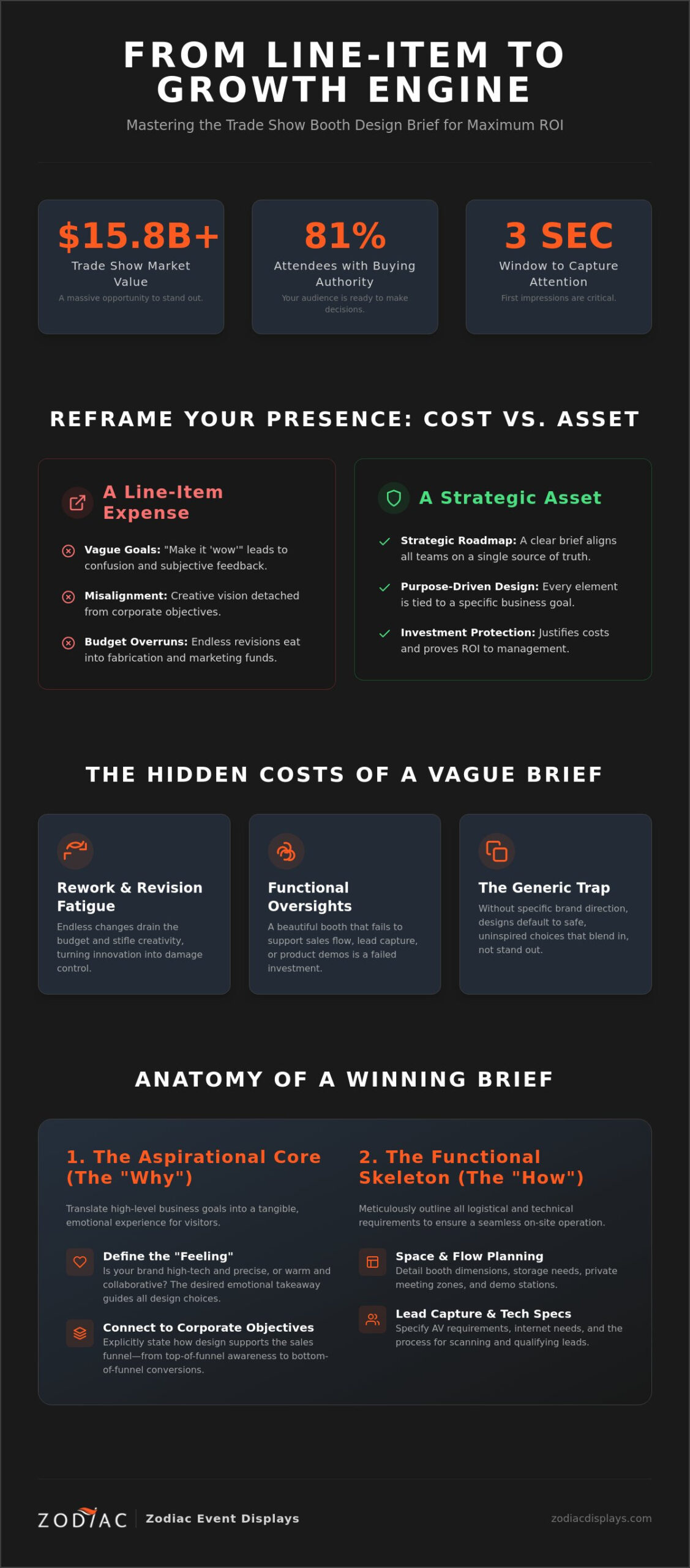
What if your next trade show floor space wasn’t just a line-item expense on a spreadsheet, but a high-performance asset that your CFO actually championed? In a market valued at over $15.8 billion, the pressure to stand out is immense, yet many teams struggle to bridge the gap between creative ambition and corporate reality. You likely feel the weight of management viewing these events as a cost rather than a catalyst for growth. It’s time to change the narrative. By utilizing a comprehensive trade show booth design brief template, you can transform your planning process into a strategic power move that justifies every dollar of your investment.
We believe that a successful exhibit requires more than just bold graphics; it demands a partnership built on clarity and precision. This guide will show you how to craft a brief that acts as a definitive contract of expectations, ensuring your team and your partners are perfectly aligned from the first sketch to the final installation. We’ll explore the essential metrics to prove ROI and the design strategies that capture attention within the critical three-second window. You’re about to discover how to turn your event presence into a high-impact growth engine that leaves a lasting impression on the 81% of attendees who carry buying authority.
Key Takeaways
- Reframe your event presence from a line-item expense into a strategic asset that’ll fuel long-term professional growth and visibility.
- Discover the core technical and aspirational elements of a professional trade show booth design brief template to ensure every detail aligns with your corporate mission.
- Master the language of ROI to justify your investment, focusing on high-impact metrics like brand equity and cost-per-lead that’ll resonate with management.
- Gain a tactical roadmap for presenting your brief to stakeholders, ensuring you lead with visionary objectives to secure rapid and enthusiastic project approval.
Better Briefs, Bigger Business: Why Your Design Brief is a Strategic Asset
A design brief is the North Star for your entire event marketing strategy. It’s the single source of truth that keeps your creative team, marketing department, and executive stakeholders moving in the same direction. When you utilize a professional trade show booth design brief template, you aren’t just filling out a form; you’re building a strategic roadmap. This document translates your high-level business goals into actionable design requirements, ensuring that every visual element serves a specific purpose. Without this clarity, your project is susceptible to the whims of subjective opinion, which often leads to expensive pivots and missed deadlines.
Vague goals are the primary drivers of budget overruns. Requesting a “wow stand” or a “modern look” provides no real direction for a design team. What looks modern to one person might feel cold to another, and “wow” doesn’t necessarily generate leads. This lack of precision forces designers to guess, leading to multiple rounds of revisions that eat into your fabrication budget. By defining your expectations early, you protect your investment and ensure the final result reflects your brand’s true identity. Every trade show is a high-stakes environment where clarity is your greatest competitive advantage.
The most successful exhibitors have made a psychological shift: they’ve stopped buying booths and started investing in brand environments. A booth is a physical structure made of aluminum and fabric, but a brand environment is a sensory experience designed to facilitate professional growth and connection. This shift in perspective changes how you justify costs. You aren’t just paying for hardware; you’re funding a high-impact growth engine. A professional brief acts as an insurance policy against creative misalignment, guaranteeing that the final presentation resonates with your target audience and supports your long-term objectives.
The True Cost of a Poorly Defined Brief
Rework is a budget assassin. When a project lacks a clear trade show booth design brief template, revision fatigue sets in quickly. Your team spends more time fixing mistakes than innovating, which stifles the creative energy required for a standout presence. Functional oversights are equally damaging. If the brief fails to account for how your sales team actually interacts with prospects, you’ll end up with a beautiful space that’s impossible to work in. Finally, there’s the “Generic Trap.” Without specific details, designers often default to safe, uninspired choices, resulting in a booth that blends into the background of a crowded hall rather than commanding attention.
Aligning Vision with Corporate Objectives
To secure management approval, you must translate “visual impact” into the language of the C-suite. Executives don’t just want to see a pretty display; they want to see how that display increases market share and improves brand recall. Your brief should explicitly state how the design supports different stages of your sales funnel, whether that’s top-of-funnel awareness through bold signage or bottom-of-funnel conversions in private meeting areas. By connecting every design choice to a corporate goal, you transform the conversation from “how much does it cost?” to “how much will it return?” The brief serves as the essential bridge between creative aspiration and fiscal responsibility.
Defining Your Design: The Essential Elements of a Winning Template
A high-performance trade show booth design brief template must bridge the gap between logistical necessity and creative inspiration. While basic forms focus on booth dimensions and venue specs, a strategic template digs deeper into the aspirational core of your brand. You aren’t just building a structure; you’re engineering an emotional experience. Start by defining the specific “feeling” you want visitors to take away. Is it the precision of a high-tech laboratory or the warm, collaborative energy of a creative studio? This emotional anchor guides every subsequent choice, from the density of the carpet to the specific Kelvin rating of your LED lighting.
Functional requirements are the skeletal system of your exhibit. Your template should meticulously outline storage needs, private meeting zones, and the specific AV requirements for your product demos. Think about the lead capture flow. If your team needs to scan badges quickly, ensure the layout facilitates a seamless entry and exit. Brand integration goes far beyond sticking a logo on a backwall. It involves layering textures, utilizing movement through digital displays, and strategically placing Backwall Displays that command attention from every angle. When these elements work in harmony, they create a cohesive environment that reinforces your market authority.
The Audience Profile and Visitor Journey
Success on the floor requires knowing exactly who you’re talking to. Identify your “VIP” attendees and their primary pain points. Since research shows that 81% of trade show attendees have buying authority, your design must cater to high-level decision-makers. Apply the “Three-Second Rule” to your visual hierarchy. A visitor should grasp your value proposition from 20 feet away in less than three seconds. Map the physical journey from the initial aisle-side attraction to the deep-dive demo area, ensuring there are no bottlenecks that disrupt the engagement process.
Technical Specs and Hard Constraints
Precision in technical specifications prevents expensive onsite surprises. Your trade show booth design brief template should clearly define hanging sign requirements and overhead visibility constraints to maximize your vertical footprint. Don’t overlook power and data connectivity for interactive custom inflatables or multi-sensory digital installations. As sustainability becomes a competitive differentiator, many exhibitors are now integrating Eco-Friendly Trade Show Displays into their requirements. This commitment to reusable materials not only reduces waste but also resonates with the growing number of eco-conscious attendees and organizers.
By documenting these hard constraints early, you allow your creative partners to innovate within a realistic framework. This proactive approach is essential for evaluating critical metrics later, as it ensures the physical space is optimized for the data you intend to collect. A well-constructed brief is the first step toward a presentation that isn’t just seen, but remembered.
Calculating the Cost: Justifying Your Event Investment to Management
Securing a significant budget for your exhibit requires a shift in language. Executives often view fabrication costs as a sunken expense, but a sophisticated trade show booth design brief template reframes the conversation around investment and return. Instead of defending the total price of the hardware, lead with the cost-per-lead (CPL). Research indicates that the average CPL at a trade show is approximately $112, which is significantly more efficient than the $259 typically spent on a traditional field sales call. When you present your budget through this lens, you’re no longer asking for money for a booth; you’re proposing a more efficient customer acquisition channel.
A solid trade show strategy begins with the understanding that brand equity is a tangible asset. A premium presence elevates your market position, signaling stability and leadership to the 81% of attendees who carry buying authority. Conversely, the opportunity cost of a “budget” booth is steep. You aren’t just saving money; you’re potentially losing thousands of high-value impressions and project leads. By documenting these risks within your brief, you highlight the danger of a generic presentation that fails to capture the three-second attention span of a busy attendee.
Scalability and reusability are your strongest allies in the three-year budget cycle. Modular exhibits allow you to reconfigure your presence for different show footprints, drastically reducing the long-term cost of ownership. This strategic approach ensures that your initial investment continues to deliver value across multiple events. Your brief should act as a financial roadmap, detailing how each component can be repurposed to maintain a consistent, high-impact presence without requiring a total redesign for every show.
Linking Design Features to ROI
Every creative choice should have a measurable purpose. Integrating backlit displays and custom lighting isn’t just about aesthetics; these features are proven to increase foot traffic by making your brand visible from the far end of the hall. Similarly, semi-private meeting zones are essential for transitioning a casual lead into a high-value deal. Use your trade show booth design brief template to set “Success Tiers” (Good, Better, Best). This gives management flexibility while clearly outlining the specific ROI benefits lost if they opt for a lower tier.
Fabrication vs. Value: The Quality Equation
Durability is a silent budget saver. High-end hardware and large-format event signage withstand the rigors of shipping and drayage, preventing the need for emergency onsite repairs. A boutique design approach reduces the friction of installation, ensuring your team can focus on engagement rather than troubleshooting a faulty display. Consider the impact on lead quality below:
| Feature | Off-the-Shelf Solution | Strategic Custom Exhibit |
|---|---|---|
| Lead Quality | High volume, low intent | Targeted, high-authority |
| Brand Recall | Fades after the hall | Lasting market authority |
| Dwell Time | Average 1-2 minutes | Extended engagement (5+ mins) |
Mastering the Meeting: Presenting Your Brief for Approval
Presenting your vision to the executive team is often the most daunting phase of the event cycle. However, a meticulously prepared trade show booth design brief template transforms this high-pressure meeting into a collaborative strategy session. Success starts long before you enter the boardroom. You should socialize the brief with key stakeholders early, gathering feedback and building a quiet consensus. This proactive approach ensures that when you finally present, your audience already feels a sense of ownership over the project’s direction. It’s about building a partnership, not just asking for a signature.
When the time comes for the formal pitch, lead with the “Why” before the “What.” Executives care about strategic objectives like market share and lead generation far more than the specific radius of a counter’s curve. By focusing on the goals you established in your brief, you frame the budget as necessary fuel for a high-impact growth engine. Use visual mood boards to bridge the gap between technical text and sensory reality. These boards help management visualize the vibrancy and scale of the presentation, making the abstract concept of brand presence feel tangible and exciting. You’re selling a vision of professional growth, not just a physical structure.
Addressing the durability of your materials is a critical final step. Management often fears the hidden costs of one-off fabrication. By highlighting the reusability of your event display materials, you demonstrate fiscal responsibility. Show them how the components can be reconfigured for different venues, proving that the initial spend is a long-term investment in your brand’s visibility. This level of foresight positions you as a seasoned strategist who understands the endurance required for success in a competitive market.
Handling Common Management Objections
Objections are rarely about the design itself; they’re usually about perceived risk. When management suggests the project is too expensive, pivot to your multi-show deployment plan. Explain how the durability of your hardware ensures a lower cost-per-impression over several years. If they feel the design is too bold, present a competitor analysis that proves the need for differentiation in a crowded hall. Using Custom Trade Show Displays as a benchmark for excellence allows you to show what it takes to actually command attention rather than just blending into the background.
Creating a Collaborative Environment
Invite management to contribute to the “Success Metrics” section of your brief. This shift in dynamics turns potential critics into dedicated allies who are personally invested in the measurable outcome of the event. Positioning your choice of a specialized boutique partner is also critical. Explain that a creative consultancy or a high-profile show production firm like Lar&Co provides the personalized attention and precision that a high-volume factory simply cannot match. This pitch is an invitation to lead the industry through a well-executed presentation, not just a request to attend another show.
Ready to transform your vision into a high-impact reality? Connect with our design strategists today to start building your winning exhibit.
Zodiac’s Zenith: Partnering for Professional Presentation
A meticulously crafted trade show booth design brief template provides the vision, but executing that vision requires a partner who understands the high stakes of the 2026 event landscape. At Zodiac Event Displays, we don’t just build stands; we breathe life into your strategic objectives. Our boutique approach ensures that your project receives the specialized attention it deserves, moving beyond the cold, transactional feel of high-volume manufacturers. Based in Denver, our design team collaborates directly with you to ensure every texture, lighting choice, and structural element aligns with the “feeling” you’ve defined in your brief. We act as an essential extension of your own creative team, guiding you through the complex journey from a conceptual sketch to a commanding presence on the show floor.
The full-service advantage is central to our philosophy. When fabrication and design live under one roof, the risk of creative misalignment evaporates. This synergy allows us to maintain rigorous quality control, ensuring that the physical structure matches the digital render in every detail. You’ve already done the hard work of justifying the investment to your management; now you need a partner who protects that investment with precision. Transitioning from a static template to a finished, high-impact exhibit is a journey we navigate together, providing the flair of a high-end designer combined with the logistical expertise of a seasoned strategist.
From Fabrication to Global Delivery
Experience matters in a hall where you have only three seconds to capture a prospect’s attention. With a decade of event display fabrication expertise, we provide the peace of mind required for complex international shows. We manage the intricate logistics of global delivery, ensuring your assets arrive on time and ready for action regardless of the venue. Our commitment to excellence means your graphics remain as sharp as your strategy, reflecting the premium service your brand represents. We take pride in the endurance of our materials, ensuring your booth remains a reusable, high-performance asset for years to come.
Your Next Step Toward Event Excellence
Elevating your presence starts with a purposeful conversation. We invite you to a strategy session where we can refine your new brief and explore the visual possibilities of our extensive portfolio. Whether you need the towering presence of Hanging Signs, the versatility of Backwall Displays, or the unique engagement of custom Inflatables and Custom Flags, we have the tools to make you stand out. Don’t settle for a booth that simply fills a space; choose a brand environment that drives professional growth and market authority. Your journey toward a well-executed, high-impact presentation begins with a single strategic choice.
Command the Floor with Strategic Design Mastery
Your journey from a crowded trade show hall to an industry-leading presence depends on the clarity of your vision. By mastering the trade show booth design brief template, you’ve moved beyond simple logistics to define a brand environment that resonates with high-authority decision-makers. You’ve learned to reframe costs as investments and to pitch with the confidence of a seasoned strategist. Now, it’s time to bridge the gap between a well-crafted document and a physical exhibit that commands attention within the critical three-second window.
With over 10 years of boutique branding expertise, our Denver-based creative team is ready to act as an extension of your own. We specialize in high-impact, durable event assets that deliver global reach and measurable ROI. Whether you’re deploying custom flags or immersive backwall displays, we ensure your presentation reflects the vibrant excellence of your brand. Success on the floor is a marathon of endurance and flair; we’re here to guide you every step of the way.
Ready to turn your brief into a brand powerhouse? Contact Zodiac Event Displays today.
Frequently Asked Questions
What is the most important section of a trade show booth design brief?
The “Objectives and Success Metrics” section is the most critical part of your document. It defines the “Why” behind your investment, ensuring every creative decision supports lead generation or brand recall. Without this core focus, your trade show booth design brief template becomes a mere shopping list rather than a strategic roadmap for professional growth and market authority.
How far in advance should I start writing my booth design brief?
You should ideally begin drafting your brief 6 to 12 months before the event opening. Starting early allows your creative partners to innovate within your constraints and secures better rates for fabrication and logistics. This timeline provides the endurance needed for a flawless presentation, ensuring your team isn’t rushing critical decisions as the deadline approaches.
How do I calculate the ROI of a custom trade show booth?
To calculate ROI, divide the total value of sales or leads generated by the total cost of the exhibit. While the average ROI for trade shows is 4.5:1, focusing on Cost-Per-Lead (CPL) is often more revealing for management. With an average CPL of $112, you can directly compare your event’s efficiency against traditional field sales calls, which often cost significantly more.
Can a design brief help reduce the overall cost of my exhibit?
A precise brief significantly reduces costs by eliminating “revision fatigue” and expensive mid-project pivots. When you provide clear direction from the start, you avoid the rework that often drains event budgets. It also allows for more accurate fabrication quotes, protecting you from hidden costs and ensuring your spend is focused on high-impact visual elements that drive growth.
What should I include in the ‘Brand Personality’ section of the brief?
This section should go beyond your logo to describe the sensory experience of your brand. Include specific adjectives like “vibrant,” “authoritative,” or “approachable,” and mention preferred textures or lighting styles. Defining these aspirational qualities helps your design team create a brand environment that resonates emotionally with the 81% of attendees who possess buying authority at the show.
How do I handle budget changes after the brief is finalized?
Reference your previously established “Success Tiers” to navigate budget shifts without losing strategic impact. If management requests a reduction, you can clearly show which high-impact features or lead-capture zones will be removed. This transparency keeps the focus on ROI and ensures that any cuts are made logically rather than emotionally, preserving the core mission of your exhibit.
Is it necessary to include technical specs like electrical needs in the initial brief?
Including technical constraints like electrical needs and data connectivity is essential for a seamless setup. Documenting these hard specs in your initial trade show booth design brief template prevents expensive onsite troubleshooting and ensures your interactive displays or custom inflatables function perfectly. To guarantee technical reliability, you might explore Test Equipment Rental for the specialized tools required to validate your booth’s power systems. Precision in the planning phase is the hallmark of a seasoned strategist who understands the complexities of the floor.
How do I choose between a modular exhibit and a fully custom booth?
Choose modular exhibits if you need scalability and long-term reusability across different show footprints. They offer incredible value over a three-year cycle and are easier to ship. However, if your goal is a singular, high-impact presentation that requires unique architecture to command attention, a fully custom booth is the visionary choice. Your brief should clarify which path better serves your current growth objectives.
 Previous reading