


Picture this: you’ve spent months crafting a visionary brand experience, only to have a Fire Marshal halt your setup because a hanging sign lacked the necessary 60-day approval. It’s a frustrating scenario that many teams face when they underestimate the intricate Denver trade show display regulations. We know that you view your exhibit as more than just a booth; it’s a strategic platform for growth and a testament to your professional pride. You deserve a process that’s as polished and precise as the custom flags and inflatables you’re showcasing at the Colorado Convention Center.
Mastering these specific local standards is the key to transforming regulatory hurdles into a framework for success. This guide delivers a clear roadmap for 2026, ensuring your high-impact presentation is compliant, safe, and stunning. We’ll dive into the details of the $75 floor plan approval fee, fire-resistant material requirements, and the nuances of working with IATSE Local No. 7 union labor. By the time you finish reading, you’ll have the confidence to execute a stress-free installation that stands out for all the right reasons.
Key Takeaways
- Ensure your vibrant backwall displays and custom flags meet NFPA 701 standards to breeze through fire inspections with ready-to-show flame certificates.
- Master the specific Denver trade show display regulations regarding line-of-sight and height limits to keep your brand visible while respecting your neighbors’ space.
- Navigate the Denver Fire Marshal’s approval process early to secure your floor plans and avoid high-stakes delays at the Colorado Convention Center.
- Embrace Denver’s sustainability initiatives by utilizing reusable tension fabrics and modular components that reflect the city’s forward-thinking “Green Print” goals.
- Partner with a local boutique branding expert to receive the specialized attention required to merge high-impact creativity with total regulatory compliance.
Navigating the Denver Exhibit Landscape: Venue-Specific Basics
Success in Denver requires more than just a bold vision; it demands a deep respect for the jurisdictional landscape. While the Colorado Convention Center (CCC) is the primary stage, local hotels like the Hyatt Regency or Gaylord Rockies operate under their own specific nuances. Central to all of these is the Denver Fire Marshal. They aren’t just there for a final walkthrough. They are active partners in the approval process. For 2026, Denver trade show display regulations place a heavy emphasis on crowd flow and emergency egress. This means your high-impact signage, from soaring backwall displays to custom flags, must exist within a carefully calculated footprint that prioritizes safety without sacrificing visual scale.
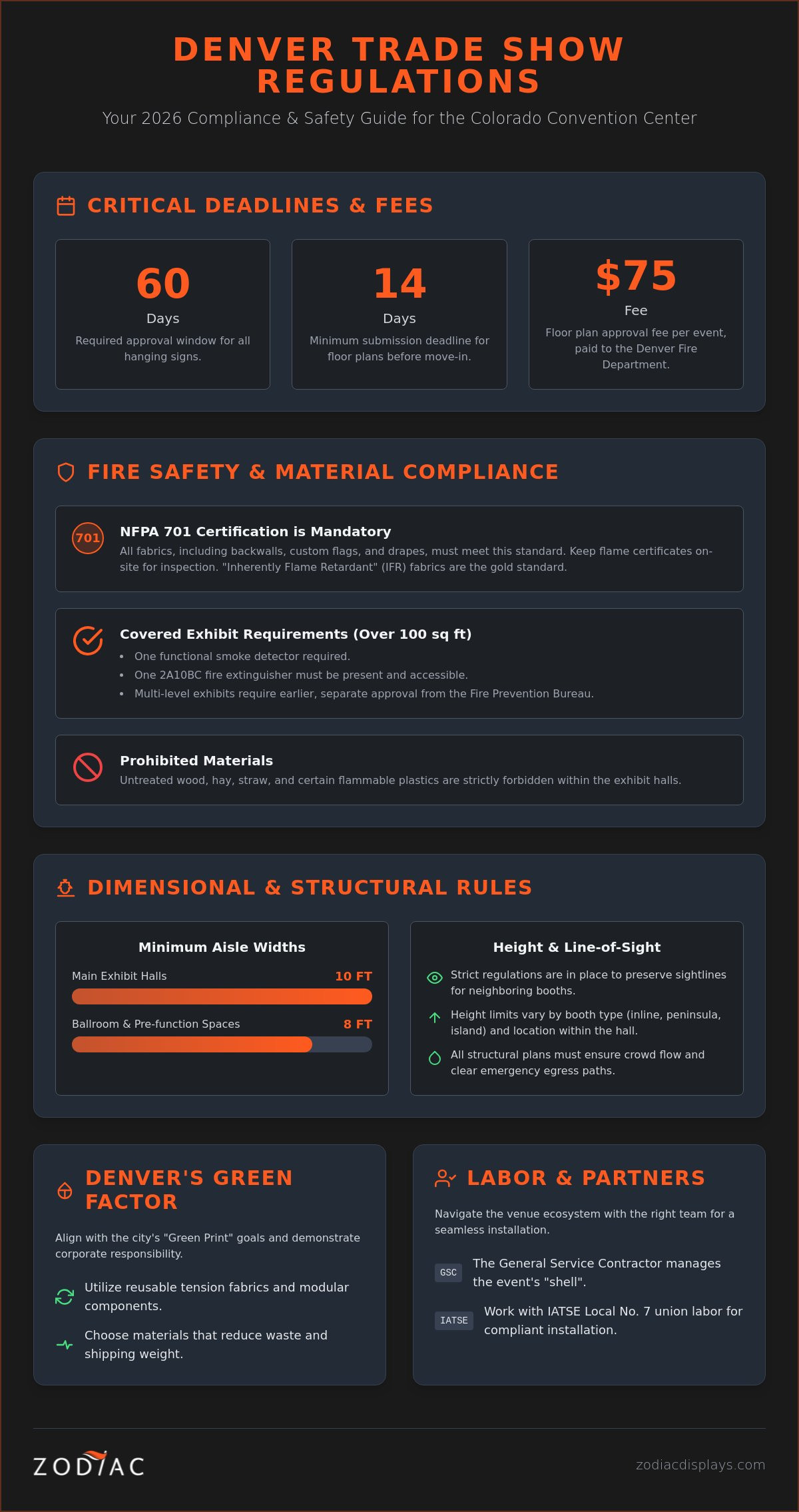
Participating in a modern trade show is an endurance sport. The city’s municipal codes are designed to ensure that even the most ambitious inflatables or hanging signs don’t compromise the integrity of the venue’s exit paths. The Denver Fire Department (DFD) requires a $75 floor plan approval fee per event, and these plans must be submitted at least two weeks before move-in. It’s a precise timeline that leaves no room for guesswork. When we design your space, we look at these codes as a strategic framework rather than a barrier to creativity.
The Colorado Convention Center Authority
The CCC is a massive, multifaceted venue with distinct rules for different zones. The Bellco Theatre, for instance, has different load-in protocols compared to the main exhibit halls. If you’re utilizing the Ballroom or Pre-function spaces, you’ll find that aisle widths are strictly set at 8 feet, whereas the main halls require a 10-foot minimum. Missing a submission deadline for electrical requirements or floor plans can lead to costly on-site adjustments. We help you stay ahead of these dates at Zodiac Event Displays so your focus remains on your brand’s growth and visibility.
The Role of Official Service Contractors
Understanding the ecosystem of a Denver event is vital for a seamless setup. You’ll encounter the General Service Contractor (GSC), who manages the overall “shell” of the event, but they are distinct from your creative branding partner. Denver venues utilize an “exclusive services” list for things like catering (Sodexo Live!) and technology (Smart City Networks). Our team acts as your dedicated ally, coordinating directly with IATSE Local No. 7 union labor. This partnership ensures that your sophisticated booth is installed with the precision it deserves while staying fully compliant with local labor jurisdictions.
Fire Safety and Material Standards: The Denver “Must-Haves”
Denver’s Fire Marshal doesn’t just scan for aesthetics; they look for the NFPA 701 seal of approval. This standard is the bedrock of Denver trade show display regulations. It ensures that your vibrant backwall displays and fabric elements won’t contribute to a fire’s spread. If your materials aren’t certified, you risk an immediate teardown before the show even opens. We treat these rules as a baseline for quality. Every custom flag banner we produce is crafted to meet these rigorous safety benchmarks, giving you the peace of mind to focus on your audience.
Documentation is your primary shield during on-site inspections. You must keep flame certificates for all fabrics, including table cloths and draping, easily accessible within your booth. If you’re planning a covered exhibit space over 100 square feet, the requirements get even tighter. You’ll need a functioning smoke detector and a 2A10BC fire extinguisher on hand. Multi-level exhibits require even earlier intervention and approval from the Fire Prevention Bureau. Certain materials like untreated wood, hay, or specific flammable plastics are strictly prohibited. These details might feel like red tape, but they’re essential for the safety of the thousands of professionals walking the floor. We help you navigate these hurdles so your booth remains a safe, high-impact environment.
Certification Checklist for Soft Signage
A valid certificate must clearly state that the material passes the NFPA 701 test. For 2026, “Inherently Flame Retardant” (IFR) fabrics are the gold standard. Unlike materials treated with a topical spray, IFR fabrics are woven with flame-resistant fibers that won’t wash or wear off over time. When we print your large-format graphics, we use testing protocols that account for the ink’s impact on the fabric’s flammability. This ensures your presentation remains both stunning and safe under the bright lights of the convention floor.
Electrical and Lighting Codes
Denver venues are leading the charge in energy efficiency, making 100% LED lighting a standard expectation for modern booths. High-intensity lighting must maintain specific safety clearances from flammable materials to prevent heat buildup. Power strips must be UL-listed and have built-in circuit breakers. Crucially, daisy-chaining power strips or extension cords is a major violation that will be flagged during setup. Proper cable management isn’t just about clean lines; it’s a core safety requirement. If you want to ensure your electrical layout is as efficient as your design, you can partner with our creative team to map out your power needs early.
Dimensional Limits: Height, Sightlines, and Hanging Signs
Designing a booth that commands attention while respecting your neighbors is a delicate balance of art and logistics. In Denver, the “Line of Sight” rule is the cornerstone of this balance. For standard inline or linear booths, your display materials generally shouldn’t exceed 8’3″ in height. To ensure every exhibitor remains visible, any fixtures over 4′ tall that sit within 10 lineal feet of a neighboring booth must be confined to the rear five feet of your space. It’s a regulation that prevents “walling off” smaller exhibitors and maintains the open, energetic atmosphere of the show floor. We view these Denver trade show display regulations as a creative prompt to build depth and layers into your presentation rather than a simple restriction.
When your vision scales up to island or perimeter exhibits, the possibilities for vertical impact expand. Perimeter booths often allow for a maximum height of 16 feet, providing a massive canvas for your brand. However, once your structure exceeds the 12-foot mark, Denver venues typically require stamped structural engineering plans to be submitted well in advance. This ensures that your soaring backwall displays or complex architectures are as safe as they are stunning. We work as your seasoned strategist to maximize every inch of your vertical air rights, utilizing lightweight tension fabrics and modular frames to keep your presence bold without triggering a safety violation.
Overhead Hanging Sign Protocols
Soaring above the competition requires more than just a creative design; it requires meticulous planning. Rigging at the Colorado Convention Center is an exclusive service, and trade show hanging signs generally require approval from the exhibition organizer and the venue at least 60 days before installation. These signs are typically prohibited in linear or perimeter linear booths. For island exhibits, you’ll need to account for weight limits and ensure the bottom of the sign maintains the venue’s required minimum height clearance. This careful coordination ensures your brand is visible from across the hall without interfering with lighting or fire suppression systems.
Custom Inflatables and Air-Supported Structures
Inflatables offer a unique, high-energy way to grab attention, but they come with specific Denver-based stipulations. Cold-air inflatables are often preferred over helium-filled options due to safety, but they require quiet, high-efficiency blower systems to comply with noise ordinances in quiet exhibit halls. Proper anchoring is non-negotiable. Your inflatable must be secured with safety tethers that meet the venue’s rigorous standards. Whether it’s a massive product replica or a branded icon, we ensure your air-supported structures are anchored with precision, keeping your presentation vibrant and secure throughout the entire event.
Logistics and Sustainability: The Denver Green Factor
Denver is a city that breathes sustainability. The municipal “Green Print” initiative isn’t just a policy; it’s a culture that has transformed the Colorado Convention Center into one of the greenest venues in the nation. When you align your presentation with these values, you’re doing more than checking a box. You’re demonstrating corporate responsibility. Denver trade show display regulations increasingly reflect this shift, encouraging exhibitors to ditch single-use materials in favor of longevity. We see this as an opportunity to innovate with reusable tension fabric backwall displays and modular components that look stunning and minimize environmental impact. This isn’t just about being “green”; it’s about being a sophisticated, forward-thinking partner in the Denver market.
Logistics in the Mile High City are heavily influenced by drayage, the cost of moving your materials from the loading dock to your booth. Traditional, heavy wood booths carry a massive carbon footprint and an even heavier price tag. By choosing local fabrication and lightweight soft signage, you slash both shipping emissions and material handling fees. It’s a strategic move that protects your budget and the planet. Transitioning to lighter materials like banner stands and fabric backwalls allows for a more agile setup while maintaining a premium, high-impact aesthetic.
Waste Reduction and Recyclable Graphics
The Colorado Convention Center currently diverts nearly 50% of its waste from landfills through its comprehensive management program. This success relies on exhibitors choosing eco-friendly trade show displays that are designed for longevity. Instead of printing graphics that end up in a dumpster after a single weekend, we focus on high-quality tension fabrics that can be repurposed for future multi-city tours. Choosing materials that are recyclable or biodegradable is no longer just a trend; it’s a standard for the 2026 Denver exhibitor who wants to make a lasting impression.
Navigating Denver Labor and Union Rules
Efficiency on the show floor is often a matter of understanding labor jurisdictions. At the Colorado Convention Center, the Denver Theatrical Stage Employees Union, IATSE Local No. 7, has jurisdiction over most decorating, rigging, and material handling. There’s a vital exception you should know: full-time employees of an exhibiting firm can install and dismantle their own displays if the work takes less than 60 minutes and doesn’t require power tools. Understanding this “60-minute” rule is essential for managing your budget and ensuring a smooth hand-off to the professional installation crews. If you want to ensure your logistics plan is as sustainable as your design, connect with our expert team to start your strategy.
Partnering with a Denver-Based Boutique Branding Expert
In the high-stakes environment of a major exhibition, the distance between your creative partner and the venue floor matters. Global production houses often treat projects as SKU numbers, missing the local nuances that define success at the Colorado Convention Center. Choosing a boutique branding expert ensures your vision isn’t lost in translation. We understand that Denver trade show display regulations are more than just a PDF; they’re a living set of standards enforced by officials we’ve worked with for over a decade. This local mastery allows us to anticipate challenges before they become delays, providing a level of precision that a cold, corporate factory simply cannot match.
Local fabrication is your ultimate insurance policy. If a last-minute adjustment is needed to satisfy a specific sightline rule or fire safety requirement, having your production team nearby is a game-changer. At Zodiac Event Displays, we merge the flair of a high-end design firm with the practical endurance of a seasoned strategist. We don’t just hand you a box of hardware. We act as an essential extension of your own creative team, guiding you through the complex process from initial concept to the final, triumphant installation. Our deep commitment to your visibility means we are invested in your long-term success, not just a one-time transaction.
While local fabrication serves as a metaphorical insurance policy for your booth, ensuring your team and assets are protected by modern digital services is equally vital for business travel; for streamlined online coverage options, you can visit insure.az.
The Zodiac Full-Service Advantage
Our end-to-end process is designed for high-impact results and strategic growth. From the first sketch of your event tents to the final rigging of your hanging signs, we manage every detail with a focus on visual excellence. Our custom trade show displays are engineered to withstand the rigors of the Denver market while remaining agile enough for multi-city tours. Whether you need a massive inflatable or a sleek set of banner stands, our offerings are built to exceed standard requirements and grab attention on a crowded floor. We invite you to engage in a strategic branding consultation to see how our personalized attention can transform your next presentation.
Ready to Stand Out in Denver?
The most stunning presentations are the result of deliberate, steady planning. For complex builds or custom fabrications, we recommend starting the design process 4 to 6 months in advance. This timeline allows for seamless floor plan approvals and structural engineering reviews without the stress of a looming deadline. Before you move in, ensure you have your flame certificates, rigging approvals, and union labor schedules in order. If you’re ready to elevate your presence with a partner who understands the Mile High landscape, contact the Zodiac team for a custom quote and design preparation today.
Command the Floor with Confidence
Success in the Mile High City isn’t just about showing up; it’s about standing out within a framework of safety and precision. We’ve explored how mastering Denver trade show display regulations ensures your booth avoids the Fire Marshal’s red tag while maximizing visual impact. From the strict NFPA 701 fabric certifications to the nuanced line-of-sight requirements, every detail serves as a building block for a high-impact, professional brand experience. By aligning your strategy with local sustainability goals and union jurisdictions, you’re positioning your brand as a leader in the 2026 exhibit landscape.
You don’t have to navigate these complexities alone. With over 10 years of Denver event experience and a 100% compliance record with local fire marshals, we bring Red Dot-level design aesthetics to every project. We’re ready to act as your dedicated ally, ensuring your 2026 presentation is as stunning as it is secure. It’s time to transform regulatory hurdles into your competitive advantage. Elevate your Denver brand presence with Zodiac Event Displays and let’s start building your visionary exhibit today. Your audience is waiting for something spectacular.
Frequently Asked Questions
What are the fire marshal requirements for trade show booths in Denver?
The Denver Fire Department requires all display materials, including table cloths and backwall displays, to be fire-resistant and compliant with NFPA 701 standards. A $75 floor plan approval fee is required for each event. If your booth features a covered space larger than 100 square feet, you must provide a smoke detector and a 2A10BC fire extinguisher to meet safety codes.
Do I need a structural engineer for my booth at the Colorado Convention Center?
You typically need a stamped structural engineering plan for any exhibit structure that exceeds 12 feet in height. This requirement ensures that soaring towers or complex multi-level builds are safe for the high-traffic convention environment. Submitting these plans early is essential to navigate the Denver trade show display regulations and secure your permit before the installation crew arrives.
Can I use a custom inflatable display inside a Denver exhibit hall?
Yes, custom inflatables are allowed, but they must be properly anchored and comply with venue noise ordinances. Cold-air inflatables are the most common choice, though you must ensure the blower systems are quiet enough not to disrupt neighboring exhibitors. Safety tethers and fire-resistant materials are non-negotiable requirements for any air-supported structure on the show floor.
What is the “Line of Sight” rule for Denver trade shows?
The “Line of Sight” rule ensures that every exhibitor remains visible to attendees walking the aisles. For standard inline booths, any display components taller than 4 feet must be placed in the back 5 feet of your 10-foot deep space. This prevents large backwalls or banner stands from blocking the view of the booths immediately next to yours.
Are there specific sustainability requirements for exhibits in Denver in 2026?
Denver’s “Green Print” initiative has made sustainability a core expectation rather than an option. The Colorado Convention Center diverts nearly 50% of event waste from landfills, so exhibitors are encouraged to use recyclable graphics and reusable tension fabrics. Choosing lightweight, modular components helps you align with the city’s goal of making every event a “green event” by 2026.
How far in advance should I submit my booth plans for Denver approval?
You must submit your final floor plans to the Denver Fire Department and the Colorado Convention Center at least two weeks before your move-in date. However, for complex elements like hanging signs, the venue requires approval at least 60 days in advance. Starting your design process 4 to 6 months early provides the necessary cushion for these administrative deadlines.
What happens if my booth materials do not have a flame certificate?
If you cannot produce a valid flame certificate during an inspection, the Fire Marshal has the authority to halt your setup or require the immediate removal of the non-compliant items. This can lead to a partial booth shutdown and wasted budget. We ensure all our soft signage, from custom flags to event tents, comes with the necessary documentation to avoid these high-stakes disruptions.
Can I install my own trade show display in Denver or do I need union labor?
Full-time employees of your company can install and dismantle your display if the process takes less than 60 minutes and doesn’t require power tools. For more complex setups or anything involving mechanized equipment like forklifts, you must hire union labor from IATSE Local No. 7. Understanding this “60-minute rule” is a vital part of managing your logistics and on-site costs.
Planning a compliant exhibit in the area? Explore our Denver trade show displays and event branding services to get started.

 Previous reading