


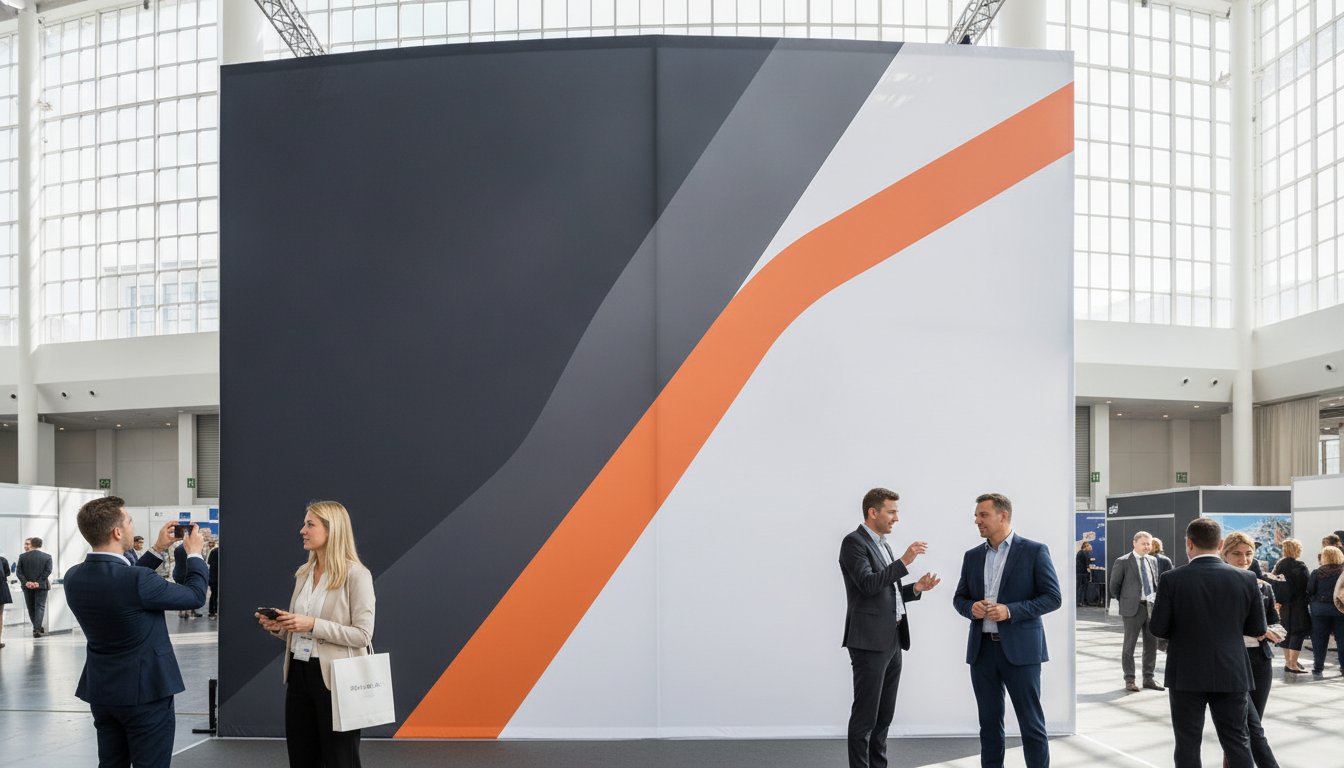
Did you know that 68% of consumers believe the quality of your signage directly reflects the quality of your products? In a crowded convention hall, your visual presence is your first and most powerful handshake. You likely understand the struggle of trying to stand out when every booth is shouting for attention. Mastering event banner design best practices is the key to cutting through that noise and ensuring your brand doesn’t just show up, but actually dominates the space.
We’re here to help you move past the frustration of uninspired displays and wasted marketing spend. This guide provides a strategic framework to help you design high-impact assets that capture eyes and reinforce your professional authority. You’ll learn how to apply the 1-inch-per-10-feet readability rule, navigate essential NFPA 701 fire safety standards, and select durable materials that last for seasons. Let’s turn your next event into a masterclass in visual excellence.
Key Takeaways
- Unlock the secrets of the 3-second rule to capture attention instantly and align every design element with your core event objectives.
- Master event banner design best practices by implementing the 10-to-100 font sizing strategy for flawless readability at any distance.
- Elevate your presentation with tension fabric displays that offer a premium, wrinkle-free aesthetic while supporting sustainable event initiatives.
- Transform your signage into a social media powerhouse by designing immersive backdrops that invite engagement and organic brand amplification.
- Experience a seamless transition from initial concept to global delivery through a partnership focused on precision, durability, and visual excellence.
Establishing the Strategic Vision: Why Intent Precedes Design
Visual excellence begins long before the first pixel is placed on a digital canvas. It starts with a pulse of purpose. True mastery of event banner design best practices requires you to view your signage not as a decoration, but as a strategic tool designed to achieve a specific business outcome. Whether you’re aiming for massive brand awareness or surgical lead generation, your design must be an unapologetic reflection of that singular intent. Without a clear objective, even the most beautiful graphics become expensive wallpaper that fails to move the needle.
Clarity is the ultimate currency in a high-traffic environment. The “One Message” rule is your most powerful ally here. You must resist the urge to include every service, award, and contact detail on a single surface. Visual clutter creates cognitive friction, forcing attendees to work too hard to understand your value. By stripping away the non-essential, you create a focused experience that resonates with precision. Your physical environment also dictates your visual strategy. Factors like ceiling height, floor traffic patterns, and lighting will determine whether you should prioritize high-contrast vinyl banner materials or soft, non-glare fabric alternatives to ensure your message remains legible from every angle.
The 3-Second Rule and Cognitive Capture
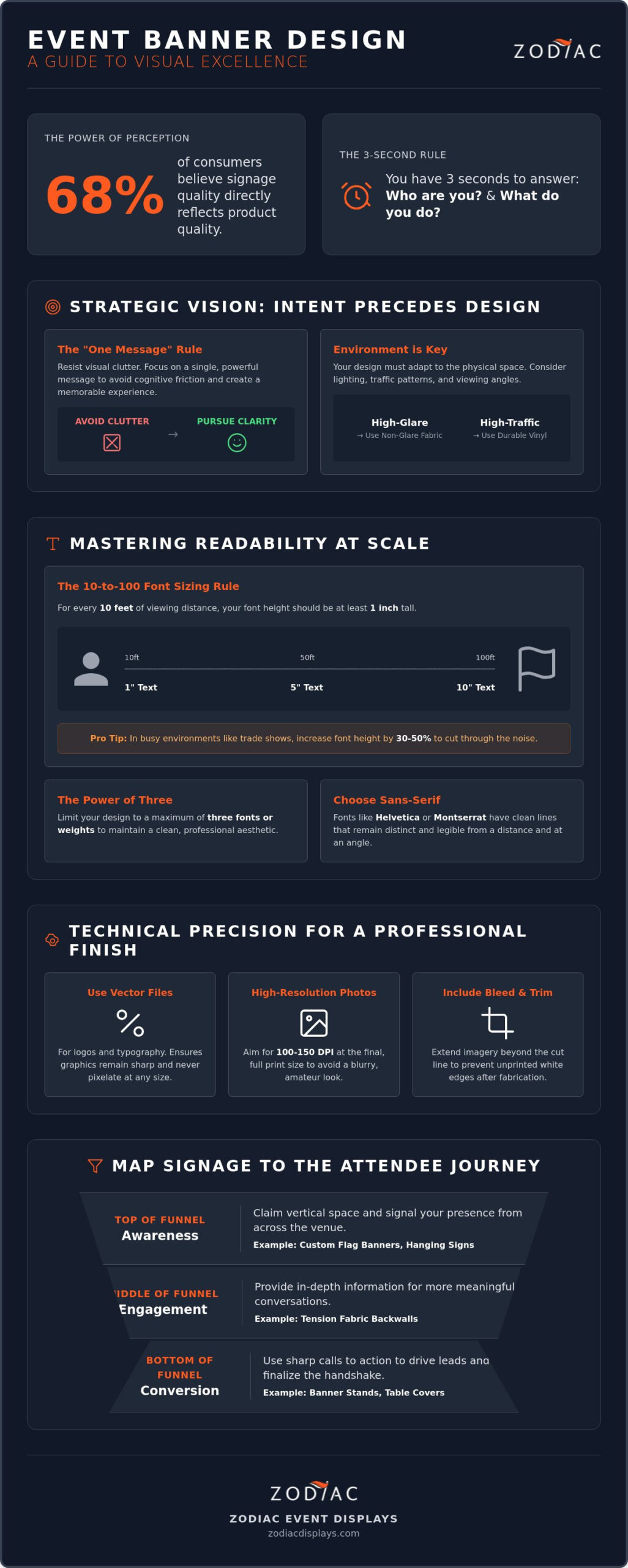
The 3-second rule is the undisputed gold standard for event visibility. Within this tiny window, an attendee must subconsciously answer two questions: Who are you, and what do you do? To win this moment, you must prioritize your “What” and “Who” with bold typography and high-scale imagery. Don’t let the “How” take up valuable real estate on your main signage. Effective event banner design best practices also lean heavily on white space. This negative space isn’t empty; it’s a visual breather that prevents attendee fatigue and guides the eye toward your most critical information.
Mapping Banners to the Marketing Funnel
Your signage strategy should mirror the attendee’s journey through the marketing funnel. At the top of the funnel, focus on broad visibility and brand recognition. Using custom flag banners allows you to claim vertical space and signal your presence from across the venue. As prospects move closer, middle-of-funnel educational backwalls provide the depth needed for more meaningful engagement. Finally, at the bottom of the funnel, use sharp calls to action on banner stands and table covers to drive conversions and finalize the handshake. This tiered approach ensures your brand is present and persuasive at every touchpoint.
Mastering Visual Hierarchy and Large-Format Readability
Designing for scale is a fundamentally different discipline than designing for a handheld screen. When you move into large-format production, you’re essentially engineering a visual experience that must remain coherent from across a crowded exhibit hall. Adhering to event banner design best practices means understanding how the human eye processes information at a distance. You have to guide the attendee’s gaze with intentionality, using focal points to lead them from a bold headline directly toward your call to action. Whether you’re utilizing high-impact Backwall Displays or elevated Hanging Signs, your layout must command attention through a disciplined arrangement of elements.
Technical precision is the foundation of a professional presentation. To avoid the amateur look of pixelated graphics, always prioritize vector files over raster images for logos and typography. For photographic elements, aim for a resolution of 100 to 150 DPI at full print size. You also need to account for bleed and trim lines to ensure your background imagery extends seamlessly to the very edge of the material. This attention to detail prevents thin, unprinted white lines from appearing after the fabrication process, preserving the high-end finish your brand deserves.
Typography and the Science of Distance
Legibility is non-negotiable. The 10-to-100 rule serves as your baseline: for every 10 feet of viewing distance, your font height should be at least 1 inch tall. However, in visually aggressive environments like trade shows, industry standards suggest increasing this height by 30% to 50% to ensure your message isn’t swallowed by the surrounding noise. Sans-serif fonts like Helvetica or Montserrat dominate large-format design because their clean lines remain distinct even when viewed from an angle. To maintain a professional polish, stick to the “Power of Three”: limit your palette to three fonts or weights to prevent visual chaos. For outdoor signage, slightly increase your kerning (letter spacing) to ensure characters don’t blur together when the fabric moves in the wind.
Color Contrast and Brand Recognition
Color is the emotional heartbeat of your display, but it’s also a tool for accessibility. Following the 60-30-10 rule (60% primary color, 30% secondary, and 10% accent) creates a balanced aesthetic that doesn’t overwhelm the senses. To meet professional standards, aim for at least a 70% contrast ratio between your text and background colors. It’s also vital to remember that venue lighting significantly shifts perceived tones; LED spotlights can wash out subtle pastels, while warm incandescent bulbs can yellow your whites. Utilizing CMYK color matching is critical for brand consistency, ensuring the vibrant blues on your digital proof translate perfectly to the physical fabric. If you’re ready to elevate your visual presence, a professional signage strategy can help you align these technical details with your broader marketing goals.
Environmental Engineering: Choosing Materials for Performance
Environmental engineering isn’t just about survival; it’s about setting the stage for a flawless performance. Once you’ve mastered the visual hierarchy of your layout, the next step in event banner design best practices is selecting a medium that honors your creative vision. The material you choose acts as the skin of your brand. It must endure the rigors of high-traffic environments while maintaining the vibrancy of your original design. While traditional vinyl remains a reliable choice for outdoor resilience due to its UV-stable properties, the industry is seeing a definitive shift toward premium soft signage that communicates a higher level of sophistication. Your material choice shouldn’t be an afterthought; it’s a strategic decision that influences how attendees perceive your brand’s authority.
Resilience is critical when your assets are deployed in unpredictable settings. For outdoor activations, managing wind loads is a primary concern. Mesh banners are often the superior choice for high-wind areas, as their perforated design allows air to flow through the graphic without compromising the structural integrity of your display. Indoors, the focus shifts to how your materials interact with venue lighting. High-gloss finishes can create distracting hotspots, while matte or fabric surfaces provide a smooth, professional look. Integrating your graphics with the right hardware is equally vital. A premium frame doesn’t just hold a banner; it provides the tension necessary to eliminate sagging and shadows, ensuring your message remains crisp from every perspective.
The Rise of Tension Fabric in 2026
Soft signage has become the modern gold standard for high-end presentations. Tension fabric offers incredible anti-glare benefits, making it the ideal choice for environments where high-flash photography and social media sharing are expected. Unlike vinyl, which can reflect harsh overhead LED lights, fabric absorbs light to create a rich, saturated appearance that feels more like a custom installation than a temporary sign. Traveling teams also benefit from the extreme portability of these systems. The wrinkle-resistant nature of modern polyester blends means you can fold your graphics into a small bag and have them look pristine minutes after setup.
Designing for Durability and Sustainability
True visual excellence includes a commitment to the future. We’re seeing a massive trend toward sustainable event displays that prioritize longevity over disposability. You can maximize your budget by designing “evergreen” graphics that focus on your core brand identity rather than event-specific dates. This allows you to reuse high-quality assets across multiple seasons. By selecting modular hardware systems that accommodate different graphic sleeves, you reduce waste and ensure your brand presence remains adaptable. This collaborative approach to fabrication ensures that your investment continues to drive engagement long after the final curtain falls.
The Psychology of Presence: Engagement and Social Shareability
Banners aren’t static background noise; they’re the stage for your brand’s digital afterlife. In a world where every attendee is a potential content creator, your signage must do more than just inform. It has to invite interaction. Mastering event banner design best practices means thinking beyond the physical booth and considering how your brand will look through the lens of a smartphone camera. When you design with a “social-first” mindset, you transform a simple backwall into a powerful engine for organic brand amplification. You’re not just buying space; you’re creating an experience that people feel compelled to share with their own networks.
Engagement often hinges on the “Human Scale.” We’ve seen many brands bury their most important logos at the very top or bottom of a banner where they’re easily cropped out of photos. Instead, position your primary branding at the 5-foot to 6-foot mark. This is the sweet spot for the perfect selfie, ensuring your logo remains visible behind the attendee’s head. Strategic QR code placement is another critical factor. Don’t hide them in corners. Place them at eye level and ensure they’re large enough to be scanned from three to five feet away. This creates a seamless digital transition, allowing attendees to move from visual appreciation to active lead conversion in seconds.
Designing the Perfect Photo Backdrop
- Step 1: Position your primary logo at the 5-foot to 6-foot mark to ensure it frames the subject perfectly in social media posts.
- Step 2: Use step-and-repeat patterns or subtle textures to ensure brand visibility from any angle, even when the subject is moving.
- Step 3: Integrate matte finishes to eliminate camera flash glare, a common issue that can ruin an otherwise perfect branded photo.
Cohesive Environmental Branding
Your visual voice must remain consistent across every touchpoint to build lasting brand authority. A high-impact banner should never exist in a vacuum; it must complement your custom trade show displays to create a unified environment. Whether you’re using custom event tents for an outdoor festival or sleek table cloths for an intimate seminar, the color fidelity and font hierarchy must match perfectly. Secondary signage like flags and pop-ups should reinforce the primary message of your main backwall, acting as visual echoes that guide the attendee deeper into your brand story. If you’re ready to create a high-impact presence that dominates the floor, explore our custom display solutions to see how we can bring your vision to life.
From Concept to Global Delivery: The Fabrication Partnership
The most meticulous digital design remains just a concept until it meets the precision of professional fabrication. Adhering to event banner design best practices is only half the battle; the other half is choosing a partner who treats your brand with the same reverence you do. At Zodiac Event Displays, we’ve spent over a decade moving beyond the cold, automated “upload and print” model. We function as a creative consultancy, ensuring that every stitch and grommet aligns with your strategic vision. This boutique approach means you aren’t just another order number in a factory queue; you’re a partner in a high-stakes visual journey that demands excellence at every turn.
Denver is our home, but our reach is truly global. We combine the personalized attention of a local studio with the logistical muscle required to support international brand growth. Managing the fabrication timeline is a delicate dance of creative briefs, technical proofs, and final delivery schedules. By positioning ourselves as an extension of your own team, we eliminate the friction often found in traditional vendor relationships. We understand the endurance required for success on the trade show floor, and we build our assets to reflect that resilience.
The Collaborative Design Process
Professional layout optimization is more than just a proofing step; it’s a critical financial safeguard. By catching resolution issues or bleed errors early, we prevent costly reprints and wasted materials before they ever reach the printer. A rigorous technical file review is especially vital for complex event display fabrication, where the geometry of a backwall or hanging sign must be perfect to avoid sagging or distortion. Having a dedicated design partner in Denver provides you with a direct line to experts who understand the nuances of large-format production and the specific demands of the 2026 event circuit.
Logistics and Scaling Your Presence
Your brand’s impact shouldn’t be limited by geography. We’ve refined our global logistics to support worldwide festival and trade show circuits, ensuring your assets arrive in pristine condition whether they’re heading to a local convention center or an international expo. Maintaining color consistency across different materials and international shipments is a complex task that requires a strategic eye for detail. We take pride in ensuring that the vibrancy of your brand remains identical from one city to the next. Ready to elevate your brand? Contact the experts at Zodiac Event Displays to start your next creative collaboration.
Dominating the Stage with Strategic Visual Excellence
Your journey toward a commanding presence requires a blend of bold intent and technical mastery. By implementing event banner design best practices, you’ve moved beyond simple signage and into the world of high-impact brand storytelling. You now have the framework to capture attention in seconds, optimize for large-format readability, and select premium materials that reflect your brand’s authority. These elements work in harmony to turn your physical space into an engine for growth and engagement.
Success on the global event circuit demands a partner who understands the nuances of both design and fabrication. With over 10 years of boutique branding expertise, Zodiac Event Displays serves as your Denver-based creative consultancy with a global reach. We specialize in premium soft signage and custom fabric backwalls, ensuring your vision is executed with surgical precision. Elevate your brand with high-impact design from Zodiac Event Displays and transform your next activation into a landmark success. The stage is set for your brand to shine, and we’re ready to help you lead the way.
Frequently Asked Questions
What is the most important factor in event banner design?
The most important factor is clarity of strategic intent. You must define a singular message that captures an attendee’s attention within three seconds. If your design is too cluttered with competing information, people will simply walk past without registering your brand. Focus on high-contrast visuals and bold typography to ensure your core value proposition is understood instantly from across the room.
How do I choose between vinyl and fabric for my event banner?
Choose tension fabric for premium indoor aesthetics and vinyl for rugged outdoor durability. Fabric is the modern standard for trade shows because it eliminates distracting glare from harsh overhead LED lights and provides a sophisticated, high-end feel. Vinyl is often more cost-effective for short-term outdoor use, but it lacks the saturated, non-reflective quality that makes fabric displays look so professional in photographs.
What font size do I need for a banner to be readable from 50 feet?
To be readable from 50 feet away, your letters should be at least 5 inches tall. This follows the industry baseline of one inch of letter height for every 10 feet of viewing distance. In busy environments like trade shows, we recommend increasing this height by 30% to 50% to ensure your event banner design best practices help you cut through the visual noise of competing booths.
Can I use my company’s social media photos for a large-format banner?
You generally cannot use social media photos for large-format banners because their resolution is too low. Most social platforms compress images to 72 DPI, while professional printing requires at least 100 to 150 DPI at full scale. Using low-resolution files results in pixelation that can damage your brand’s perceived quality. Always provide high-resolution raster files or vector graphics to maintain visual excellence.
How do I ensure my brand colors look the same on a banner as they do on my screen?
Ensure color consistency by using CMYK color matching and specific Pantone references rather than relying on your RGB computer screen. Screens emit light, while banners reflect it, which naturally creates a shift in how colors appear. By providing specific color codes, you allow our fabrication team to calibrate the output to match your brand identity perfectly across different materials and lighting conditions.
Are fabric banners suitable for outdoor events with wind and rain?
Fabric banners are highly suitable for outdoor events when they are engineered for resilience. Modern polyester blends are treated for UV resistance and can withstand light rain without color bleeding. For windy conditions, we recommend specialized tension systems or mesh options that allow air to pass through. These assets offer a more sophisticated look than traditional vinyl while maintaining the durability needed for outdoor festivals.
How can I make my event banner more eco-friendly?
Make your banners more eco-friendly by investing in modular hardware and evergreen graphics that can be reused for multiple seasons. By avoiding event-specific dates on your main displays, you extend the lifespan of your assets and significantly reduce waste. Choosing high-quality fabrication also ensures your materials don’t need frequent replacement, which is a core part of event banner design best practices for sustainable brand growth.
What is the typical turnaround time for custom event display fabrication?
Turnaround time for custom fabrication depends on the complexity of the project and the level of design collaboration required. A boutique agency approach focuses on precision, which involves a technical proofing phase to ensure every detail is perfect before production begins. We recommend starting your creative brief at least four to six weeks before your event to allow for thorough file review and global delivery.

 Previous reading