


A corporate event step and repeat backdrop needs to do more than display logos. It should frame guests, keep your brand visible in event photos, and suit the venue. Choosing the right size, keeping logos readable, and getting artwork approved before production begins can feel like a lot to coordinate. Treat the backdrop as part of the photo setup, not just as décor, and those decisions become easier to work through.
This guide walks through the details to settle before production: the photo area and camera angles, logo scale and placement, format and setup requirements, and artwork approvals. It also covers what to include in a project brief and what to confirm with a production partner. Zodiac Event Displays is a Denver-based boutique branding agency with more than ten years of industry experience. Its backwall displays may suit your project, so discuss your format and artwork requirements with the team.
Key Takeaways
- Plan your corporate event step and repeat backdrop around the venue and the photos you expect to capture.
- Set logo size, spacing, contrast, and brand hierarchy so marks remain recognizable in close-ups and wider shots.
- Compare formats by footprint, setup, portability, image coverage, and reuse potential before choosing one.
- Gather event goals, venue measurements, approved artwork, approval contacts, and delivery details before requesting a quote.
- Ask potential partners how they handle design, proofing, fabrication, and delivery, and confirm the proposed format and specifications directly.
Why a Corporate Event Step and Repeat Backdrop Matters in Event Photos
A well-planned photo background gives photographers and guests a consistent setting that carries your brand into event coverage and shared snapshots. Unlike wayfinding or booth signage, a step and repeat is positioned for the camera. Its role is to make the event identity visible in the frame, whether the image shows one speaker or a group of attendees.
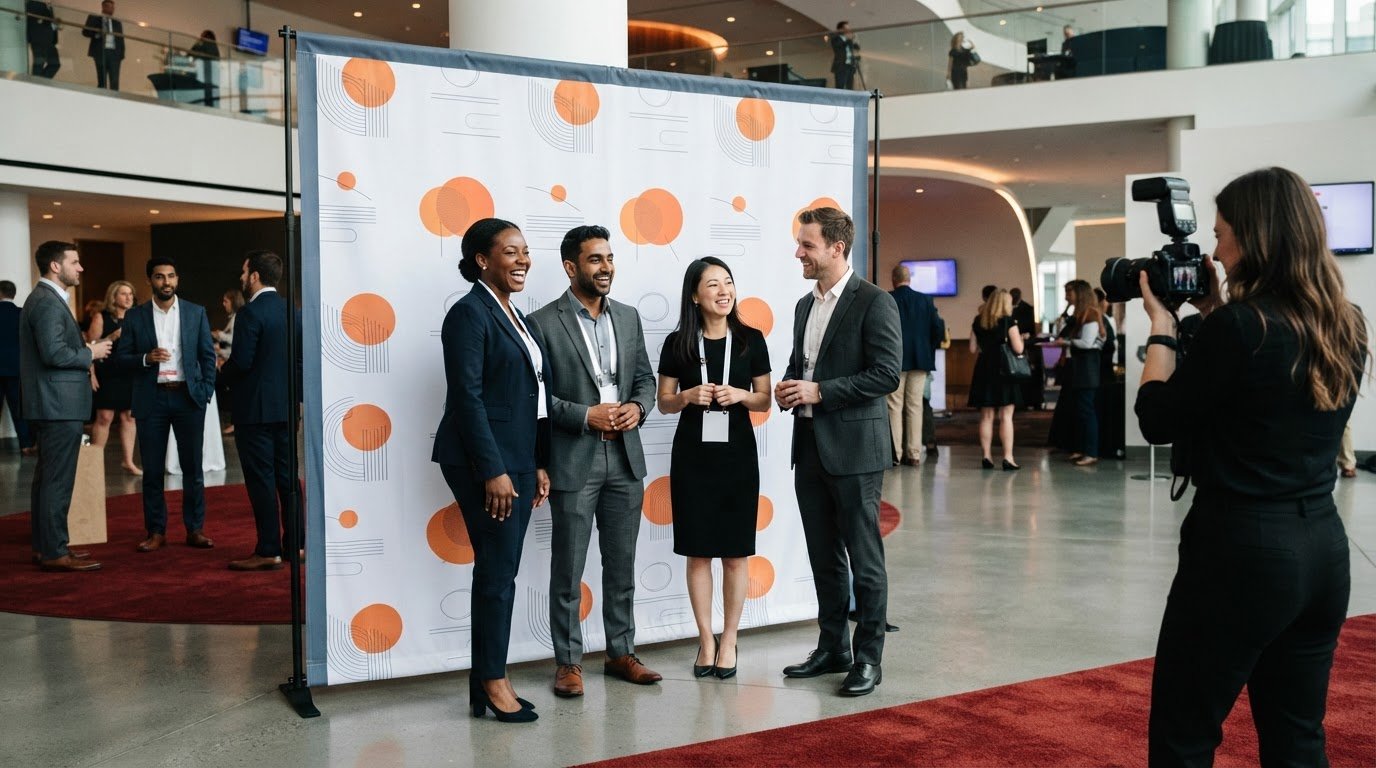
A corporate step and repeat backdrop is a camera-facing event background with a repeated logo pattern, created to identify a brand or its sponsors in photographs taken at a designated event photo area. The Step and repeat banner format is associated with publicity photography, where repeating marks help keep branding in view across different poses and crops. For corporate use, the pattern should support the event’s message without competing with the people in front of it.
What corporate teams use a step and repeat backdrop for
Product launches, conferences, award ceremonies, media events, and company celebrations can all benefit from a recognizable photo location. A press image might show one spokesperson, while attendee snapshots and executive portraits include different numbers of people and different crops. Repeated logos help connect those images visually, whether they appear in event recaps, internal communications, or social channels. The backdrop should complement other event branding, not replace directional signs, schedules, or booth information.
How to set a clear objective before choosing a backdrop
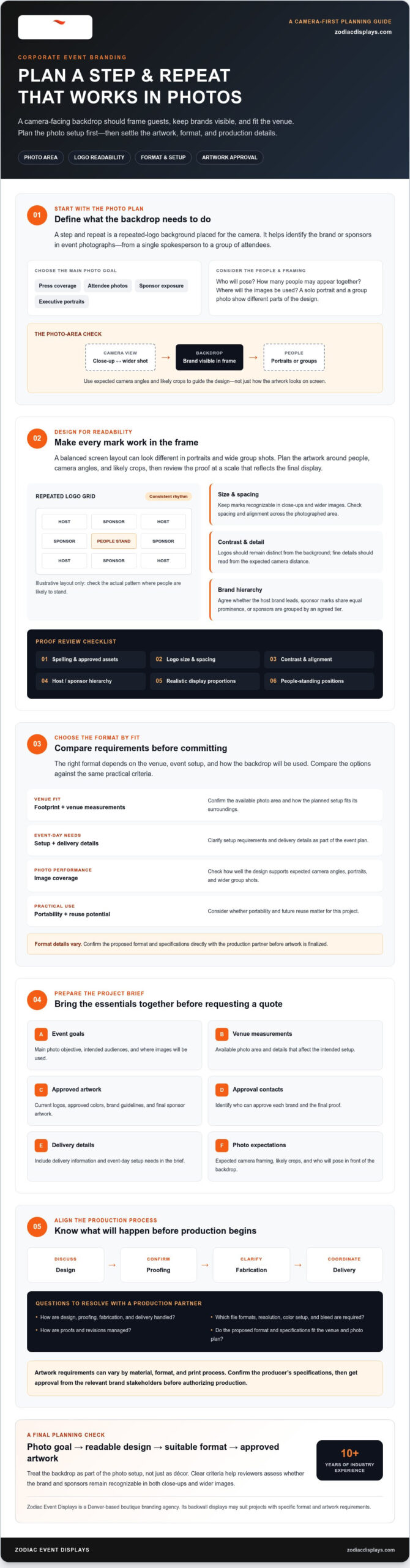
Start by naming the main photography goal: press coverage, attendee photos, sponsor exposure, executive portraits, or a combination. Note who will pose in front of the backdrop, how many people might appear together, and where the images will be used. A solo portrait and a group photo show different portions of the design, so the planned framing should guide the creative brief.
Set practical success criteria before choosing a format. Check whether the host brand and sponsors can be recognized in both close-up and wider images. Consider whether the backdrop fits the event environment without overwhelming the people in the frame. Clear criteria give reviewers something specific to assess, instead of asking only whether the design “looks branded.”
Design a Corporate Step and Repeat Backdrop for Clear, Camera-Ready Branding
Start the layout with the photos you expect to take. Logos that look balanced on a screen may appear too small in a wide group shot, while oversized marks can dominate portraits. Plan the artwork around the people, camera angles, and likely crops, then review the proof at a scale that reflects the final display. If you have an event photographer, ask them to share the expected framing before the layout is approved.
How should logos be arranged on a step and repeat?
A consistent grid gives the background a deliberate rhythm and helps keep key marks visible across the photographed area. Check the pattern at the positions where people are likely to stand, not just at the center of the artwork. Contrast matters: logos should remain distinct against the background, and fine details should still read from the expected camera distance.
When sponsors share the backdrop, agree on their visual hierarchy before arranging the artwork. Decide whether the host brand leads, sponsor marks have equal prominence, or sponsors are grouped by an agreed tier. Settling this early makes the design easier to review and approve. It also connects the photo background to the core elements of event branding, so it feels like part of the event’s identity rather than a separate design.
What artwork details should corporate teams prepare?
Gather current logo files, approved colors, brand guidelines, and final sponsor artwork before design begins. Use official assets rather than recreating marks from screenshots, and identify who can approve each brand. When reviewing a proof, check spelling, logo size, spacing, contrast, alignment, and how the pattern reads where people will stand.
- Map the visual priorities: Identify the host brand, sponsors, and any marks that need greater or equal prominence.
- Check the layout in context: Review a proof at realistic display proportions and consider both close-up portraits and wider group shots.
- Confirm production requirements: Ask the selected producer which file formats, resolution, color setup, and bleed they need, and how proofs and revisions are handled.
File requirements can vary by material, format, and print process. Confirm the producer’s specifications before finalizing artwork, then get approval from the relevant brand stakeholders before authorizing production.
For teams exploring branded event displays, Zodiac Event Displays’ event display capabilities include design and fabrication. Discuss your brief with the team to confirm whether the project fits its current offerings.
Compare Backdrop Formats and Setup Needs Before You Commit
Choose a format based on the room, camera view, and event logistics, not appearance alone. A corporate event step and repeat backdrop might fit a compact reception area or anchor a larger photo zone. Measure the available width, height, and depth, then check ceiling limits, access routes, and venue restrictions before asking a producer to recommend a configuration.
Which backdrop format fits the venue and event flow?
Map the full photo area, including where photographers will stand, where lighting may go, and whether guests will queue or pass nearby. A backdrop might fill the camera frame yet still obstruct circulation. Share the site measurements and event flow with the producer, then confirm the format’s dimensions, setup steps, transport needs, and storage requirements for your project.
The comparison below is a planning framework, not a promise that every format is available from every supplier. Verify the construction, footprint, and setup requirements of the option you are considering.
| Format | Footprint | Setup needs | Portability | Image coverage | Reuse potential |
|---|---|---|---|---|---|
| Portable banner system | Often suited to a defined photo zone; confirm dimensions | Ask how the support is assembled and secured | Check packed size and transport requirements | Confirm coverage from planned camera angles | Ask whether graphics can be reused or replaced |
| Fabric media wall | May suit a broader photo area; verify width and height | Confirm frame, assembly, and venue access needs | Check how components pack and travel | Assess the full background visible in group shots | Confirm care, storage, and graphic replacement options |
| Other backwall format | Varies by configuration; measure the site | Request format-specific installation details | Depends on construction and transport plan | Review sightlines and likely photo crops | Discuss use across future events |
When should you consider an alternative to a classic logo wall?
Repeated logos work well when the main goal is recognizable branding in event photos. If the backdrop also needs to tell a broader visual story, consider whether a branded backwall would better suit the creative direction. In either case, the layout should fit the event environment and keep the people in the frame prominent. For wider exhibit planning, explore custom trade show display guidance.
Think about how often the display will be used. For a display that travels between venues, ask about transport and storage. For a single event, prioritize fit and photo coverage. Zodiac Event Displays offers backwall displays, but confirm directly with the team whether a specific step-and-repeat format suits your project.
Plan the Backdrop Brief, Artwork Approval, and Event-Day Setup
A clear brief gives brand, sponsor, venue, photography, and production teams the same information to work from. For a corporate event step and repeat backdrop, assign one person to consolidate feedback and collect final approvals. This helps prevent conflicting edits from reaching the producer and makes it clear who is responsible for sign-off.
What should a corporate backdrop brief include?
Build the brief in sequence, from the event’s purpose to the delivery plan:
- Set the objective: Define whether the display is primarily for press photos, attendee snapshots, sponsor visibility, or executive portraits.
- Record the site details: Share the event date, venue measurements, intended photo area, access routes, and any setup constraints provided by the venue.
- Gather brand inputs: List the host brand, sponsor requirements, approved logo files and colors, brand guidelines, and the people responsible for reviewing artwork.
- Confirm the production plan: Ask the producer to verify the proposed format, specifications, artwork requirements, proof and revision process, production schedule, and delivery details.
- Approve the final proof: Have the appropriate brand and sponsor stakeholders review one consolidated version before production is authorized.
Quote-ready checklist: Event date; venue and measurements; photo-area location; intended audience and image use; host and sponsor assets; review contacts; expected reuse; delivery location; and questions about format, specifications, proof timing, and setup.
How can you prevent event-day surprises?
Before the event, coordinate arrival and setup with venue staff and the event operations lead. Confirm who will receive the display, where it can be assembled, and when the photo area needs to be ready. Assign someone to check the graphic, frame, and supplied components on arrival, and decide whom to contact if anything appears missing or damaged.
Take a test photo from the expected camera positions. Check the framing, glare, logo visibility, and background clutter, then adjust the display or photo area if needed. Include the photographer in the check, since their view may reveal cropping or lighting issues that are hard to spot in person.
Planning design, fabrication, and delivery together can make project handoffs clearer. Zodiac Event Displays offers backwall displays and works across design, fabrication, and global delivery. Confirm whether the team’s current capabilities fit your project. To discuss your event display brief, talk with Zodiac Event Displays.
Choose a Creative Production Partner for Your Corporate Step and Repeat
A production partner should do more than receive artwork and make a display. They should help clarify what the photo area needs to achieve, identify details that still need confirmation, and make the handoffs between artwork, production, and delivery clear. That collaboration matters for a corporate event step and repeat backdrop, where brand approvals and venue requirements need to come together before the event.
What to ask a potential event display partner
Use these questions to understand how a supplier works and whether the project fits its current capabilities:
- Design collaboration: Who can advise on artwork development and technical preparation? How should the team provide brand and sponsor assets?
- Proofing: What does the proof show, who reviews it, and how are revisions and final approval handled?
- Production: Which display formats, materials, and production specifications are currently available for this project? What information is needed to confirm a suitable option?
- Delivery: Can the supplier deliver to the event destination? What milestones should the client track, and what delivery details need to be settled?
- Event coordination: Who confirms venue constraints, setup responsibilities, and any requirements that could affect the display?
Get clear answers before finalizing artwork. A supplier should distinguish confirmed capabilities from details that still need checking, so assumptions do not surface close to the event.
How Zodiac can fit into a broader branded event environment
Zodiac Event Displays is a Denver-based boutique branding agency with more than ten years of industry experience. Its confirmed offerings include backwall displays, and its capabilities span design, fabrication, and global delivery for event display materials. The team may suit organizations planning a cohesive branded environment. Discuss the specific format, specifications, and fit of a step-and-repeat project directly with them.
For adjacent production planning, consider how event display fabrication can bring brand assets together. Start with a concise brief that covers the event date, venue details, photography goals, artwork needs, and delivery destination. Then ask which options can be confirmed for your project and what decisions remain.
Ready to explore the fit? Contact Zodiac Event Displays about your event project to discuss your requirements and potential display options.
Make Your Next Event Photo-Ready
A strong corporate event step and repeat backdrop starts with a clear purpose: frame people in event photos while making the host brand and sponsors easy to recognize. Match the format to the venue and camera angles, then confirm logo hierarchy, artwork approvals, and delivery details before production. A brief that aligns the brand, venue, photography, and production teams helps make the backdrop a considered part of the event experience rather than a last-minute décor choice.
Zodiac Event Displays is a Denver-based boutique branding agency with more than ten years of industry experience and capabilities across design, fabrication, and global delivery. Backwall displays are among its offerings. Discuss your project with the team to confirm whether a step-and-repeat format fits its current capabilities.
Discuss your corporate event backdrop project with Zodiac and take the next step toward a photo-ready brand environment. Thoughtful planning can help your display look consistent across the images that matter to your event.
Frequently Asked Questions
What is a corporate event step and repeat backdrop?
A corporate event step and repeat backdrop is a branded background designed for event photography. Its repeated logos or sponsor marks identify the organization in press images, executive portraits, and attendee photos. Unlike general event signage, which guides guests or shares information, this display faces the cameras. Set its placement and artwork according to the photography goals and intended use of the images.
How do you design a step and repeat backdrop for a corporate event?
Agree on brand priorities and gather current, approved logo assets for the host and sponsors. Arrange the marks with consistent spacing and enough contrast to remain recognizable without distracting from people in the frame. Set the sponsor hierarchy before layout begins. Review a proof at realistic display proportions and consider expected photo distances and angles. Confirm file specifications and the proofing process with the producer before approving production.
What size should a corporate step and repeat backdrop be?
The right size depends on venue measurements, how many people may pose together, camera angles, and available floor space. Measure the photo area, including width, height, depth, access routes, and any venue constraints. Consider where photographers and guests will stand so the display fills the frame without obstructing event flow. Share these details with the producer and confirm which dimensions and formats are feasible for your project.
Can a step and repeat backdrop include multiple sponsor logos?
Yes, multiple sponsor logos can be included if the design and event requirements allow. Before artwork is prepared, agree on the host brand’s prominence, sponsor order or grouping, and any rules for logo size. Confirm that the appropriate teams have permission to use each mark and provide approved artwork. Review spacing and legibility in the proof, including how the pattern will look in close-up portraits and wider group photos.
What is the difference between a step and repeat backdrop and a media wall?
The terms can overlap, so compare the design and intended use rather than relying on the label alone. “Step and repeat” describes a treatment in which logos or marks repeat across a photo background. “Media wall” often refers more broadly to a branded photography backdrop, which might feature a larger graphic or visual story. Confirm the display’s dimensions, construction, artwork, and camera-facing role with the producer.
How far in advance should I order a corporate event backdrop?
There is no single timeline for every project. The event date, design development, brand and sponsor approvals, production schedule, shipping, and delivery destination all affect the lead time. Start discussions once the venue details and artwork stakeholders are known, then ask the supplier to confirm the project schedule. Clarify when final artwork needs approval and when the display is expected to arrive.
Can a step and repeat backdrop be reused for future events?
A backdrop may be reusable depending on the display system, the condition of its graphic, how it is stored, and whether the branding remains current. Before choosing a format, consider whether future events will use the same logos, sponsors, and photo-area dimensions. Ask the producer how to care for and store the display, and whether replacement graphics are available for the selected system. Confirm the details for your chosen format before planning to reuse it.

 Previous reading