


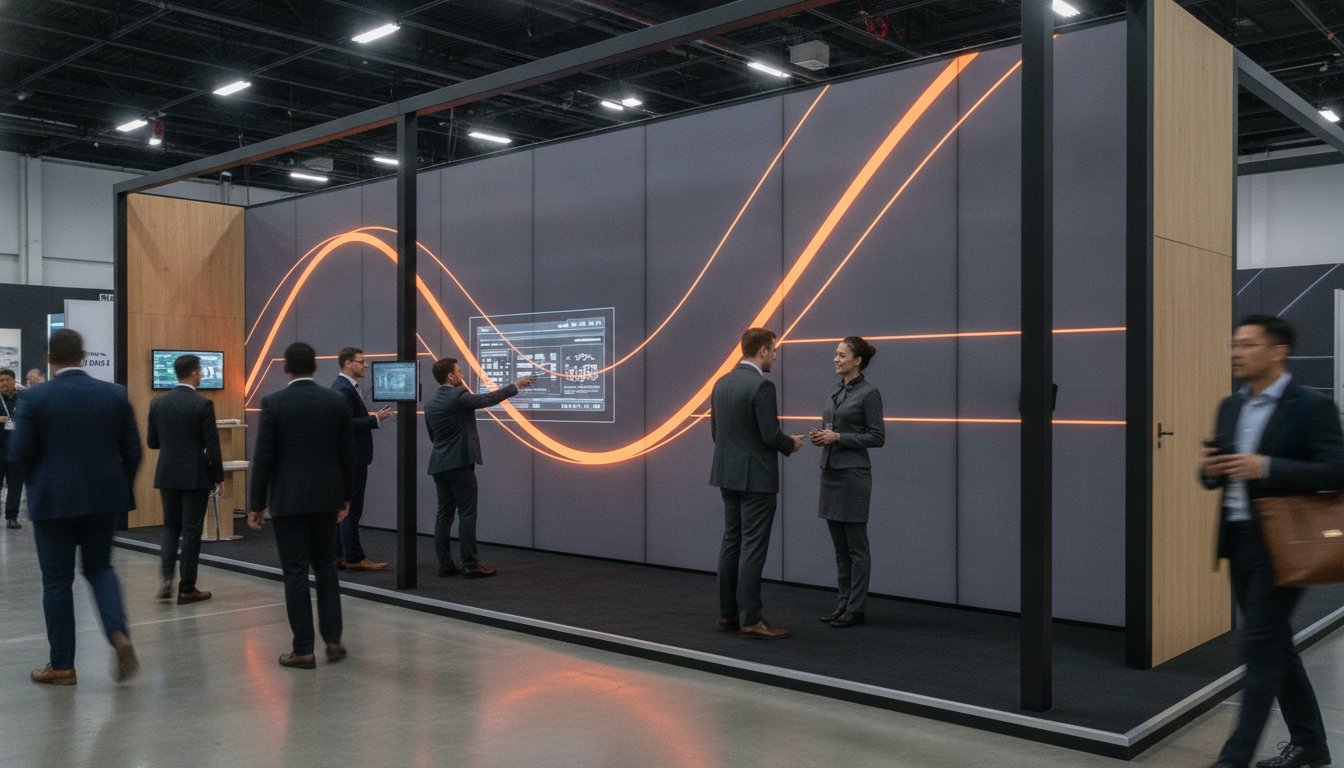
In a 2026 event landscape valued at over $466 billion, your booth has exactly three seconds to convert a distracted passerby into a high-value prospect. It’s a high-stakes environment where a single blurry logo or a cluttered layout can signal amateurism instead of authority. You’ve likely worried about how your small-scale branding will translate to massive ten-foot walls, or feared that your expensive hardware will be undermined by busy designs that fail to invite engagement. We understand that tension because we see trade show display graphic design not just as art, but as a strategic architectural layer essential for your success.
This article promises to transform your approach by blending technical precision with the psychology of distance-viewing. You’ll gain the confidence to prepare flawless files and the vision to create a high-impact brand destination that stops foot traffic in its tracks. We’re diving into the 2026 shift toward visual clarity, providing a roadmap to ensure your next presentation reflects the premium quality your business represents. From navigating NFPA 701 fire safety standards to mastering matte finishes that eliminate glare, you’re about to learn how to turn every square inch of your booth into a conversion engine.
Key Takeaways
- Master the three-second rule to ensure your brand communicates immediate value to attendees from over 20 feet away.
- Learn the technical essentials of trade show display graphic design, including why vector files and large-format scaling are non-negotiable for crisp, professional results.
- Implement the “top-down” layout strategy to keep your most critical messaging above the five-foot line for maximum visibility in crowded halls.
- Explore 2026 design trends like backlit display technology and sustainable substrates that combine high-impact aesthetics with eco-conscious brand values.
- Discover the benefits of a boutique agency partnership that prioritizes collaborative briefs over the generic output of big-box printers.
The Psychology of Visibility: Why Strategic Trade Show Display Graphic Design Matters
Custom trade show graphics are more than just a printed logo. They represent a sophisticated form of environmental design. This specialized field requires a deep understanding of how humans navigate physical spaces and process information under pressure. In a crowded hall, your booth isn’t just a stall; it’s a high-conversion brand destination. Effective trade show display graphic design acts as the essential bridge between cold hardware fabrication and the warm, human element of brand storytelling. It transforms a standard frame into a narrative journey.
Success on the floor is often dictated by the three-second rule. Research into attendee behavior suggests you have a tiny window to communicate your primary value proposition from a distance of 20 feet. If a passerby can’t identify who you are and what you do in that heartbeat, they’ll likely keep walking. This is where visual merchandising principles become critical. By applying retail-tested strategies to your exhibit, you create an environment that feels intuitive and welcoming rather than chaotic and confusing.
The Three Zones of Event Branding
To master the floor, you must design for three distinct layers of interaction. Each zone serves a specific psychological purpose in the visitor’s journey.
- Long-range: Use high-altitude assets like trade show hanging signs to act as beacons. These are designed for visibility from several aisles away, establishing your presence in the room.
- Mid-range: Your backwall graphics should state a singular, powerful value proposition. This is the “hook” that stops them as they approach.
- Short-range: Once they are in the booth, large format event signage and table-level details provide the technical depth needed for one-on-one engagement.
Color Theory for the Convention Floor
Vibrancy isn’t just about being loud; it’s about being legible. High-contrast palettes are your best defense against the visual noise of a trade show floor. You must consider how venue lighting, which varies from harsh overhead halogens to modern LED arrays, will affect your brand colors. Soft signage materials like tension fabric can absorb light differently than vinyl, so maintaining consistency across these diverse substrates is a hallmark of professional trade show display graphic design. A well-executed color strategy ensures your brand feels cohesive, authoritative, and impossible to ignore.
Technical Excellence in Large Format Event Signage: Pre-Flight Essentials
Designing for a smartphone screen is a world apart from crafting visuals for a 10-foot tension fabric wall. In the high-stakes environment of trade show display graphic design, technical precision is the primary difference between a booth that commands respect and one that looks like a blurry afterthought. You need to understand that large-format printing isn’t just “bigger” design; it’s a completely different mathematical approach to visual communication. When your brand is magnified to a massive scale, every minor flaw becomes a glaring distraction.
Vector graphics are your most powerful tool in this environment. Unlike raster images composed of finite pixels, vectors use mathematical paths that allow for infinite scaling without any loss of quality. Your logos and structural design elements must be submitted in AI, EPS, or high-resolution PDF formats. If you try to stretch a low-resolution JPEG across a 20-foot booth, the resulting pixelation will undermine your brand authority instantly. For photographic elements, resolution requirements depend heavily on viewing distance. While a brochure requires 300 DPI, a massive backwall can often thrive at 100 to 150 DPI at full size because attendees view it from several feet away. As we move into 2026, attendee expectations for high-definition clarity are rising, making ultra-high-resolution imagery essential for a premium feel.
Tension fabric systems introduce another layer of complexity: the stretch factor. You must strictly adhere to “bleed” and “safe zones.” Bleed ensures the color wraps completely around the frame without leaving white gaps, while safe zones keep your critical text and logos away from the edges where they might be distorted or obscured by the aluminum hardware. Ignoring these boundaries often results in cut-off headlines or logos that disappear into the corners of your display.
Vector vs. Raster: Choosing Your Weapons
Logos and typography should always remain in vector format to ensure razor-sharp edges at any size. When you do use photography, ensure the source files are massive. Sourcing 2026-quality imagery means looking for files that maintain clarity even when enlarged by 1,000 percent. If your photography isn’t up to the task, consider using stylized vector textures or high-contrast gradients that scale flawlessly and add a modern, sophisticated depth to your trade show display graphic design.
CMYK and Pantone Matching
Color management is where many designs stumble. Screens use RGB (light), but printers use CMYK (ink). This conversion can lead to muddy or unexpected shifts in your brand colors if not handled correctly. We prioritize Pantone matching to ensure your corporate identity remains consistent across every substrate. Whether you’re printing on a knit polyester or a heavy-duty vinyl, the fabric type will influence ink absorption and final saturation. Our team at Zodiac Event Displays specializes in navigating these technical nuances, ensuring your final presentation is as vibrant as your original vision.
Designing for Impact: Visual Hierarchy and Layout Optimization
Strategic layout is the silent engine of a successful booth. While we’ve discussed the psychology of visibility, the actual execution of your trade show display graphic design relies on a strict visual hierarchy. You must guide the attendee’s eye through a deliberate path, starting with your most authoritative brand elements and ending with a clear invitation to engage. Without this structure, even the most beautiful artwork becomes a confusing blur in a high-traffic environment.
The “Top-Down” rule is your most critical layout guideline. Convention floors are crowded places where sightlines are constantly interrupted by other attendees, furniture, and lead-capture stations. For this reason, your primary logo and essential brand identity must live above the five-foot line. Anything placed lower risks being obscured by a person standing in front of your backwall. By keeping your “hero” messaging at eye level or higher, you ensure your brand remains visible from across the aisle, even when your booth is full of prospects.
In the quest for impact, white space is your greatest ally. Many exhibitors feel the urge to fill every square inch of their 10-foot walls with text and imagery, but this often leads to cognitive overload. A clean, balanced design uses negative space to create a frame for your primary message. It allows the viewer’s brain to rest and focus on what truly matters. When you balance bold imagery with concise text, you create a professional atmosphere that reflects brand authority and sophistication. Remember, your graphics are the hook, not the entire sales pitch.
Typography for Distance and Speed
Legibility is the foundation of trust. Your font choices must withstand the harsh, often inconsistent lighting of a convention center. Sans-serif typefaces generally offer better readability at a distance than complex scripts or thin serifs. For your main headline, aim for a font size that is at least three inches tall for every ten feet of viewing distance. Avoid the trap of using all-caps for long sentences, as it’s significantly harder for the human eye to scan quickly. Instead, use bold weights and varying scales to create a rhythmic flow that highlights your key takeaways.
Integrating the CTA into Your Graphic Flow
Your graphics should do more than just look good; they should drive immediate action. In 2026, the bridge between physical and digital is often a well-placed QR code. Position these at “touch height,” roughly three to four feet from the floor, where they’re easy to scan without bending down or reaching up. Use short, punchy copy that promises immediate value, such as “Scan for the 2026 Trend Report” or “Start Your Demo.” Directional graphics, like subtle arrows or leading lines in your artwork, can also pull traffic toward your demo areas or consultation zones, turning passive observers into active participants.
Future-Proofing Your Exhibit: Trends in Branded Event Graphics for 2026
The trade show floor of 2026 is a multisensory battlefield. To stay ahead, your trade show display graphic design must evolve beyond simple ink on fabric. We’re seeing a decisive shift toward designs that breathe, glow, and interact. This evolution is driven by a need for deeper engagement and a growing corporate responsibility toward the environment. As we’ve mastered the basics of hierarchy and technical prep in earlier sections, we now look toward the innovations that separate industry leaders from the rest of the pack.
One of the most significant shifts is the “phygital” frontier. By embedding subtle triggers into your artwork, you can turn a static wall into an Augmented Reality (AR) experience. This allows visitors to see 3D product demos or interactive data visualizations through their smartphones, triggered directly by your booth graphics. When combined with the seamless, high-end look of Silicone Edge Graphics (SEG), your booth achieves a clean, architectural finish that hides the frame entirely. These textures and digital layers create a sense of depth that traditional prints simply cannot match.
Illuminated Graphics: Beyond the Standard Print
Designing for a backlit display requires a specific artistic approach. You aren’t just managing color; you’re managing luminescence. High-contrast designs with deep blacks and vibrant highlights perform best under internal LED arrays. UV-printed fabrics are essential here because they maintain their saturation even when light passes through them, preventing the “washed out” look common in inferior prints. You can use light strategically to spotlight a new product or pull the eye toward a critical headline, creating a focal point that commands attention even in the dimmest convention halls.
Sustainable Design Choices
Modern brands are increasingly judged by their footprint. Designing for eco-friendly trade show displays means choosing substrates like recycled polyester or biodegradable vinyl alternatives. But sustainability is also about longevity. We advocate for modular trade show display graphic design that allows you to swap out specific panels or sections without discarding the entire kit. This “refresh rather than replace” philosophy saves budget and aligns your brand with the 61% of attendees who now favor sustainable events. Showing your commitment to green events isn’t just good for the planet; it’s a powerful branding statement that resonates with modern buyers.
Ready to elevate your presence with the latest in visual technology? Explore our premium display options to see these 2026 trends in action.
From Concept to Fabrication: The Boutique Design Journey with Zodiac
Choosing a partner for your event presence is a choice between a transactional vendor and a dedicated ally. While “big box” printers often treat your files as just another job in a massive queue, a boutique agency approach prioritizes the soul of your brand. Mastering the nuances of trade show display graphic design requires more than just high-end software; it demands a deep understanding of your specific marketing objectives. We don’t just print graphics. We engineer visual experiences that align with your long-term success.
Our collaborative journey begins with a comprehensive design brief. This isn’t a mere checklist, but a strategic alignment session where our creative team syncs with your brand goals. We bridge the gap between your initial vision and the technical realities of large-format fabrication. By managing the entire process from the first sketch to the final stitch on a backwall display, we eliminate the risk of “lost in translation” errors that often plague fragmented production chains. You gain the peace of mind that comes from knowing the vibrant colors on your screen will match the precision of the final fabric.
Success in 2026 also demands logistical agility. Whether you’re exhibiting at the Las Vegas Convention Center or an international summit, our global delivery and support network ensures your assets arrive in pristine condition. We handle the complexities of technical file preparation and quality control so you can focus on your booth’s performance. From custom flags to intricate hanging signs, every element undergoes rigorous inspection to meet our premium standards before it ever reaches the show floor.
Our Creative Consultation Process
We believe great design starts with great questions. Our Denver-based team analyzes your event goals before a single pixel is moved. Are you looking to launch a product, or are you focused on brand authority? This goal-oriented approach informs every layout choice and color selection. Our iterative revision process ensures we refine your vision until it’s ready for maximum impact. You aren’t just getting a designer; you’re gaining a seasoned strategist who understands the endurance required for trade show success.
Ready to Elevate Your Brand?
Strategic graphics are the most direct path to higher ROI and meaningful lead generation. When your booth reflects professional pride and visual excellence, you stop being a passive participant and start becoming a destination. We’ve helped countless brands transform their presence from “busy and uninviting” to “bold and authoritative.” It’s time to move beyond standard templates and embrace a design strategy that truly represents your vision. Connect with the Zodiac Event Displays team today to start your custom quote and see how we can bring your 2026 strategy to life.
Mastering Your Brand’s Visual Future
Your presence on the 2026 trade show floor is a bold statement of your brand’s ambition. By mastering the strategic hierarchy of the top-down rule and embracing the technical precision of vector-based assets, you’ve moved beyond simple booth setup. You’re now ready to craft a high-conversion destination. Integrating future-proof trends like backlit illumination and sustainable substrates isn’t just about aesthetics; it’s about building a narrative that resonates with the modern attendee. Expertly executed trade show display graphic design is the vehicle that carries your brand story from the aisle to the final handshake.
Success requires a partner who sees your vision as clearly as you do. With over 10 years of industry expertise and a boutique design agency focus, we provide the personalized attention your project deserves. Our global delivery capabilities ensure your high-impact visuals arrive perfectly, no matter where your next event takes you. It’s time to transform your exhibit into a visionary masterpiece. Partner with Zodiac Event Displays for Your 2026 Graphics and lead the floor with confidence. Your journey toward a more vibrant, authoritative presentation starts today.
Frequently Asked Questions
What is the best file format for trade show graphics?
Vector-based files such as .AI, .EPS, or high-resolution .PDF are the industry gold standard for large-scale displays. These formats allow for infinite scaling without any loss of quality, ensuring your logos and typography remain razor-sharp. While raster images have their place for photography, vector elements are essential for maintaining professional brand authority on massive backwall displays or hanging signs.
How much bleed do I need for a fabric backwall display?
A standard bleed of at least two inches on all sides is typically required for tension fabric and backwall displays. This extra margin allows the printed graphic to wrap around the frame or account for the stretch of the material without leaving unprinted white edges. Proper bleed management is a critical step in professional trade show display graphic design to ensure a seamless, high-end finish.
What resolution should my images be for a 10×10 booth?
For a 10×10 booth, your images should ideally be 100 to 150 DPI at 100 percent of the final physical size. While desktop printing requires 300 DPI, the viewing distance on a convention floor allows for a lower resolution without sacrificing perceived clarity. Using ultra-high-resolution source files ensures your visuals remain crisp and engaging as attendees approach your booth for a closer look.
Can I use my website photos for my trade show display?
Website photos are almost always unsuitable for large-format printing because they are optimized for fast loading at 72 DPI. When stretched to fit a 10-foot wall, these images become pixelated and blurry, which can undermine your brand’s credibility. It’s best to use original high-resolution photography or professional stock images to ensure your presentation reflects the premium quality of your business.
How do I choose between CMYK and Pantone colors for my booth?
CMYK is the standard process for full-color printing, while Pantone colors are used for precise matching of specific corporate identities. We recommend providing Pantone codes for your logos to ensure color consistency across different materials like table cloths and banner stands. Our team uses these codes as a target to bridge the gap between digital vision and physical fabrication.
What is the “Safe Zone” in large format graphic design?
The safe zone is the area within your design where all critical text, logos, and essential imagery should be placed. It typically sits one to two inches inside the final trim line to prevent important elements from being obscured by hardware or distorted by the tension of the fabric. Keeping your key messaging in this zone ensures maximum legibility and visual impact.
How often should I update my trade show display graphics?
Most industry leaders update their trade show graphics every two to three years or whenever a significant brand evolution occurs. Staying current with design trends, like the 2026 shift toward visual clarity, prevents your booth from appearing dated. Regular updates allow you to refine your messaging based on previous show performance and changing market demands.
Does Zodiac Event Displays offer custom design services or just printing?
Yes, Zodiac Event Displays acts as a full-service creative consultancy offering both custom design services and high-end fabrication. We provide a collaborative boutique experience where our seasoned strategists guide you through the entire process of trade show display graphic design. From the initial conceptual brief to the final global delivery, we act as an essential extension of your own creative team.
 Previous reading