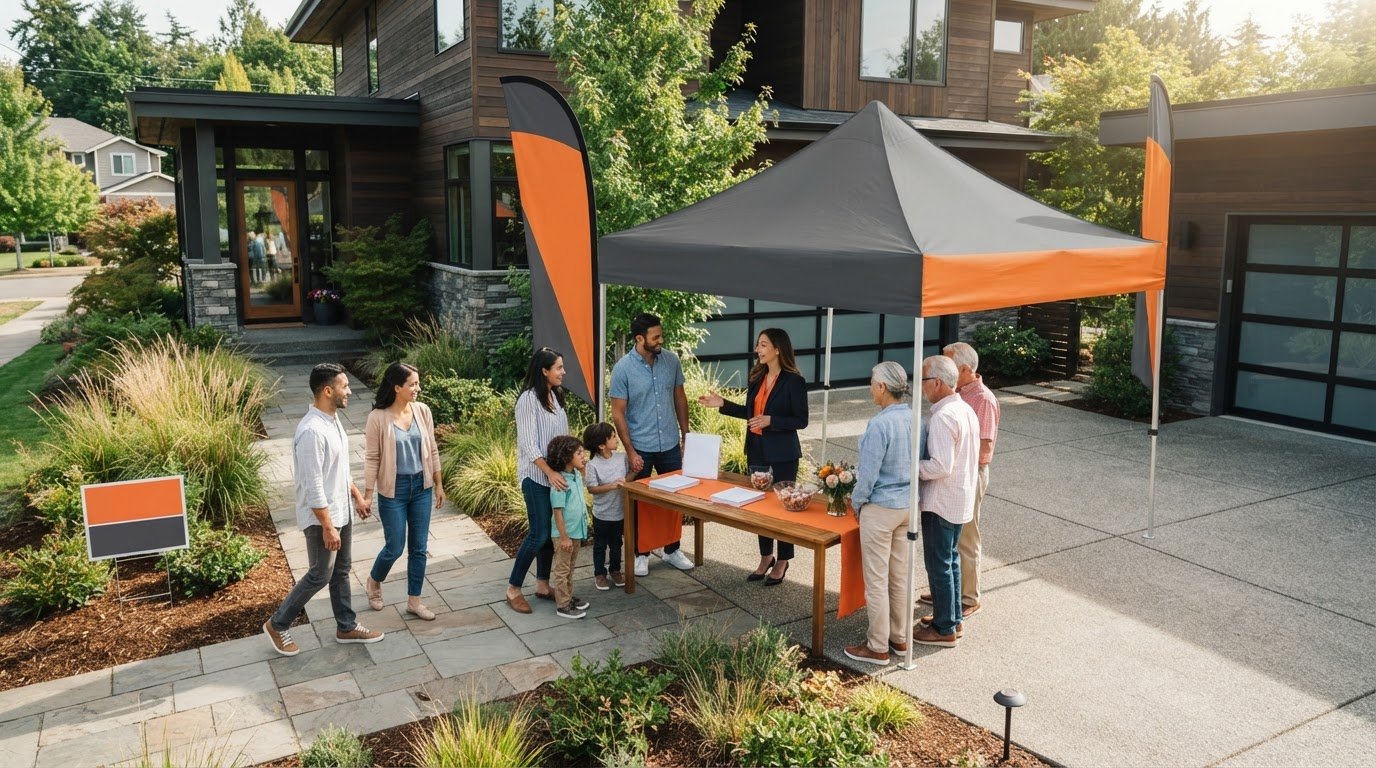
A real estate open house branded tent can help visitors spot the event, identify the host, and know where to go when they arrive. Unlike a generic setup, a tent designed around your agency’s identity can make the welcome point feel connected to your brand and suited to the property.
Make each detail purposeful. Use clear messaging to guide visitors, choose a practical location, and carry your agency identity through a polished design that complements the home. This guide covers how to plan the setup, assign useful roles to tents and supporting signage, prepare artwork, and account for site constraints. Zodiac Event Displays designs, prints, fabricates, and delivers custom event branding, including event tents, flags, and printed tablecloths, to help bring the pieces together.
Key Takeaways
- Use a real estate open house branded tent as a clear welcome point that helps visitors identify where to go and who is hosting.
- Plan placement around the property’s access, pedestrian routes, visibility, and overall presentation.
- Give tents, flags, and yard signs distinct roles so each supports the visitor journey without competing for attention.
- Keep tent graphics focused on agency identity, the open-house purpose, and one useful instruction.
- Prepare your event purpose, property context, brand assets, and print-ready artwork for a coordinated design-to-delivery process.
Why a Real Estate Open House Branded Tent Can Improve the Visitor Welcome
An open house begins before a guest steps inside. Someone may spot the listing, arrive at the property, then pause to work out which entrance to use and where to meet the agent. A branded tent brings your agency identity and the welcome point together, making the arrival feel clearer and more considered.
A branded open-house tent is a visible welcome point that identifies the hosting agency and helps guide visitors toward the event’s designated arrival area. It does more than display a logo. It connects the first visual cue with the next practical step: approach the host, get oriented, and continue into the home.
Where the tent fits in the open-house visitor journey
Consider arrival in sequence. First, a guest needs to recognize that an open house is taking place. Next, they need to find the intended entrance or welcome area. Finally, they should be able to approach the host without guessing where to go. Depending on the property, the tent might sit near the driveway entrance, beside the front approach, or at another designated spot that guests can reach easily.
Choose a location that keeps the walking route clear, preserves driveway access, and avoids blocking the home or existing property signage. Check the view from the direction visitors are most likely to arrive. The tent should be easy to notice without turning the entrance into an obstacle or hiding the property’s strongest features.
What a branded welcome point communicates
Keep the home in the lead. The tent should support the listing’s presentation, not compete with its architecture, curb appeal, or property signage. Consider its scale, location, and visual emphasis. A tent near the welcome area can make the event easier to recognize while leaving the home as the main attraction.
Before setting up, look at the arrival from a guest’s perspective. Where would they first notice the event? What might make them hesitate? Is the route obvious, and can they reach the host without crossing a vehicle path or blocking others? These questions help make the display useful for wayfinding, not just decoration.
A real estate open house branded tent works best when each part of the welcome has a clear job: property signage identifies the listing, the tent marks the gathering point, and the host greets visitors. Coordinate those elements, keep the route open, and let the home remain the focus.
Plan the Open House Tent Around the Property, Audience, and Event
Start with the event’s purpose, not the graphics. A single-property open house needs to help prospective buyers find the listing and understand where to arrive. A brokerage gathering or community promotion has a broader job: making the agency easy to recognize across an event area. Let that purpose guide the site plan, message, and supporting displays.
Assess the open-house site before planning the display
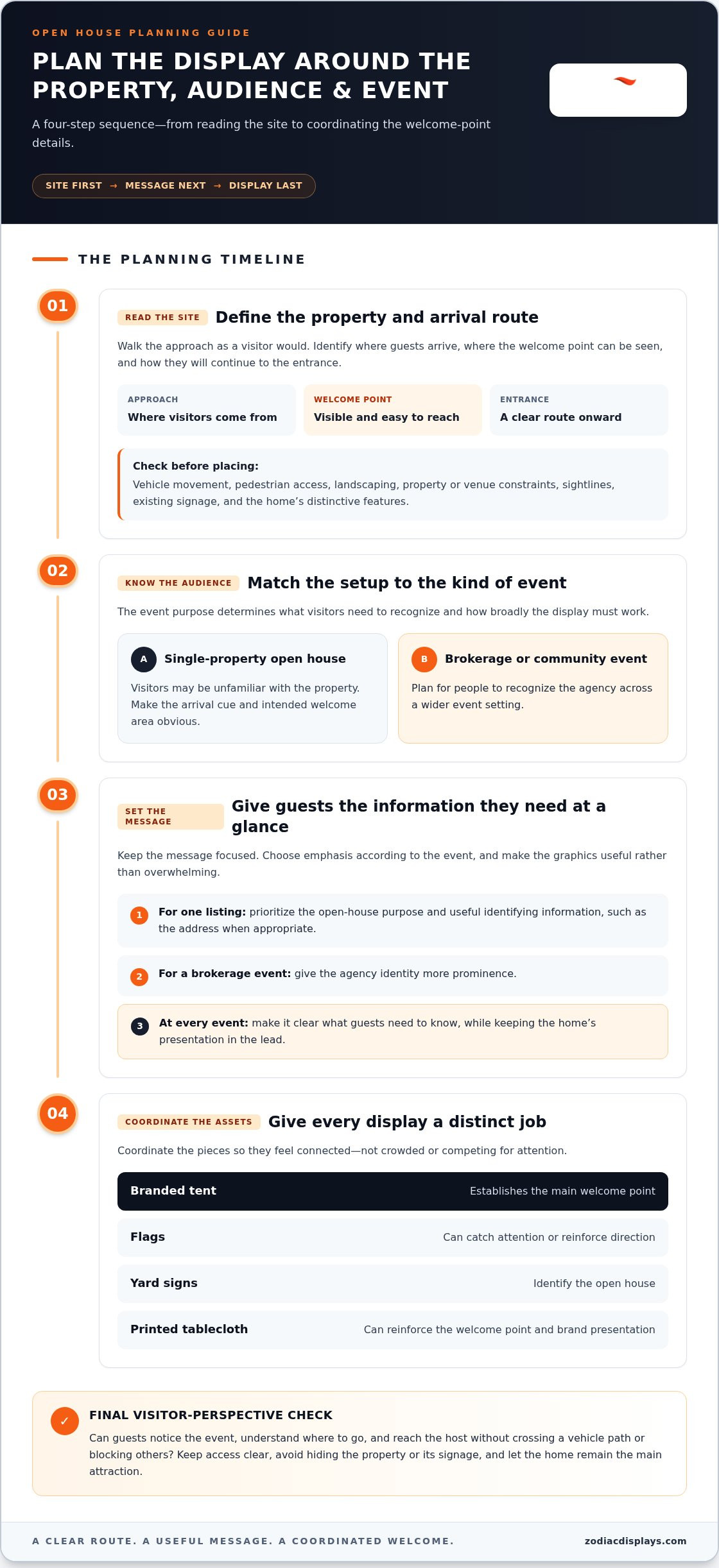
Walk the arrival route as a visitor would. Note where people approach from the street, where a welcome point is visible, and how guests will move from it to the entrance. Consider vehicle movement, pedestrian access, landscaping, and the home’s most distinctive features. A clear sightline matters, but so does keeping the display from interrupting access or hiding the house.
Review property or venue constraints that affect where a temporary display can go. Then assess the view from the approach, the driveway, and the path guests will actually walk. The real estate open house branded tent should fit the site rather than force visitors to change their route or compete with the home’s presentation.
Match the setup to the event’s purpose
Use this checklist to turn your observations into a practical plan. Each step informs the next, keeping the design connected to the property and the people attending.
- Define the site. Identify the likely approach, welcome location, clear walking route, and placement constraints. Consider how the display will look beside the home and its existing signage.
- Know the audience. At a listing open house, visitors may be unfamiliar with the property and need an obvious arrival cue. At a brokerage or community event, plan for people to recognize the agency across a wider setting.
- Set the message. For one listing, prioritize the event purpose and useful identifying information, such as the address when appropriate. For a brokerage event, give the agency identity more prominence. Keep the message focused on what guests need to know at a glance.
- Coordinate supporting assets. Decide whether flags or a printed tablecloth will reinforce the welcome point and brand presentation. Give each item a distinct purpose so the display feels cohesive rather than crowded.
Adapt the plan to the property. A home with a prominent front entrance may call for a welcome point that supports that approach. If visitors are more likely to arrive from a side drive, another location or visual cue may work better. Aim for a setup that feels intentional for the event, not like a one-size-fits-all arrangement.
For a coordinated approach from concept through delivery, explore event branding design and production as you shape the display around your site and audience.
Branded Tent, Flags, or Yard Signs: Choose the Right Open-House Roles
Each display should solve a different visitor problem. A tent can establish the main welcome point, flags can catch attention or reinforce direction, and yard signs can identify the open house or point the way. A coordinated setup works when the pieces complement one another instead of repeating the same message. Decide what guests need to notice first, then give each asset one clear job.
For many listings, the real estate open house branded tent is most useful as the central gathering point, especially when an agent will greet visitors there. Other signs can support the journey toward it. Use this comparison to assign roles before planning the graphics:
| Asset | Purpose | Placement | Message |
|---|---|---|---|
| Branded tent | Welcome and gather | Staffed arrival area | Agency identity and open-house purpose |
| Custom flag | Attract attention or guide | Visible approach or near the welcome point | Agency name or a short direction |
| Yard sign | Identify or direct | At an appropriate property location | Open house or directional cue |
When a branded tent should lead the setup
Let the tent lead when visitors need an obvious place to approach, pause, or meet the agent. Keep the agency name and event purpose readable from the distance at which guests first encounter the display. The tent should anchor the welcome, not overpower the home or crowd the arrival area with competing messages.
Imagine a guest arriving at a property with more than one possible approach. A clearly identified welcome area gives them a destination, and a nearby host can greet them and direct them onward. Choose the tent as the visual anchor when it supports that function, while keeping the home and essential property signage visible.
How flags and signs can guide visitors
Flags and yard signs provide supporting cues, not substitutes for a staffed welcome point. A flag can draw the eye toward the event or reinforce a route; a yard sign can identify the open house or give a simple direction. Keep the wording brief, such as “Open House” or “Welcome,” and make sure it suits the sign’s location.
Zodiac Wing Banners set up in under one minute, which can make them a practical part of an event plan. That setup time applies to the banners, not the tent. Place a flag where it adds visibility without distracting from the home or confusing the visitor’s route.
Before adding another display, ask what new information it contributes. If the flag, tent, and sign all compete to announce the same thing, simplify. A distinct combination creates a more deliberate welcome: signs identify or direct, flags draw attention, and the tent gives visitors a clear place to meet the agent.
Design Open House Tent Graphics That Welcome Rather Than Overwhelm
Graphics should answer three quick questions: who’s hosting, what’s happening, and where should visitors go? A polished real estate open house branded tent carries the agency identity while helping guests understand the event at a glance. Build the design around your agency’s existing logo, colors, and typography so the setup feels like a natural extension of its brand, not a new identity for one listing.
Build a simple open-house message hierarchy
Give each message a clear level of importance. Lead with the brokerage or agent identity, follow with “Open House” or another direct event description, then add one useful instruction if it solves a real point of confusion, such as “Please check in here.” Include a property address or contact detail when it helps visitors identify the listing, but avoid squeezing in every feature, social handle, and promotional phrase.
Think about how the design reads from the visitor’s approach, not just on a screen. Strong contrast and uncluttered spacing help essential information stand out. Keep decorative copy secondary so a slogan doesn’t make the event purpose harder to spot. When you coordinate the tent with flags or a printed tablecloth, repeat brand elements but give each item only the information suited to its role.
Prepare print artwork to Zodiac’s specifications
Production-ready files help move a design into print. Zodiac accepts Adobe Illustrator files in AI, PDF, or EPS formats, as well as Adobe Photoshop files. InDesign files are not accepted, and artwork must be supplied in PC-compatible format. Convert text to outlines or curves, or supply the font file; outlining is preferred. Keep images as separate, linked files rather than embedding them.
Use Pantone colors for accurate matching and verify the selection with a Pantone guide. CMYK can be used, but color variation is expected. Gold and fluorescent Pantones in the 800 series cannot be printed; use approved alternative gold or silver colors instead. Preserve the agency’s established color identity when adapting the artwork.
- Set photos, JPGs, and PSD images to at least 72 ppi and no more than 100 ppi at 100% print size. Do not send 300 ppi images. GIF, PNG, and TIFF files are not accepted for banners.
- Keep Photoshop PSD files to no more than five layers at 72 ppi. A flattened PSD or JPG is preferred. JPGs larger than 20 MB are unsuitable for full-background use.
- Follow the product template for bleed, which varies from 0.7 to 3 inches. Plain banners require 2 inches of bleed all around.
- Maintain a minimum line thickness of 0.1 inches. Do not flatten template markings, which are for reference only. Never place an EPS file inside another EPS.
These checks help carry a clean concept into print and fabrication while keeping the visitor’s experience in focus. Explore coordinated event branding design and production to shape open-house graphics around your agency identity.
Bring Your Real Estate Open House Branded Tent from Concept to Event
A well-planned display starts with a clear brief and develops through coordinated creative and production work. Zodiac Event Displays handles event branding from concept and design through print, fabrication, and delivery, bringing the real estate open house branded tent and purposeful companion pieces into one cohesive presentation. Your knowledge of the property and audience shapes the concept, while approved brand assets and production-ready artwork help carry it through.
What to include in a project brief
Start with the details that shape the visitor experience. Describe the property setting, event purpose, expected audience, and intended location for the welcome point. Note how guests approach the property and what you want them to notice first. This context helps the design respond to the actual event rather than rely on generic real estate graphics.
Gather approved agency logos, Pantone color references, fonts, and existing artwork. Share any message that must appear, such as the open-house purpose or a useful visitor instruction. If flags or a printed tablecloth have a clear role, include them in the brief so the visual system can be coordinated. Add an asset when it supports navigation, recognition, or the staffed welcome.
Provide Adobe Illustrator files in AI, PDF, or EPS format, or Adobe Photoshop files, in PC-compatible format. InDesign files are not accepted. Convert text to outlines or curves, or supply the font file, with outlining preferred. Use Pantone references for color matching, and provide images as separate linked files. Follow the supplied product artwork guidance for resolution, bleed, line thickness, and file preparation.
Coordinate design, production, and delivery
Once the brief and assets are assembled, the project moves through connected stages: develop the creative concept, refine the design around your agency identity and event needs, then carry approved artwork into print, fabrication, and delivery. Keeping those stages aligned helps preserve the intended look from the initial idea to the finished event assets. Zodiac brings more than 10 years of experience in soft signage and event branding to this collaborative process.
For broader planning inspiration, explore the custom event tent guide as you consider how a tent fits your open-house setting. Choose each supporting piece for its role: a flag can reinforce visibility or direction, while a printed tablecloth can extend the agency identity at a staffed welcome area. Coordinate them when they improve the visitor experience, not simply to add more branded surfaces.
Bring your property context, event purpose, brand assets, and artwork together to plan a polished, practical display. Zodiac Event Displays can support your project from creative design through production and delivery.
Make Your Next Open House Feel Unmistakably Yours
Your next event is an opportunity to create a welcome that feels true to your agency and right for the property. Treat the display as part of the guest experience: make the arrival feel intentional, the brand recognizable, and the first interaction easy to begin. A thoughtfully planned real estate open house branded tent can help set that tone while giving your listing room to shine.
Bring your event purpose, property details, and approved brand assets together, then shape a display that can serve as a consistent part of your agency’s future marketing. Zodiac Event Displays has partnered with notable clients including Mercedes-Benz, Tito’s Vodka, and Garmin, bringing care and creativity to branded event presentations.
Start planning your open house display with Zodiac Event Displays and create a confident welcome that reflects your brand.
Frequently Asked Questions
What should a real estate open house branded tent say?
Keep the message to what guests need at arrival: the agency or agent name, a clear “Open House” identifier, and a brief instruction if it solves a real point of confusion. For example, “Please check in here” can help at a staffed welcome area. Include the property address when it helps visitors identify the listing, but save long feature lists and extra promotional copy for other marketing materials.
Can a branded tent help visitors find an open house?
Yes. A real estate open house branded tent can make the welcome area easier to recognize, especially when a visitor has arrived but isn’t sure where to meet the agent. It doesn’t replace directional signs that guide people from a nearby street or turn. Treat signage as the route cue and the tent as a recognizable destination once guests reach the property.
Should I use flags with a real estate open house tent?
Use flags when they add visibility or clarify a route that the tent alone doesn’t explain. A flag near an appropriate approach can draw attention toward the staffed welcome point, while the tent identifies where guests can meet the agent. Keep each message distinct: let the flag support wayfinding or recognition, and reserve the tent for the main welcome.
What artwork files does Zodiac Event Displays accept?
Zodiac accepts Adobe Illustrator files in AI, PDF, or EPS formats, as well as Adobe Photoshop files. Artwork must be PC-compatible. Convert text to outlines or curves, which is preferred, or supply the font file. Link images as separate files, and prepare photos, JPGs, or PSD images at 72 to 100 ppi at 100% print size. Use Pantone references for accurate color matching and follow product-specific bleed guidance.
Can I use the same branded tent for brokerage events and open houses?
You can keep the agency identity consistent while tailoring the event message to each setting. A single-listing open house may need a property-focused identifier and check-in cue, while a brokerage gathering can emphasize the firm and the event. Plan each presentation around its purpose and audience, using approved brand elements to make the connection clear.
How do I begin a branded open house display project?
Begin with a concise brief covering the property setting, event purpose, audience, welcome-point location, and approved brand assets. Zodiac collaborates from creative concept and design through print, fabrication, and delivery, aligning the display with your project details and artwork. Start planning your open-house display with Zodiac Event Displays.

 Previous reading