
Sidewalls can change the anchoring math. A 10×10 canopy generally needs 25 to 40 pounds of ballast per leg, while a tent with sidewalls should have at least 50 pounds per leg. That’s the practical answer to how much weight to hold down a 10×10 tent, but wind and surface conditions affect the amount you need.
Tent size matters, but so does exposure: sidewalls catch wind, and hard surfaces require a different anchoring method than grass or sand. This guide explains how to adapt your setup to the conditions instead of relying on one weight recommendation.
You’ll find guidance for grass, concrete, sand, and gravel, plus the effects of wind and sidewalls. Use it to plan balanced anchoring across all four legs and determine when greater exposure calls for more ballast.
Key Takeaways
- Match ballast per leg to the wind conditions, and distribute it evenly across all four legs.
- Adjust your anchoring approach for the surface: grass, concrete, sand, and gravel each affect how the tent can be secured.
- Choose stakes for suitable ground and ballast for hard surfaces, where stakes can’t be driven in.
- Account for sidewalls because they increase wind exposure and call for more securing weight.
How Much Weight is Needed to hold down a 10×10 Canopy Tent?
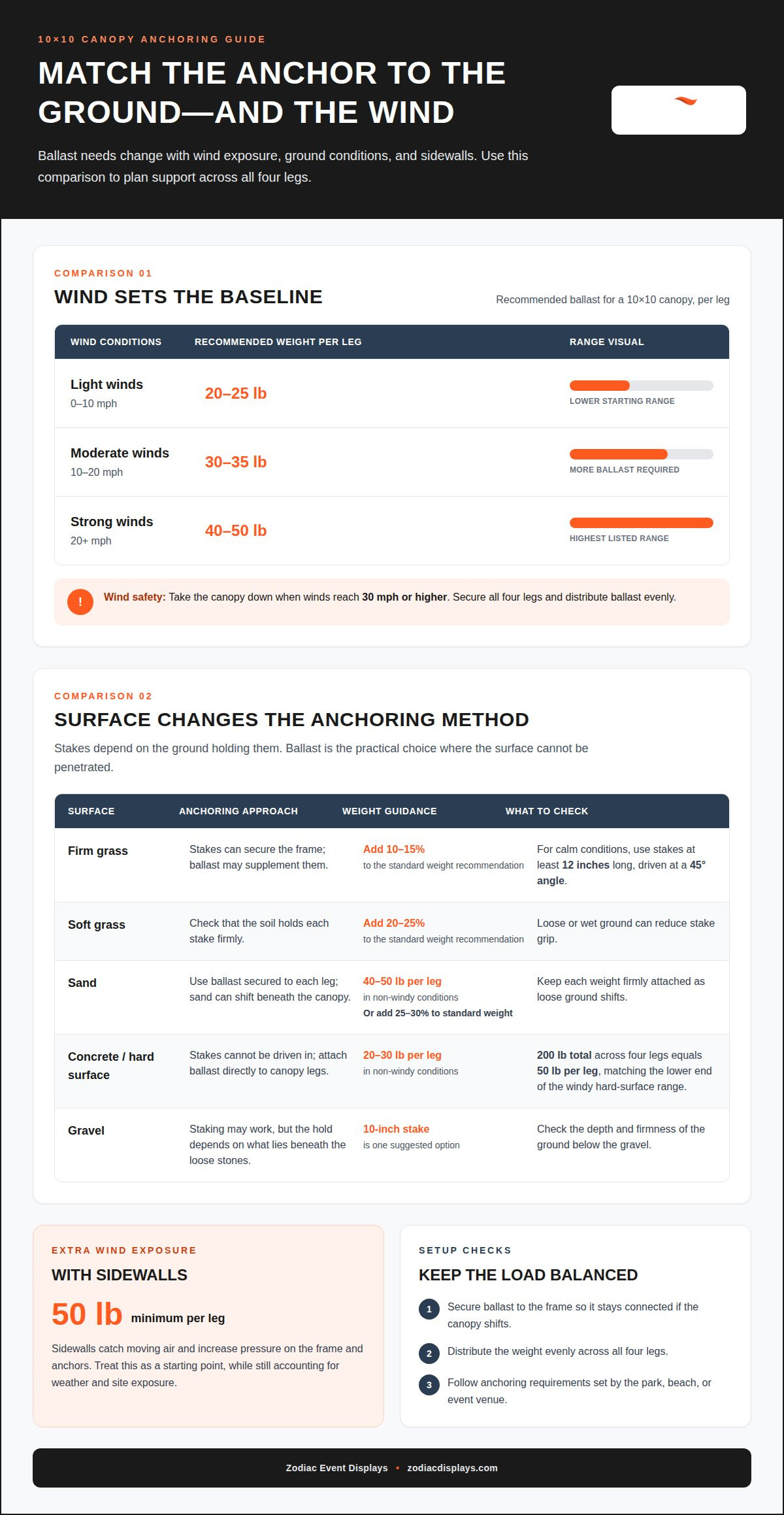
For a 10×10 canopy, use 20-25 pounds per leg in light winds, 30-35 in moderate winds, and 40-50 in strong winds. The question of how much weight to hold down a 10×10 tent also depends on the surface and setup. U.S. parks, beaches, and event venues may set their own anchoring requirements, so follow the rules for your site.
Wind-Speed Weight Recommendations
Wind-speed recommendations rise as moving air puts greater force on the canopy. For light winds of 0-10 mph, use 20-25 pounds per leg; for moderate winds of 10-20 mph, use 30-35 pounds per leg. Strong winds of 20+ mph call for 40-50 pounds per leg. These ranges help answer how much weight to hold down a 10×10 tent as conditions change. Distribute the ballast evenly across all four legs.
Leg Weight Recommendations by Canopy Size
Recommended ballast per leg rises with canopy size and wind exposure. A 10×10 canopy calls for 20-25 pounds per leg in light winds, 30-35 in moderate winds, and 40-50 in strong winds. For a 10×20 canopy, choose ballast based on wind exposure and site conditions, and secure each leg appropriately. Compare dimensions and forecast conditions before selecting ballast.
Weight of Water-Filled Anchors
Water-filled anchors don’t have one fixed weight. Their loaded weight depends on the container’s capacity and how full it is. Compare the filled anchor’s weight with the recommended amount for each leg, then distribute the ballast evenly. A partly filled container weighs less than its full capacity, so don’t assume it provides the maximum weight unless it’s filled accordingly.
An unsecured tent can shift or lift in wind, risking injury or damage to nearby property. Secure all four legs and take the canopy down when winds reach 30 mph or higher.
Adjustments for grass, concrete, sand, and gravel
For a 10×10 tent, surface-specific recommendations range from 20-30 pounds per leg on hard ground in non-windy conditions to 40-50 pounds per leg on sand. These differences matter because the ground affects how securely stakes hold and how much ballast each leg needs.
Weight Adjustments by Surface
Surface adjustments account for how well the ground supports stakes and resists movement. On firm grass, add 10-15% to the standard weight recommendation; on soft grass, add 20-25%. Sand calls for a 25-30% increase. These adjustments help tailor anchoring to the site instead of assuming every patch of ground offers equal stability.
Gravel can make staking less predictable, so consider the depth and firmness of the ground beneath it. A 10-inch stake is one suggested option for grass or gravel. Concrete is different: stakes cannot be driven into it, so use ballast secured directly to the canopy legs.
Sand and Concrete Weights per Leg
For non-windy conditions, use 40-50 pounds per leg on sand and 20-30 pounds per leg on a hard surface such as concrete. Wind exposure can therefore change the amount needed more sharply than the surface alone.
For concrete, 200 pounds total across four legs works out to 50 pounds per leg, matching the lower end of the windy hard-surface range. Keep the load balanced so one corner does not carry less ballast than the others. On sand, choose weights that stay secured to each leg as loose ground shifts beneath the canopy.
Grass may call for a different anchoring approach, especially as conditions change. For a polished event setup, explore event tent options alongside your surface and anchoring plan.
Anchoring on hard surfaces, grass, dirt, and sand
Choose an anchoring method that suits the surface beneath each leg. Stakes rely on firm ground, while weights provide ballast where a hard surface prevents penetration.
Anchoring Options by Surface
On grass or dirt, stakes can secure the frame directly to the ground. For a 10×10 canopy on calm grass, use stakes at least 12 inches long, driven at a 45-degree angle. Check that the soil holds each stake firmly; loose or wet ground can reduce its grip.
Concrete needs a different solution because stakes cannot penetrate it. Use weights attached to the frame instead. Sand can shift under pressure, so place ballast securely at each leg. Gravel also complicates staking; a 10-inch stake is one suggested option, but its hold depends on the ground beneath the loose stones.
Weights Compared with Stakes and Tie-Downs
Weights add downward force directly at the canopy legs, making them useful on concrete and other hard surfaces. Stakes anchor into soil, grass, or dirt, while tie-downs connect the frame to a separate anchor point. Each method helps limit movement differently, so choose based on the surface and available anchor points.
On grass, stakes can supplement ballast; drive them diagonally rather than vertically. On concrete, use leg weights and connect tie-downs to those anchors where the setup allows. A weight bag can hold up to 40 pounds, while concrete blocks commonly weigh under 30 pounds, so compare the loaded weight with the needs of your setup.
Attaching Weights to a Pop-Up Tent
Secure the ballast to the frame so it stays connected if the canopy shifts. Wraparound weights fit around individual legs, while weight bags can be fastened or strapped to the frame. Distribute the load evenly across all four legs instead of concentrating it at two corners.
For a removable option, fillable bags can hold more than 100 pounds each. Check that straps stay tight and fabric bags remain closed, then position each weight beside its leg. On a hard surface, this creates a stable connection without relying on stakes or loose material.
Additional weight for tents with sidewalls
Sidewalls change how wind interacts with a 10×10 canopy. They add broad surfaces that can catch moving air, increasing pressure on the frame and its anchors. Use at least 50 pounds of securing weight per leg when the tent has sidewalls. That is a clear starting point, not a reason to ignore changing weather or the site’s exposure.
Why Sidewalls Change the Anchoring Plan
An open canopy lets air pass through its sides, while fabric walls block that airflow. Wind pushing against the panels transfers force through the frame toward the legs. A sidewall facing the wind can therefore make a weighted canopy less stable than the same canopy without walls.
Wind ratings need careful interpretation: the stated rating applies only to a tent without walls or peak flags. Adding either changes the setup, so don’t treat an open-canopy rating as proof that a fully enclosed version is equally durable in that weather. The 50-pound-per-leg recommendation reflects the extra exposure from sidewalls.
Balance Ballast with Weather
Attach ballast to all four legs and distribute it evenly. A heavily weighted corner alone can’t balance the pull across the frame, especially when a sidewall catches a gust. On concrete, connect ballast to each leg. On grass or dirt, stakes can supplement weights when the ground holds them securely.
Consider the direction and strength of wind before adding panels. If conditions become more severe, removing a sidewall reduces the surface catching wind, but it doesn’t replace secure anchoring. Take the canopy down when winds reach 30 mph or higher. That limit matters even with added pounds, because ballast does not make a tent immune to dangerous gusts.
Before setting up, confirm that each leg has at least 50 pounds attached, check straps and connections, then reassess if the weather changes. Proper anchoring starts with the sidewalls in place, not with the open-canopy rating alone.
Zodiac Event Displays: Event Tents
Zodiac Event Displays offers Event Tents for branded outdoor events and trade show presentations. Once you’ve planned for the surface, wind, and sidewalls, consider how the tent fits into the full event setup. Custom Flags can add visibility nearby, while Backwall Displays help define a branded area. These elements support a cohesive presentation, but they don’t replace securing the tent with suitable ballast or stakes.
For a setup that needs both shelter and a polished visual presence, explore the Event Tent options and related display elements. Visit Zodiac Event Displays to learn more.
Make Your Next Event Setup Work as One
Your tent’s anchoring plan is one part of an event space that should feel intentional from arrival to breakdown. Use your understanding of how much weight to hold down a 10×10 tent as a starting point, then consider how the shelter and surrounding display will work together. Keep the layout responsive to venue conditions and guest movement.
Before settling on a design, map where attendees will approach, pause, and gather. Arrange branded elements to support that flow, with clear sightlines and practical access. A polished presentation feels cohesive when visual choices and on-site needs work together rather than compete for attention.
Zodiac Event Displays offers Event Tents, Backwall Displays, and Custom Flags for coordinated event branding. Contact Zodiac Event Displays to explore options for your next event, and shape a space that’s both purposeful and memorable.
Frequently Asked Questions
How much weight is recommended for each leg of a 10×10 pop-up tent?
For a 10×10 pop-up tent, plan on 20-25 pounds per leg in light winds, increasing to 30-35 pounds in moderate winds and 40-50 pounds in strong winds. Keep the weight distributed across all four legs so no corner is left lightly anchored. If the tent has sidewalls, use at least 50 pounds per leg because the added fabric catches more wind.
What is the total weight needed to secure a 10×10 canopy tent?
For all four legs combined, a 10×10 canopy needs 80-100 pounds in calm conditions, 120-140 pounds in moderate winds, and 160-200 pounds in strong winds. Divide the total evenly among the legs rather than loading only two corners. For example, 100 pounds total means 25 pounds at each leg, keeping the setup balanced on its anchors.
How does required tent weight change in windy conditions?
Increase ballast as wind rises: the recommendation moves from 20-25 pounds per leg in light winds to 30-35 in moderate winds and 40-50 in strong winds. Gusts can place uneven force on a canopy, so check that each leg remains secured and reassess conditions during the event. Added weight doesn’t make a tent safe in every wind speed.
What wind speed can a weighted 10×10 tent safely withstand?
Many properly ballasted 10×10 canopies are generally described as handling winds up to 20-25 mph, but that isn’t a universal safe-use rating. Frame design, surface, gusts, and sidewalls all affect stability; stated ratings apply to tents without walls or peak flags. Take the canopy down when winds reach 30 mph or higher, rather than relying on extra ballast.

 Previous reading