


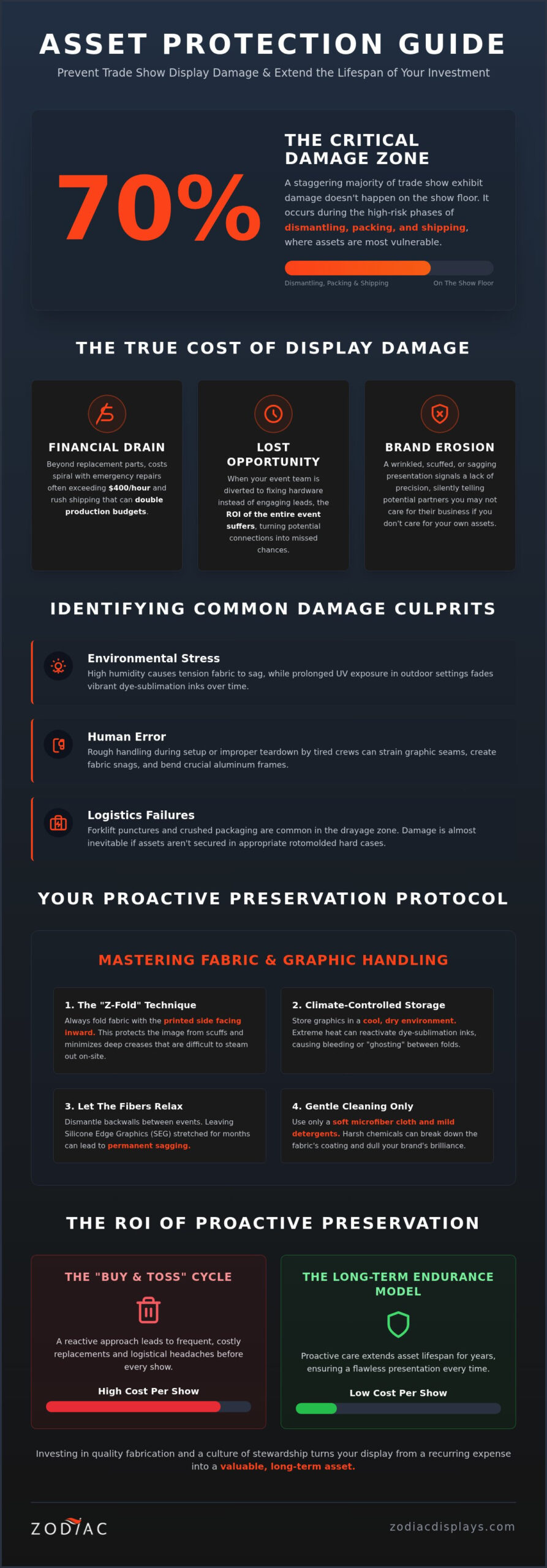
Did you know that a staggering 70% of trade show exhibit damage happens during dismantling, packing, and shipping, rather than while your display is actually on the show floor? It’s a frustrating reality for many ambitious brands. You spend months perfecting a visionary presentation only to have it compromised by a single careless forklift or an improper fold. We’ve seen the pressure of arriving at a venue only to face the embarrassment of damaged branding or the hidden costs of emergency repairs that can soar above $400 an hour for labor. It is a logistical hurdle that can dim even the most vibrant brand presence.
You deserve a seamless experience where your creative investments retain their brilliance for years. This 2026 asset protection guide will teach you exactly how to prevent trade show display damage through proactive management and specialized handling techniques. We’ll explore the endurance required for long term success, from mastering the logistics loop to implementing precision packing protocols. By the end of this article, you will have a clear roadmap to extend the lifespan of your branded assets and ensure every setup is stress free, consistent, and visually stunning.
Key Takeaways
- Quantify the true cost of asset damage, from the drain of emergency shipping fees to the subtle loss of brand authority on the show floor.
- Master the specific folding and storage techniques that explain how to prevent trade show display damage for delicate tension fabrics and dye-sublimated graphics.
- Identify the optimal protective casing and logistics strategies to help your assets survive the high-risk drayage zone and forklift-heavy environments.
- Adopt a white-glove maintenance protocol that ensures your backwalls and custom flags remain pristine through every stage of setup and storage.
- Discover how investing in high-quality fabrication creates a foundation of durability, reducing the need for last-minute fixes and extending the life of your presentation.
The True Cost of Trade Show Display Damage
Your presence at a trade show is a bold investment in your brand’s visibility and future growth. However, when a high-impact backwall display arrives with a jagged tear or a custom flag is stained by warehouse grime, that investment begins to bleed value. The true cost of damage extends far beyond the immediate invoice for a replacement part. It manifests as operational friction that stresses your event team and creates a frantic scramble for last-minute repairs. When your team is focused on fixing hardware instead of engaging leads, the ROI of the entire event suffers.
Financial drains are often hidden in the logistics. Rush shipping for a replacement frame or overnight printing for a damaged graphic can easily double your initial production budget. Beyond the dollars, there is the silent tax on your reputation. A wrinkled, sagging, or scuffed presentation signals a lack of precision to potential partners. It suggests that if you don’t care for your own assets, you might not care for theirs. Learning how to prevent trade show display damage isn’t just about saving money; it’s about protecting the integrity of your professional narrative and ensuring your visual impact remains flawless.
Identifying Common Damage Culprits
Understanding the threats to your hardware and soft signage is the first step in a strategic defense. Most damage stems from three primary areas:
- Environmental Stress: High humidity can cause tension fabric to sag while prolonged UV exposure in outdoor settings fades vibrant dye-sublimation inks.
- Human Error: Rough handling during the setup process or improper teardown by tired crews can strain seams and bend aluminum frames.
- Logistics Failures: Forklift punctures and crushed crates are common when assets aren’t secured in appropriate rotomolded hard cases.
The ROI of Proactive Preservation
A well-maintained tension fabric display shouldn’t be a single-use expense. When you master how to prevent trade show display damage, you shift from a “buy-and-toss” cycle to a model of long-term endurance. High-quality fabrication combined with a culture of stewardship can extend the lifespan of your assets for several years. This significantly reduces your “Cost Per Show” metric, allowing you to reallocate those savings into more ambitious marketing efforts. By treating your displays as essential extensions of your creative team, you ensure that every event starts with the pride of a flawless, high-impact presentation.
Material Matters: Protecting Tension Fabric and Soft Signage
Soft signage is the pulse of a modern exhibit. Its vibrancy and scale create an immersive brand experience that hard-panel displays simply cannot match. This visual excellence relies on dye-sublimation technology, where ink is heat-fused directly into the textile fibers. While this makes the graphic durable, it also introduces specific vulnerabilities. If you are focused on how to prevent trade show display damage, you must respect the science of the material. Improper handling can lead to “ghosting,” where ink migrates from one fold to another during storage, effectively ruining your high-impact visuals before the next show even begins.
Temperature control is your first line of defense. Extreme heat can reactivate dye-sublimation inks, leading to bleeding or transfer. Always store your tension fabrics in a cool, dry environment. Mastering Trade Show Logistics requires a commitment to climate-controlled warehousing. Beyond temperature, the physical tension of Silicone Edge Graphics (SEG) requires attention. Leaving these graphics stretched over a frame for months can lead to permanent sagging. Always dismantle your backwalls between events to let the fibers relax and maintain their elastic integrity. For cleaning, use only a soft microfiber cloth and mild detergents; harsh chemicals can break down the fabric’s coating and dull your brand’s brilliance.
Handling Fabric Backwalls with Precision
Your packing strategy dictates the visual impact of your brand the moment you arrive at the venue. Mastering how to prevent trade show display damage starts with the “Z-Fold” technique. Fold the fabric with the printed side facing inward to protect the image from exterior scuffs. This method minimizes deep creases that are difficult to steam out on-site. If you encounter a minor snag in the weave, address it immediately. A small pull can quickly escalate into a structural tear once the fabric is pulled taut over its frame. Keeping a small repair kit with a needle and matching thread is a hallmark of a seasoned strategist.
Custom Flags and Inflatables Maintenance
Outdoor assets face a unique set of challenges, from relentless UV rays to unpredictable wind loads. Ensure your custom flags are treated with UV-resistant coatings to prevent premature fading. For custom inflatables, the priority is seam integrity and blower health. Conduct a thorough leak test before every event to ensure your brand stands tall. Moisture is the ultimate enemy here; never pack a flag or inflatable while it’s damp. Mold and mildew can settle into the fibers within 48 hours, creating odors and stains that are impossible to remove. For those seeking long-term endurance, choosing premium soft signage built with high-quality fabrication is the most effective way to minimize ongoing maintenance.
The Logistics Loop: Preventing Damage During Shipping
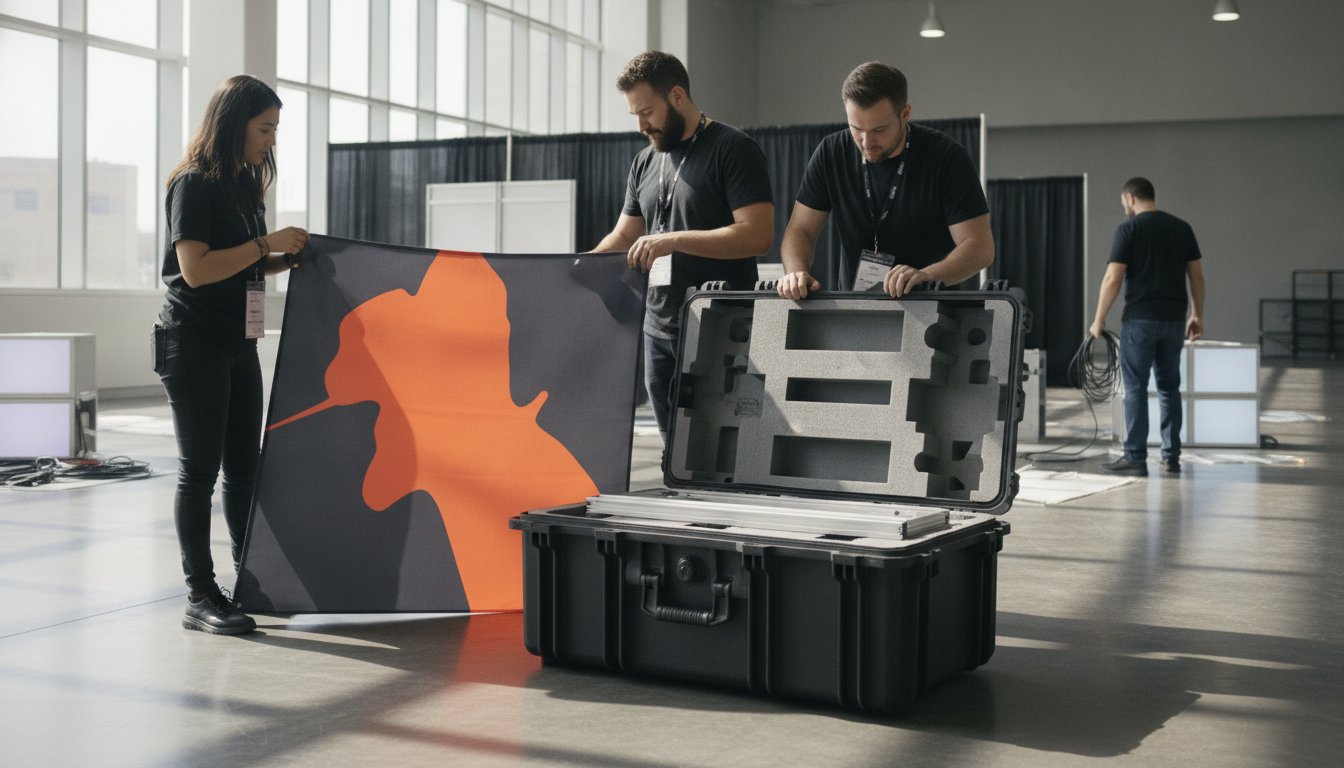
The journey from your warehouse to the convention center is the most perilous phase for your branded assets. While your team sees a visionary marketing tool, shipping carriers and drayage contractors see a heavy crate that needs to move quickly. High-impact displays often suffer their most significant injuries before they even reach the booth space. Transitioning from soft bags to rotomolded hard cases is the first step in a professional defense. These rugged containers are engineered to withstand the crushing forces of stacked freight and the accidental impact of a forklift blade, providing a sanctuary for your delicate tension fabrics and aluminum frames. For specialized protection of high-value hardware, you can explore Santosom Cases to find professional-grade solutions.
Global delivery adds another layer of complexity. International customs inspections can be invasive; poorly labeled crates are often pried open with little regard for the contents. Clear, bilingual documentation and professional labeling reduce the risk of rough handling by officials. If you are wondering how to prevent trade show display damage on a global scale, precision in your paperwork is just as vital as the strength of your shipping crates. Clear communication ensures your assets spend less time in high-risk inspection zones and more time moving toward their destination.
Internal damage is a silent killer of trade show ROI. Even if the exterior case remains intact, loose components can vibrate and abrade one another during transit. Strategic layering is essential. Always place heavy hardware and base plates at the bottom of the case to create a stable center of gravity. Use custom-molded foam inserts to isolate delicate components, ensuring that your lighting fixtures and connectors don’t “chatter” against your graphics. Securing loose parts with Velcro straps or specialized dividers—often accompanied by clear organizational labeling from DymoOnline—prevents the internal shifting and confusion that lead to scuffs and structural fatigue. This level of detail is how you ensure your presentation arrives with the same precision it had when it left the fabrication floor.
The “Drayage” zone is where your assets are most vulnerable to the chaos of a busy event. Once your crates arrive at the loading dock, they are handled by union labor and drayage contractors who prioritize speed. To protect your investment, implement a strict “Empty” sticker protocol. These stickers ensure your cases are stored safely during the event and returned to your booth promptly after the show concludes. The first hour after the show ends is notoriously dangerous; exhausted crews may rush the breakdown. Taking the extra fifteen minutes to pack according to your established protocol prevents the bent frames and torn seams that often occur during the post-show scramble. For expert guidance on managing these complex logistics, you can always connect with our specialized team to refine your asset protection strategy.
The Professional Maintenance Protocol: Setup to Storage
Your display has successfully navigated the logistics loop; now, the focus shifts to the precision of the presentation itself. A professional maintenance protocol is the ultimate insurance policy for your brand’s visual impact. Mastery of how to prevent trade show display damage requires a dedicated commitment to stewardship from the moment an asset leaves the warehouse until it returns. It begins with a comprehensive pre-show inspection. Never assume hardware is pristine just because it’s tucked away in a case. Validate every connector, bolt, and locking mechanism before the shipment leaves your dock to avoid the embarrassment of a mid-setup failure.
Once on-site, adopt a white-glove philosophy. Natural oils and dirt from hands can leave unsightly marks on vibrant tension fabrics that are difficult to remove without professional cleaning. Encourage your team to treat every graphic as a high-end work of art. This level of care ensures that your first impression remains as polished as your brand’s vision. Having an on-site troubleshooting kit with extra clips, specialized tape, and a handheld steamer allows you to address minor issues before they escalate into event-halting problems.
Step-by-Step Setup Safety
Safety and preservation go hand-in-hand during the high-energy environment of an event setup. Before unfolding any large-format graphics, ensure the floor area is meticulously cleaned or covered with a protective drop cloth. Even a small piece of debris can snag a textile or leave a dark scuff. For overhead components like hanging signs or heavy frames, implement a strict two-person lift rule. This prevents the uneven torque that can bend aluminum extrusions or strain fabric seams. Finally, always double-check your frame locking mechanisms; a minor oversight here can lead to a structural collapse that endangers both your assets and your team. Understanding these practical steps is a core part of learning how to prevent trade show display damage.
Post-Event Decommissioning
The moments after a show ends are critical for long-term endurance. Allow your electronics and LED lighting systems a “cool down” phase before packing them into cases. Trapping residual heat in a confined space can damage delicate wiring and sensitive components over time. Before folding your graphics, use a portable vacuum to remove show-floor dust and debris that can become embedded in the fibers. This is also the time for a thorough post-show audit. Document any wear and tear immediately and update your inventory log. If you identify structural issues, it’s time to flag those assets for event display fabrication repairs before the next show cycle begins.
By following this methodical approach, you ensure your presentation remains a powerful extension of your creative team. If you’re ready to upgrade to assets designed for this level of longevity, explore our collection of high-impact displays today.
Investing in Durability: How Quality Fabrication Minimizes Maintenance
The most sophisticated maintenance protocol can only do so much if the underlying hardware is inherently fragile. True asset protection begins on the fabrication floor. When you prioritize boutique fabrication, you’re investing in tighter tolerances and superior materials that naturally resist the typical wear and tear of the event circuit. Commodity displays often rely on thin-walled aluminum or plastic connectors that fail under the pressure of repeated setups. In contrast, a precision-engineered frame acts as the backbone of your brand, ensuring that your presentation remains flawless from the first show to the fiftieth. Choosing quality at the start is the ultimate answer for how to prevent trade show display damage.
At Zodiac Event Displays, we design for what we call the “Endurance of Success.” We understand that your high-impact assets need to survive the rigors of global delivery and the chaos of the show floor without losing their visual brilliance. By partnering with a Denver-based agency that offers localized expertise and a global reach, you gain a dedicated ally who understands the technical nuances of soft signage. We utilize sustainable materials, like recyclable aluminum extrusions and high-density textiles, that don’t sacrifice visual impact for durability. This strategic approach is the most effective long-term solution for how to prevent trade show display damage while maintaining a premium brand image.
The Difference Between Commodity and Custom
The gap between a standard display and a custom-built asset is found in the details you can’t see from a distance. Custom frames utilize heavy-duty aluminum extrusions that provide structural rigidity even when supporting large-format hanging signs or complex backwalls. Pair this with high-thread-count tension fabrics that resist pilling and maintain their opacity over time, and you have a display that looks brand new for years. These custom trade show displays from Zodiac are specifically engineered for the demands of 2026 and beyond, prioritizing longevity over the disposable nature of cheaper alternatives.
Next Steps for Your Event Strategy
Transitioning to a high-end asset protection strategy requires an honest assessment of your current toolkit. Start by auditing your existing inventory for potential weak points, such as cracked cases, frayed seams, or bent hardware. These are the early warning signs of a looming failure that could disrupt your next event and lead to expensive last-minute repairs. Once you’ve identified the gaps, consult with a branding partner who can help you upgrade to more durable hardware and fabrications. Ready to elevate your presence and ensure your displays remain pristine? Contact Zodiac Event Displays for a durability consultation and discover how we can help you master the art of proactive asset management.
Mastering the Endurance of Your Brand Presence
Your trade show assets are more than just hardware; they are the physical manifestation of your brand’s ambition. Protecting that vision requires a shift from reactive repairs to a culture of proactive stewardship. By mastering the nuances of logistics, implementing white-glove setup protocols, and investing in boutique-level fabrication, you ensure your presentation remains flawless event after event. Understanding how to prevent trade show display damage isn’t just a cost-saving measure. It’s a strategic commitment to consistent excellence on the global stage.
At Zodiac Event Displays, we act as an essential extension of your creative team. As a boutique Denver branding agency with over 10 years of event marketing expertise, we specialize in creating sustainable, high-impact soft signage built for long-term endurance. We don’t just provide displays; we provide the peace of mind that comes with precision engineering and dedicated partnership. Design your high-impact, durable display with Zodiac today and take the first step toward a seamless, stress-free event future. Let’s build a presentation that stands the test of time together.
Frequently Asked Questions
How do I remove wrinkles from a tension fabric display?
Use a handheld steamer while the fabric is stretched taut over its frame to release stubborn creases. The tension of the frame handles most minor wrinkles, but a steamer provides that professional, crisp finish. Avoid using a traditional iron directly on the graphics, as high heat can damage the dye-sublimation ink. Learning how to prevent trade show display damage starts with proper folding, but a steamer is your best on-site solution.
Can I wash my branded table cloths in a standard washing machine?
Most polyester branded table cloths are compatible with standard washing machines on a cold, gentle cycle. It’s vital to use mild detergents and skip the bleach to preserve the integrity of your custom graphics. Air drying is the safest method, though a low-heat tumble dryer setting works for most fabrics. Never use high heat; it can cause fabric shrinkage or reactivate the inks, leading to unsightly ghosting on your brand’s logos.
What is the best way to store custom flags during the off-season?
Clean and completely dry your custom flags before placing them in a breathable fabric bag for storage. Choose a cool, dark, and climate-controlled space to prevent UV degradation and moisture buildup. Avoid airtight plastic bins, as they can trap humidity and encourage mold growth. This methodical storage process is a vital part of how to prevent trade show display damage, ensuring your flags emerge from the off-season looking vibrant and ready for action.
How often should I replace the hardware for my pop-up signs?
Quality hardware typically lasts three to five years depending on your event frequency. You should replace frames or stands when you notice structural fatigue, such as bent aluminum, loose rivets, or failing locking mechanisms. Regular audits after every show help you track this wear and tear. While commodity hardware often fails after a single season, boutique-grade fabrication offers the endurance required for long-term success, reducing your overall cost per show.
What should be in an emergency trade show repair kit?
A professional kit acts as your final line of defense. It should include:
- Handheld steamer and microfiber cloths
- Mild cleaning solution and spot remover
- Multi-bit screwdriver and SEG tools
- Needle, thread, and heavy-duty Velcro
These tools allow your team to perform rapid on-site troubleshooting, ensuring that minor scuffs or loose connectors don’t compromise the visual impact of your visionary brand presentation.
Is it better to ship displays via freight or a standard courier?
Freight is the preferred choice for large-format assets because it reduces the number of times your crates are handled. Standard couriers rely on automated sorting hubs where packages are tossed onto belts, increasing the risk of impact damage. Freight shipments are typically palletized, which keeps your crates upright and secure. This method also integrates more smoothly with drayage contractors at the venue, providing a safer journey through the forklift-heavy logistics loop.
How do I prevent my custom inflatable from puncturing on-site?
Place a protective ground cloth beneath the base of your custom inflatable to shield it from staples, wood splinters, or concrete grit. Clear the immediate area of any sharp objects or neighboring booth hardware that could snag the material. When using inflatables outdoors, ensure the site is free of rocks and thorns. Maintaining consistent internal air pressure is also key; a properly inflated structure is more resilient to accidental bumps and less likely to sustain a puncture.

 Previous reading