




Your trade show table isn’t merely a place to rest business cards; it’s the most valuable real estate in your booth. If you view it as an afterthought, you’re missing the chance to capture attention before a single word is spoken. You’ve likely experienced the sting of a logo getting swallowed by a table edge or colors that looked electric on your monitor arriving as a dull disappointment. It’s frustrating to invest your creative energy into a presentation only to have it fall flat because of technical oversights or poor material choices.
We’re here to change that narrative. This guide will teach you how to design a trade show table cloth that functions as a high-resolution, lead-generating billboard for your brand. We’ll explore the precision of logo placement for maximum visibility, the 2026 shift toward textured and tension fabrics, and the critical fire safety standards like NFPA 701 that keep your display compliant. From choosing the right dimensions for varying event tables to mastering dye-sublimation vibrancy, you’ll gain the strategic edge needed to turn every passerby into a potential partner.
Key Takeaways
- Elevate your booth’s physical interaction zone by treating your table as a strategic communication tool rather than just a surface for brochures.
- Master how to design a trade show table cloth by prioritizing the “front panel billboard” and ensuring logo placement is high enough to avoid being obscured by chairs.
- Navigate the aesthetic and functional differences between architectural fitted styles and versatile classic throws to find the perfect fit for your 2026 event schedule.
- Secure professional-grade results by utilizing vector file formats and dye-sublimation printing to achieve vibrant, high-resolution graphics that won’t fade or peel.
- Leverage a boutique agency approach to bridge the gap between creative vision and global delivery, ensuring your brand makes a consistent impact at any venue.
The Strategic Role of the Table Cloth in Your Booth Ecosystem
Your table cloth is the front line of your brand’s physical presence. It isn’t just a piece of fabric; it’s the specific site where handshakes happen and leads are captured. Most exhibitors treat it as a utility for hiding boxes, but visionary brands recognize it as a high-stakes communication tool. When you master how to design a trade show table cloth, you transform a simple surface into a strategic billboard that anchors your entire booth ecosystem.
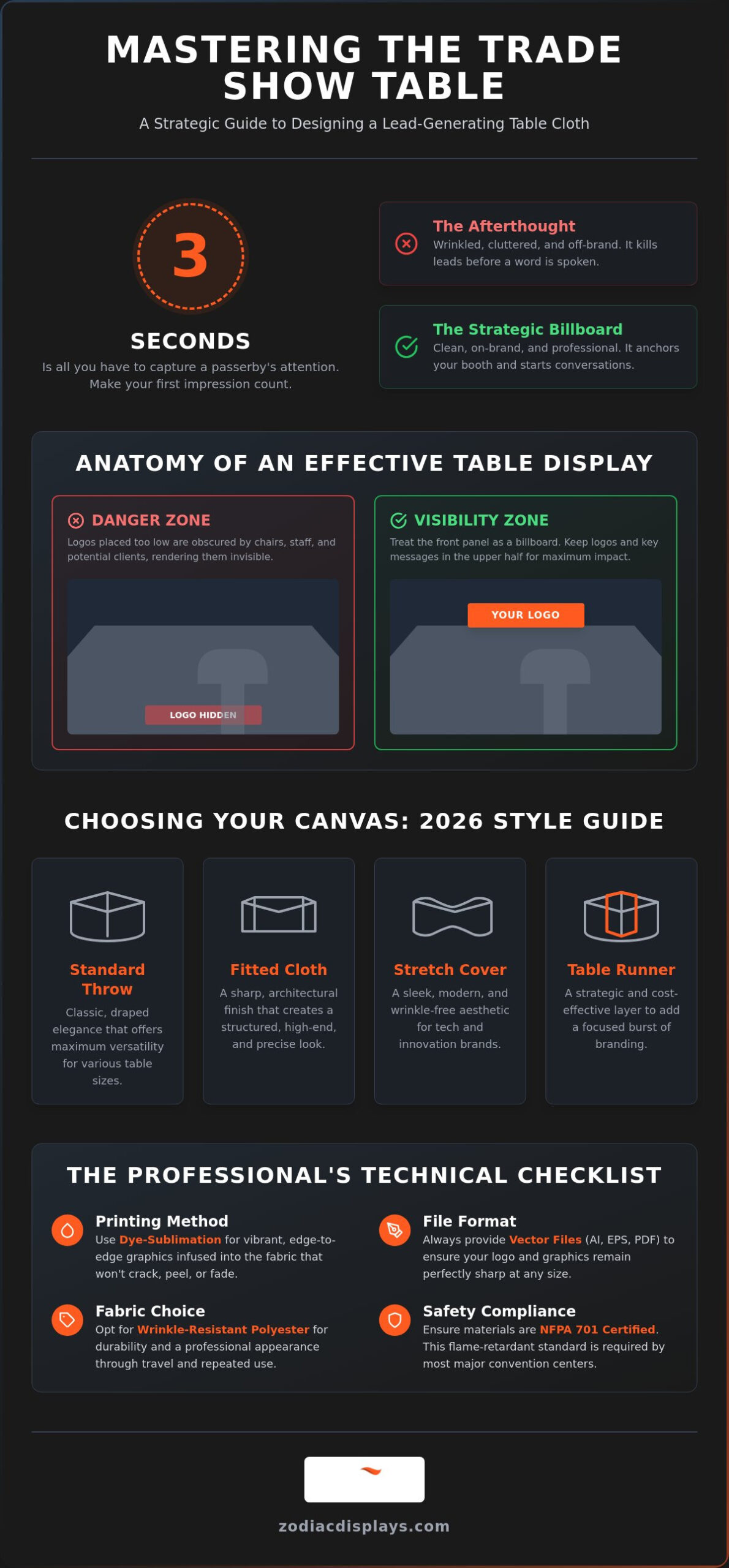
Consider the visual journey of a prospective client. At 20 feet, they see your hanging signs and backwalls. As they close the gap to 3 feet, their focus shifts downward to the interaction zone. This is where the “First Impression Math” takes over. Research from the Trade Show News Network indicates that strong visual branding is a key factor influencing booth engagement. You have roughly 3 seconds to convince a passerby to stop. If your table cloth is wrinkled, off-brand, or visually silent, that lead will walk right past you. We move beyond simple “coverage” and focus on “communication” in the foreground.
Identifying Your Primary Visual Goal
Before you open a design file, you must define the mission. Are you building brand awareness or launching a specific product? A logo-centric design creates a bold anchor for a larger custom trade show display, while product-centric layouts use high-impact imagery to spark immediate curiosity. Applying fundamental graphic design principles ensures your visual hierarchy guides the eye toward your most important message without overwhelming the viewer. Balance is everything; use negative space to let your primary graphics breathe and command attention.
Avoiding the Cluttered Countertop Trap
A beautiful design fails if it doesn’t account for reality. Your table will likely hold laptops, brochures, and giveaway items that can obscure your message. This is why understanding the “Top Surface” perspective is vital. While the front panel acts as your billboard, the top surface is what a visitor sees while they are actually talking to you. Utilizing fitted styles allows you to mask booth logistics and extra inventory underneath the table, keeping your interaction area pristine. A clean, intentional design prevents your brand from looking like a cluttered retail clearance rack. It shows that you are prepared, professional, and precise.
Choosing Your Canvas: Styles and Materials for 2026 Events
Selecting the right canvas is the foundational step in learning how to design a trade show table cloth that resonates with your specific audience. The physical silhouette of your table speaks volumes before a visitor even reads your tagline. Your choice should reflect your brand’s personality, whether you’re aiming for traditional elegance or a futuristic, high-tech vibe.
- Standard Table Throws: These offer a classic, draped elegance that works across various event venues. They are the ultimate chameleons of the trade show floor, providing a professional look even if the provided table is slightly off-size.
- Fitted Table Cloths: These provide a sharp, architectural finish. They hug the table’s corners, creating a boxy, high-end look that signals stability and precision. This style is perfect for brands that value a structured, permanent feel.
- Stretch/Spandex Covers: These are the go-to for tech and innovation brands. They create a sleek, modern, and entirely wrinkle-free aesthetic that looks like it was engineered rather than just draped.
- Table Runners: These serve as a strategic, cost-effective layer. If you have high-quality neutral linens, a custom runner adds a focused burst of branding without the cost of a full-size print.
Fabric Selection and Durability
Quality begins with the thread. For most high-traffic events, wrinkle-resistant polyester is the industry standard because it survives the rigors of shipping, folding, and heavy setup. If you’re looking for that ultra-modern, contoured look, premium stretch fabrics are essential. Safety is never optional; ensure your materials meet NFPA 701 flame retardant standards. Most major convention centers require this certification, and being turned away by a fire marshal is a risk you don’t need to take. If you’re unsure which material best suits your 2026 tour, you can explore our professional-grade fabric options to find your perfect match.
Sizing for Success: 6ft vs. 8ft Standards
A design only looks professional if it fits perfectly. Standard tables are typically 6 feet or 8 feet long, but the height is where many exhibitors stumble. While a standard table sits at 30 inches, many modern networking zones use counter-height tables at 42 inches. Designing for a “convertible” fit is a smart move for brands with a heavy event rotation; these cloths use hidden hook-and-loop systems to adjust from 8 feet down to 6 feet seamlessly. When you are planning how to design a trade show table cloth, always confirm the table dimensions provided by the show decorator to avoid a “high-water” look or excess fabric bunching on the floor. Precision in measurement leads to a polished, premium presentation.
Mastering Logo Placement and Visual Hierarchy
The front panel of your table is your most valuable real estate, often referred to as the “Front Panel Billboard.” When you are determining how to design a trade show table cloth, you must treat this space with the same reverence a luxury brand treats a Fifth Avenue window. It’s the primary point of recognition that bridges the gap between a distant glance and a direct conversation. However, placement is a game of inches, and a miscalculation here can render even the most beautiful logo invisible.
Height is the most critical factor in this equation. Many exhibitors make the mistake of centering their logo vertically on the front drape, only to find it obscured by chairs, display racks, or the inevitable clutter of a busy aisle. Follow the “12-inch Rule” for guaranteed impact. By keeping your critical text and primary logo within the upper third of the drape, roughly 12 inches from the top edge, you ensure your branding remains visible even when people are standing directly in front of the table. This placement keeps your identity above the “debris line” of the floor and the “obstruction zone” of furniture.
Don’t ignore the side panels. While the front panel greets those standing before you, the sides are your invitation to those approaching from the aisles. Strategic side-panel branding captures the attention of attendees long before they reach your booth, maximizing your visibility in a crowded hall. It’s about creating a 270-degree brand experience that feels intentional from every angle. This ensures your message is received whether a visitor is approaching from the left, the right, or the center.
The Golden Zone of Logo Sizing
Calculating the ideal logo width requires a balance of scale and sophistication. For a standard 6-foot table, a logo width of 36 to 48 inches usually provides the best impact without feeling cramped. While the temptation to go as large as possible is strong, a sophisticated design often benefits from breathing room. A logo that touches the edges of the fabric feels amateurish and strained. Centering strategies also differ by style; fitted covers require pinpoint accuracy on the seams, while draped throws allow for a slightly more relaxed orientation that accounts for how the fabric naturally falls.
Top-Surface Branding Strategy
The top surface is an often-overlooked opportunity, especially in venues with mezzanine levels or stadium seating where attendees look down on the show floor. In these scenarios, learning how to design a trade show table cloth with top-surface graphics provides an extra layer of recognition. Consider a “ghosted” or watermark logo for a subtle, textured feel. This approach adds brand depth without competing with the physical products, laptops, or brochures you’ll place on the table during the event. It ensures that even the surface your visitor interacts with is a deliberate extension of your creative vision.
Designing for Large Format: Colors, Resolution, and Files
Achieving a flawless finish requires a shift from standard desktop publishing to large-format precision. When you’re learning how to design a trade show table cloth, the technical specifications are just as vital as the creative vision. A stunning concept will fail if it’s rendered in low resolution or uses the wrong color profile. We treat every file as a blueprint for professional excellence, ensuring the transition from your screen to the fabric is seamless and vibrant.
- Vector vs. Raster: Your logo should always be in .EPS or .AI format. Unlike raster images like .JPG or .PNG, which pixelate and blur when enlarged, vector graphics are based on mathematical paths that maintain perfect clarity at any scale.
- Dye-Sublimation Printing: This advanced method infuses the ink directly into the polyester fibers rather than just sitting on top. It results in vibrant, full-color graphics that are resistant to fading, peeling, and cracking, even after multiple washes.
- Resolution Requirements: If your design includes photography, the images must be at least 150 DPI at 100% of the final print size. Anything lower will appear soft or blocky on a six-foot span.
- Color Profiles: While monitors use RGB, printing uses CMYK. For absolute brand consistency, provide Pantone (PMS) matching codes to ensure your signature brand colors remain accurate across different lighting conditions.
Color Theory for High-Traffic Environments
Contrast is king when you’re competing for attention in a crowded convention hall. A sophisticated palette is useless if your text disappears into the background. Use high-contrast pairings to ensure your message is legible from 30 feet away. The psychology of color also plays a role; blues and greens evoke trust and stability, while oranges and reds signal high energy and urgency. Be mindful of color bleed in large-format printing; overly saturated dark colors can sometimes soften the edges of fine white text, so give your elements room to breathe.
Preparing Your Design Files for Fabrication
Precision at the setup stage prevents expensive errors during production. Always use the specific template provided for your chosen table cloth style to account for seams and drape. Bleed is the area beyond the trim line to ensure ink reaches the very edge. Ensure all fonts are converted to outlines to prevent missing character errors when the file moves to our fabrication team. By following these rigorous standards, you guarantee a result that reflects your brand’s commitment to quality. If you’re ready to see your vision rendered with professional precision, reach out to our creative team today to begin your fabrication journey.
Executing Your Vision with Zodiac Event Displays
Mastering how to design a trade show table cloth is only half the battle; the other half is finding a partner who can translate that digital precision into a physical masterpiece. At Zodiac Event Displays, we don’t treat your branding as a simple transaction. We view it as a collaborative journey toward your next major success. Our boutique agency approach ensures that every detail, from the vibrancy of your logo to the durability of the final stitch, is managed with the care of a dedicated ally. We act as a seasoned strategist for your brand, providing the flair of a high-end designer with the reliability of an industry expert.
Based in Denver with over a decade of experience, we combine local expertise with a global delivery network. We understand the endurance required for a successful event season and the pride that comes with a well-executed presentation. Whether you’re exhibiting at a local boutique expo or a massive international convention center, our team ensures your display arrives on time and looking flawless. We position ourselves as an essential extension of your own creative team, guiding you through complex fabrication processes with steady confidence.
From Creative Concept to Fabrication
Our process begins with a meticulous audit of your brand assets. We don’t just print what you send; we optimize it for the unique requirements of soft signage. Our team ensures your vector files are perfect and your color profiles match your existing marketing collateral. This level of detail is especially critical when you’re integrating your foreground branding with larger assets like custom event tents for outdoor consistency. We manage the entire timeline, from initial design consultation to production and global shipping, so you can focus on your lead generation strategy instead of logistics.
Elevate Your Next Event
High-impact branding is a long-term investment in your company’s growth and visibility. While a well-executed table cloth is the anchor of your interaction zone, it’s most effective when it’s part of a cohesive visual narrative. You might consider pairing your table graphics with custom flag banners to create vertical height that captures attention from across the hall. This layered approach creates a comprehensive brand environment that feels polished, professional, and inviting. When you’re ready to learn more about how to design a trade show table cloth that turns heads, Contact Zodiac Event Displays to start your project. We’re here to turn your bold vision into a vibrant reality.
Command the Floor with High-Impact Foreground Branding
Your trade show table is more than a display surface; it’s the specific point where your brand’s vision meets the visitor’s curiosity. Prioritizing visual hierarchy and mastering the technicalities of how to design a trade show table cloth ensures your brand stands out in the most crowded convention halls. From sleek stretch covers to tailored fitted cloths, your commitment to high-resolution graphics turns your booth into a lead-generating billboard.
Zodiac Event Displays brings over 10 years of large-format expertise to your creative team. We provide boutique agency design support to refine your assets and leverage global delivery capabilities to reach any venue worldwide. We’re your partner in professional growth and visual excellence, ensuring your brand makes a lasting impression from the first second an attendee looks your way.
Elevate Your Brand with Custom Table Cloths from Zodiac
Your next event is the perfect stage for your brand’s evolution. We’re ready to help you command the floor with confidence and style.
Frequently Asked Questions
What is the best material for a trade show table cloth?
Wrinkle-resistant polyester is the industry gold standard for high-traffic events. It offers the perfect balance of durability and visual vibrancy while remaining machine washable for long-term use. For brands seeking a more modern, architectural aesthetic in 2026, premium stretch fabrics provide a sleek, wrinkle-free finish that looks engineered for precision.
How do I choose between a 6ft and 8ft table cover?
You should match the cover size to the standard table length provided by your event venue. If you frequently rotate between different booth sizes, a “convertible” table cloth is your most strategic choice. These versatile assets use hidden hook-and-loop fasteners to adjust from an 8ft throw down to a 6ft fit, ensuring a professional look at every show.
What file format do I need for a custom printed table cloth?
Vector file formats like .EPS, .AI, or high-resolution .PDF are essential for large-format printing. These files allow our team to scale your graphics to a massive size without any loss of clarity or pixelation. When you are learning how to design a trade show table cloth, remember to convert all fonts to outlines to ensure your typography remains perfectly intact during fabrication.
Can I wash my custom trade show table cloth?
Yes, professional-grade polyester cloths are designed for easy maintenance and are machine washable. We recommend using a cold, gentle cycle and hanging the fabric to dry to protect the integrity of the dye-sublimation ink. This simple care routine ensures your display remains crisp and professional for years of successful event rotations.
Where should I place my logo on the table cloth for maximum visibility?
Your primary logo should occupy the “Front Panel Billboard,” specifically within the top 12 to 15 inches of the drape. This strategic placement keeps your brand identity above the “obstruction zone” of chairs and floor-level clutter. Proper vertical alignment is a critical factor in how to design a trade show table cloth that captures attention from across the convention hall.
What is the difference between a table throw and a fitted table cover?
A table throw offers a classic, draped look that provides maximum versatility across slightly different table sizes. In contrast, a fitted table cover is sewn to the exact dimensions of the table, creating a sharp, boxy silhouette that feels permanent and high-end. While throws are more flexible for varying venues, fitted covers offer a sophisticated, architectural finish for premium booth designs.
How long does it take to manufacture a custom branded table cloth?
Standard production typically takes between 3 to 7 business days once your artwork is approved and the design is finalized. Because we act as a creative partner managing the process from file to final stitch, we can often coordinate with your event schedule for reliable delivery. Always factor in shipping times to your specific convention center to ensure your booth is ready for opening day.
Do I need a special table for a stretch spandex cover?
No, stretch covers are designed to fit standard 6ft or 8ft folding tables found at most event centers. They utilize reinforced pockets that hook under the table legs to create a tension-backed, wrinkle-free surface. This style is incredibly popular for tech and innovation brands because it creates a futuristic, contoured aesthetic without requiring specialized furniture.

 Previous reading