What if your event’s most memorable brand moment started above the crowd? A giant inflatable advertising balloon can give a campaign striking visibility, but size alone isn’t enough. Its shape, message, and placement need to work together so people can recognize your brand from the right distance and in the right setting.
A bold inflatable can help an activation stand out. The challenge is choosing a form and scale that suit your audience and venue, while keeping the artwork easy to read and setup practical. This guide covers how to make those decisions, from the first creative idea to event-day logistics.
Explore how to match an inflatable’s design to your brand and campaign, prepare artwork for production, and plan placement, anchoring, transport, and setup. Zodiac Event Displays provides custom inflatables and supports projects from concept and design through print, fabrication, and delivery.
Key Takeaways
- A giant inflatable advertising balloon can act as a visual landmark, helping your brand stand out at launches, festivals, storefronts, and public-facing events.
- Match the balloon’s shape and scale to the campaign setting, then build the artwork around one clear message and a recognizable brand mark.
- Compare inflatable concepts by campaign goal, viewing distance, venue, message, and transport needs to find a practical fit.
- Plan venue access, sightlines, placement, and event timing before production, then follow product instructions and venue requirements during setup.
- A coordinated process from campaign brief through design, production, and delivery helps bring a custom inflatable concept to life.
What Is a Giant Inflatable Advertising Balloon, and What Can It Do for a Brand?
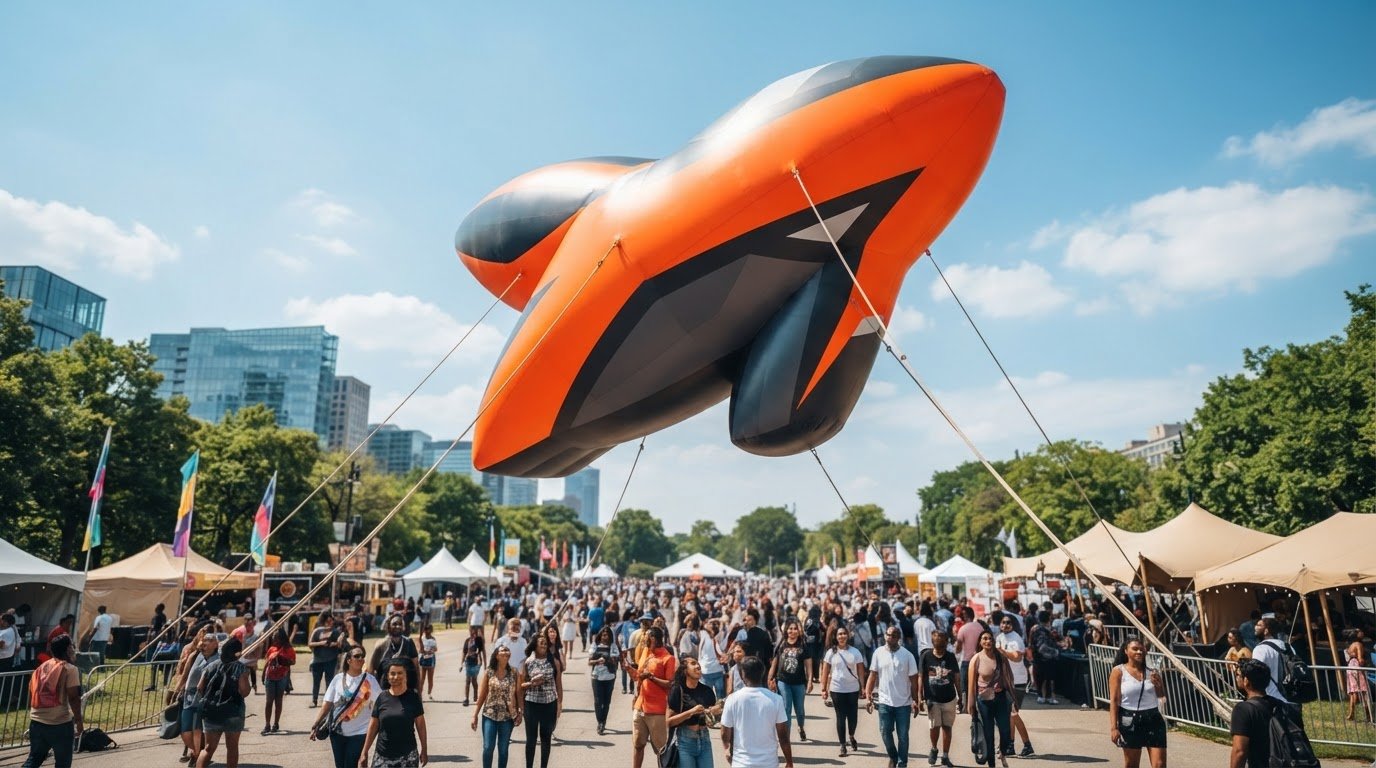
A giant inflatable advertising balloon is a large custom inflatable designed to make a branded message visible in a busy setting. Its scale can turn it into a visual landmark at a product launch, festival, storefront, or other public-facing event. Unlike a balloon used simply as decoration, a branded inflatable has a campaign purpose: helping people notice a brand, find a location, or recognize an activation.
Its impact depends on more than size. The design needs to suit the audience and surroundings, and the message should remain clear at the distance people are likely to view it. Effective event visibility comes from aligning an inflatable’s scale and placement with a concise, legible brand message.
That makes it one option within the wider world of out-of-home promotion. Outdoor advertising, also known as out-of-home advertising (OOH), encompasses various formats, including inflatables. The useful question for a campaign isn’t simply whether an inflatable can be large. It’s whether that visual presence supports the experience you want to create.
Which events benefit from a giant branded inflatable?
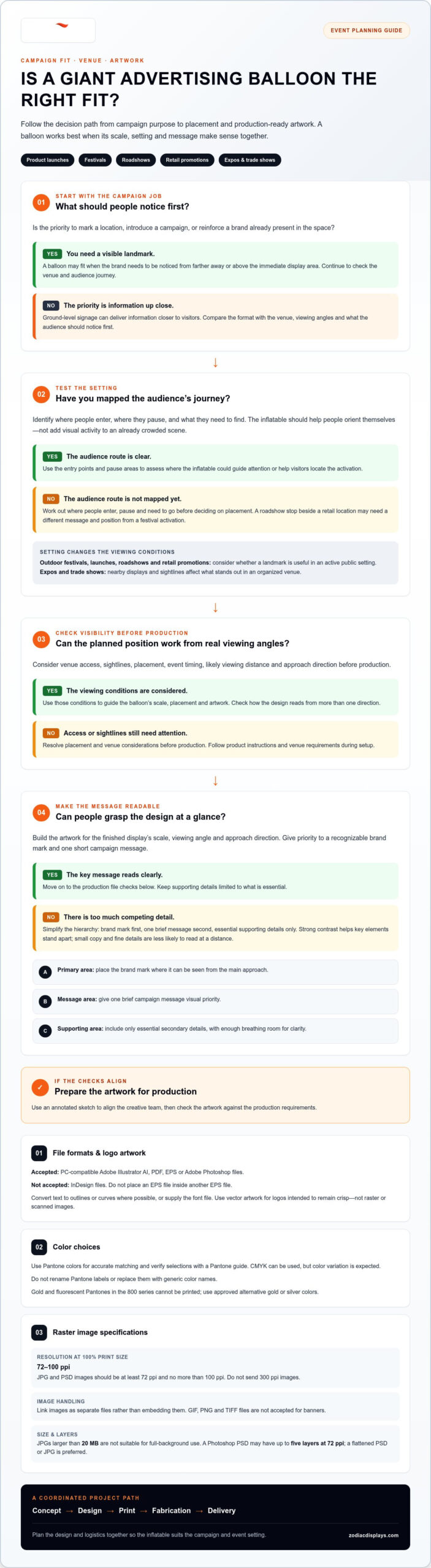
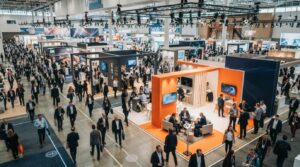
Outdoor festivals, product launches, roadshows, and retail promotions can benefit when attendees need an easy-to-spot landmark in an active public setting. Positioned thoughtfully, an inflatable can help visitors locate an activation or recognize a brand area. At an expo or trade show, the goal may be to catch the attention of a focused audience in an organized venue, where nearby displays and sightlines affect what stands out.
Start with the audience’s journey. Consider where people enter, where they pause, and what they need to find. A landmark is more useful when it helps people orient themselves, rather than adding visual activity to an already crowded scene. A roadshow stop beside a retail location, for example, may call for a different message and placement than a festival activation.
What makes an advertising balloon different from other inflatables?
A balloon is one custom inflatable format, not a universal solution for every campaign. Its visual presence may work well when a brand needs to be noticed from farther away or from above the immediate display area. Ground-level signage, by contrast, can deliver information closer to visitors as they approach. The right choice depends on the venue, viewing angles, and what the audience should notice first.
Consider the job the inflatable needs to do before choosing a format. Is the priority to mark a location, introduce a campaign, or reinforce a brand already present in the space? Those goals may call for different visual approaches. If you’re weighing a balloon against other inflatable formats, the broader custom inflatables guide can help you explore options for your event.
The strongest concept feels like part of the campaign, not a standalone novelty. When the form suits the setting and the message is easy to grasp at a glance, the inflatable can guide attention and give the event a distinctive visual anchor.
How Shape, Scale, and Brand Artwork Create a Readable Balloon
A bold shape earns attention, but the artwork has to deliver the message. Picture where people will see the balloon: across an open event space, while approaching a venue, or from a nearby viewing area. Use that distance to guide logo size, word count, and contrast between lettering and background. Plan artwork for the finished display’s real viewing conditions, including its scale, viewing angle, and approach direction.
Keep the visual hierarchy simple. Lead with a recognizable brand mark and one short message, such as a product name or campaign phrase. Supporting details may make sense up close but become visual noise from farther away. Strong contrast helps separate key elements, while small copy and fine details are less likely to read clearly at a distance.
A quick annotated sketch can align the creative team before artwork is finalized:
- Primary area: Place the brand mark where it can be seen from the main approach.
- Message area: Give one brief campaign message visual priority.
- Supporting area: Include only essential secondary details, with enough breathing room to preserve clarity.
Use the sketch to test how the design reads from more than one direction. It’s a planning aid, not a substitute for the production template.
Prepare artwork for production
File preparation is part of the design, not an afterthought. Zodiac accepts PC-compatible artwork in Adobe Illustrator AI, PDF, EPS, or Adobe Photoshop formats. InDesign files aren’t accepted. Convert text to outlines or curves where possible, or supply the font file. Logos intended to remain crisp should be vector artwork, not raster or scanned images. Never place an EPS file inside another EPS.
Color choices need equal care. Use Pantone colors for accurate matching and verify selections with a Pantone guide. CMYK can be used, but color variation is expected. Don’t rename Pantone labels or replace them with generic color names. Gold and fluorescent Pantones in the 800 series can’t be printed, so use approved alternative gold or silver colors.
For raster images, photos, JPG, and PSD files should be at least 72 ppi and no more than 100 ppi at 100% print size. Don’t send 300 ppi images. Link images as separate files rather than embedding them, and don’t submit GIF, PNG, or TIFF files for banners. JPGs larger than 20 MB aren’t suitable for full-background use. A Photoshop PSD may have up to five layers at 72 ppi; a flattened PSD or JPG is preferred. Keep line thickness at least 0.1 inches, and allow 0.7 to 3 inches of bleed depending on the product. Follow the product template for the applicable bleed, and don’t flatten template markings, which are for reference only.
Placement and artwork planning can also intersect with local requirements. The federal regulations address characteristics of outdoor advertising; the cited rule applies in its defined context, so don’t assume it covers every event display. For a coordinated path from concept to finished branded display, explore Zodiac Event Displays’ custom event branding.
How to Compare Giant Inflatable Balloons for Your Event
The best format supports the campaign and fits the space, not automatically the biggest one available. A giant inflatable advertising balloon can create a striking focal point, but impact depends on clear branding and suitable placement as much as scale. Compare ideas against the audience’s route, available space, viewing angles, and event-day handling before settling on a concept.
Which display format suits the campaign goal?
For recognition from farther away, consider a balloon concept with a simple silhouette and concise brand message. If the campaign centers on a specific product, a custom-shaped inflatable may make that story more immediate. At booth level, weigh an overhead focal point against ground-level event signage, such as flags or a backwall display, which can speak to visitors as they approach.
Use the comparison to test event fit
Compare each concept in context. A format that feels prominent in an open outdoor setting may play a different role in an indoor expo with limited space or competing sightlines. Consider audience flow, viewing distance, access for delivery and setup, and how the display will be transported between locations. These practical factors help narrow the creative options without assuming one format fits every venue.
| Campaign goal | Format concept | Setting and viewing distance | Message | Transport needs |
|---|---|---|---|---|
| Help people recognize a brand or find an event area | Balloon-style inflatable focal point | Consider open sightlines and how far away attendees will first see it | Brand mark and one concise phrase | Plan space for packed materials, venue access, and event-day handling |
| Make a featured product central to the story | Custom-shaped inflatable concept | Assess whether the venue gives the shape room to read clearly | Keep product identity and campaign message easy to understand | Account for the concept’s overall handling and transport requirements |
| Engage visitors at a booth or activation | Balloon focal point paired with ground-level signage | Map approach routes, nearby displays, and available space | Use the focal point to attract attention and signage for closer detail | Coordinate delivery and setup for each display in the campaign |
A distinctive custom concept can give a campaign an individual visual signature, while a familiar form may communicate its role quickly. The trade-off is not simply novelty versus simplicity: a distinctive design still needs to be recognizable at the intended distance, and a familiar format still needs clear brand treatment. Sketch the proposed placement and viewing routes before choosing the final scale.
For a broader look at format options and how they can support different event goals, explore the custom inflatables resource. Use that perspective to select a concept that fits the campaign, venue, audience, and transport plan.
Plan Placement, Setup, and Event-Day Use Before Production
A striking concept only works if it fits the site and can be managed on the day. Before production begins, map out where the inflatable will go, how it will arrive, who will oversee setup, and what conditions may affect its use. Early coordination helps align the design with the venue and reduce last-minute changes to the event plan.
Use this pre-production checklist to turn the idea into a practical plan:
- Confirm the venue. Identify whether the display is indoors or outdoors, and clarify site-specific restrictions, required approvals, and designated setup times.
- Select the placement. Choose a location that supports the campaign goal and doesn’t obstruct entrances, walkways, exits, or other event activity.
- Review sightlines and clearance. Consider what attendees will see as they approach, and account for overhead clearance and nearby structures or obstacles.
- Plan access. Map the route from the delivery point to the display location, including limitations that could affect moving materials into position.
- Coordinate transport and storage. Plan around the project’s packing details, vehicle, storage space, and event-site access.
- Set the event schedule. Assign setup and removal times, name a responsible event-day lead, and coordinate the plan with the event’s operating hours.
Coordinate placement and people with the venue
Share the intended display location and setup plan with the venue team early. Confirm restrictions that affect placement, overhead clearance, access routes, or attendee movement. A display should help people identify an event area without narrowing a route or disrupting normal flow. Agree on who is responsible for setup, who oversees routine visual checks, and how the team will respond if venue guidance or conditions change.
Prepare for transport and changing conditions
Transport planning starts with the project’s packing details, not assumptions about a generic inflatable. Make sure the team knows where materials will be received, stored, and moved. Assign a lead familiar with the product-specific operating instructions to coordinate setup and routine checks. Monitor weather for outdoor use, and secure or stop using the display as directed by the manufacturer and event site.
Safe event use depends on following the product’s operating instructions and the venue’s rules. Don’t rely on a general wind threshold, weather rating, power requirement, or operating duration to make a decision. Those details must come from guidance for the specific product and site. If conditions change, the event-day lead should follow that guidance and any venue direction before continuing to use the inflatable.
Planning placement, access, transport, and schedule before production gives the creative concept a stronger operational foundation. To develop a custom inflatable around your event setting and setup needs, plan your custom inflatable with Zodiac Event Displays.
Zodiac’s Design-to-Delivery: Custom Branded Inflatables
A successful custom inflatable starts with more than an eye-catching idea. It needs to express the campaign, suit the event environment, and move smoothly from creative direction into production. Zodiac Event Displays brings concept, design, print, fabrication, and delivery together, creating a connected path from early planning to a finished branded display. With over ten years of experience in soft signage and event branding, the team works collaboratively rather than treating a giant inflatable advertising balloon as a one-size-fits-all solution.
What information helps shape a custom inflatable brief?
A useful brief gives the design team the context to build a strong concept. Gather the campaign objective, target audience, venue details, event dates, and available brand assets. Note the primary message, preferred visual direction, and intended placement so the design can respond to how attendees will encounter the display. If you’re still developing the concept, share the essentials with the design team and discuss how the idea can become production-ready artwork.
Before design development, organize the project details that will guide decisions:
- Campaign purpose: Describe what the inflatable should help attendees notice, recognize, or find.
- Audience and setting: Explain who will see it and whether the event is indoors, outdoors, or moving between locations.
- Brand materials: Gather logos, brand guidelines, approved colors, and existing campaign artwork.
- Practical context: Share the planned location, event dates, access considerations, and delivery destination.
This preparation keeps the creative conversation grounded. It also gives the team a clear basis for balancing visual ambition with the realities of the venue and campaign.
What happens from design approval through delivery?
Once the brief is established, Zodiac’s design team can develop the visual direction and prepare production-ready artwork. The project then moves through print and fabrication, guided by the approved concept. Delivery completes the process, connecting the finished inflatable with its intended event use. Zodiac provides global delivery for branded event projects.
Each stage builds on the previous one: the campaign brief informs the concept, the approved design guides production planning, and the production plan carries the project through fabrication and delivery. Keeping the event setting and intended use visible throughout helps maintain a clear link between the original brand goal and the finished display. For an inflatable that needs to fit into a wider event campaign, this coordinated workflow keeps creative and production considerations connected.
Have a campaign in mind? Start a custom event branding conversation with Zodiac Event Displays and discuss how a branded inflatable can support your event.
Turn Your Campaign Idea Into a Bold Brand Moment
Give your next event a visual signature people can recognize and remember. Before moving into design, write a simple creative brief: what the audience should notice, where they’ll encounter the display, and what impression you want the brand to leave. That focus gives your giant inflatable advertising balloon a purpose beyond its scale and helps shape a concept that belongs in the setting.
Bring your campaign idea and event context into a collaborative planning conversation. A clear starting point makes it easier to explore creative directions and build a branded display around your goals. Zodiac Event Displays has supported event branding for clients including Mercedes-Benz, Tito’s Vodka, and Garmin.
Ready to give your event a distinctive visual presence? Start planning a custom branded inflatable with Zodiac Event Displays and take the first step toward a display shaped around your brand.
Frequently Asked Questions
What is a giant inflatable advertising balloon?
A giant inflatable advertising balloon is a large custom display that carries a brand or campaign message to attract attention at an event or commercial location. Its role depends on the design, placement, audience, and venue. A display meant to identify a branded area should make that location easy to recognize, while one supporting a campaign can emphasize its central message. Keep it visually connected to the surrounding event.
Are giant inflatable advertising balloons suitable for indoor and outdoor events?
They may be suitable in either setting, depending on the specific inflatable, its operating instructions, and venue conditions. An indoor convention hall and an outdoor retail event present different questions about space, overhead clearance, access, and display rules. Coordinate the setup with the venue before deciding where and how to use the display. Don’t assume an inflatable designed for one situation is appropriate for another, or that a venue’s general display policy covers every setup detail.
How do you design a giant inflatable balloon with a company logo?
Start by defining the campaign goal, audience, venue, and likely viewing distance, then make the logo the central visual anchor. Add one short message only if it strengthens the campaign idea. For production, Zodiac accepts PC-compatible Adobe Illustrator AI, PDF, EPS, and Adobe Photoshop artwork. Pantone colors help with accurate matching; if you use CMYK, expect color variation. A vector logo is a strong starting point for clear reproduction.
What artwork file formats does Zodiac accept for a custom inflatable?
Zodiac accepts Adobe Illustrator AI, PDF, EPS, and Adobe Photoshop files, and artwork must be PC-compatible. InDesign files aren’t accepted. Convert text to outlines or curves, or supply the font file, with outlined text preferred. Keep linked images separate rather than embedding them. Raster photos, JPG, and PSD images should be at least 72 ppi and no more than 100 ppi at 100% print size. Follow the product-specific bleed requirements for the final layout.
How should you prepare a giant inflatable for an event?
Prepare by turning the event plan into a site-specific operating plan for the giant inflatable advertising balloon. Identify who will receive and move the packed display, who will oversee setup, and who will check it during use. Keep the manufacturer’s operating instructions available to that lead, and align setup with venue directions. For outdoor use, monitor conditions and follow the product and event-site guidance on whether to secure or stop using the display.
Can a giant advertising balloon be customized to match a brand?
Yes. A custom inflatable project can be developed around a brand identity, campaign message, and event setting. Share the approved logo, brand guidelines, and campaign materials so the design direction stays consistent with other event elements. For example, a brand may want its familiar visual identity to carry through from a campaign display to the surrounding event environment. Zodiac provides design support through concept and artwork as part of its event branding work.
How do I start a custom giant inflatable project with Zodiac?
Begin with a short project brief covering the campaign objective, audience, venue, event dates, intended placement, and message the display should communicate. Gather available logos and brand assets, along with practical details such as access or transport considerations. Zodiac can guide the project from concept and design through print, fabrication, and delivery. Sharing event context at the outset helps the team shape the creative direction around how the inflatable will be used.
 Previous reading