


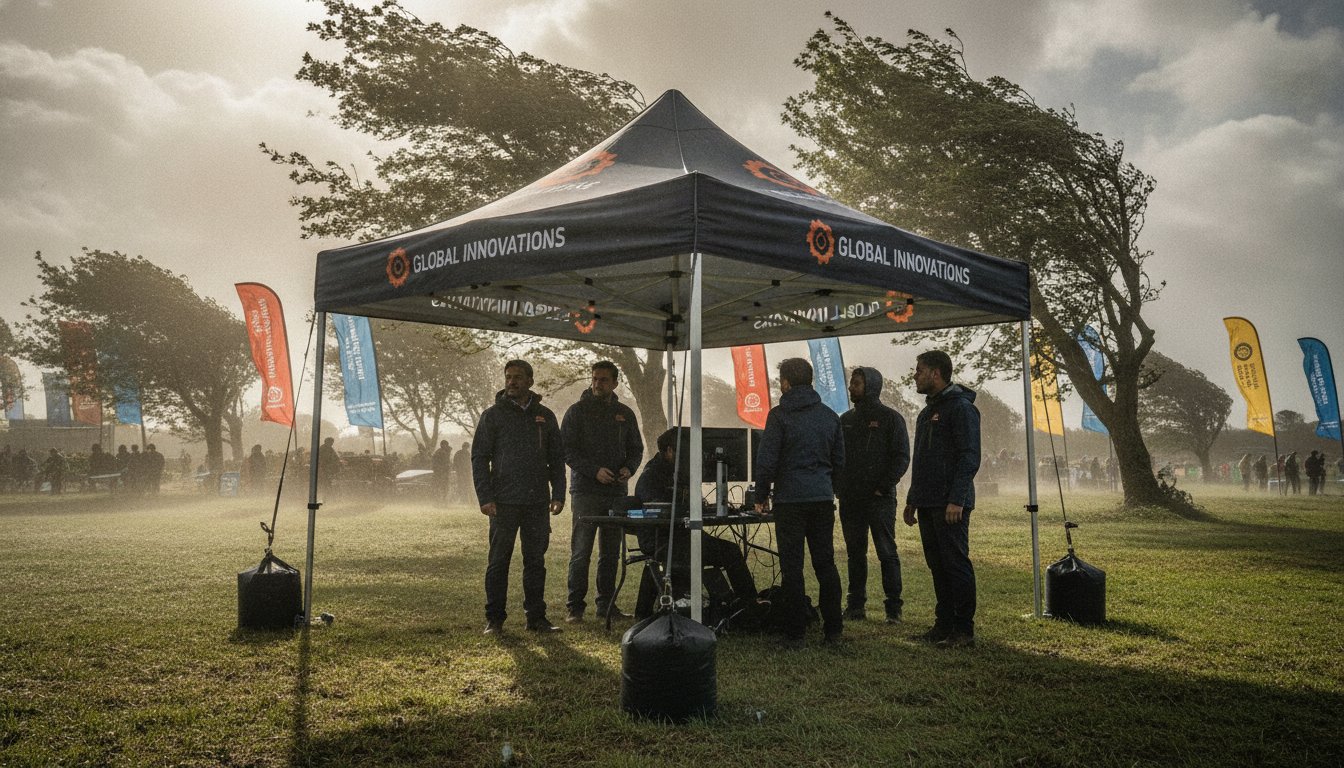
Picture this: your branded canopy tent is the centerpiece of a high-traffic outdoor event, drawing eyes and building credibility with every passerby. Then a gust rolls through, and in seconds, a flimsy frame buckles, a canopy billows skyward, and your brand’s carefully crafted image goes with it. It’s a scenario that keeps serious event marketers up at night, and it’s entirely preventable when you know exactly what to look for in a wind-resistant canopy tent.
You already know that not all canopy tents are created equal. The big-box store options that look tempting on a budget rarely survive the unpredictable conditions of real-world events, and the cost of replacing damaged equipment or recovering from a public safety incident far outweighs any upfront savings. That frustration is valid, and it’s shared by every professional who has watched a flimsy structure embarrass their brand on the field.
This guide cuts straight to the engineering details and anchoring strategies that actually matter. From frame geometry and hardware ratings to ground-anchor systems and fabric tension, you’ll walk away with a professional-grade checklist that ensures your tent stays grounded, your team stays safe, and your brand presence stays commanding, even when the wind has other plans.
Key Takeaways
- Knowing what to look for in a wind-resistant canopy tent goes beyond basic specs — true stability is a engineered combination of frame rigidity, fabric tension, and a properly rated ballast system working in unison.
- Frame material and leg geometry are the foundation of structural endurance, and understanding why hexagonal or octagonal profiles outperform traditional square legs can mean the difference between a commanding presence and a costly collapse.
- Your anchoring strategy must match your surface — stakes, weights, and ballast requirements differ significantly between grass, asphalt, and sand, with professional events often demanding 40–60lbs of ballast per leg.
- Fabric denier and peak ventilation design are critical performance factors that protect both your structure and your print investment when wind pressure builds across the canopy.
- A boutique partner like Zodiac Event Displays brings over a decade of fabrication expertise to the table, translating your creative vision into a durable, high-impact structure built for real-world event conditions — and delivered globally.
Beyond the Breeze: Why Professional Wind Resistance is Critical for Brand Integrity
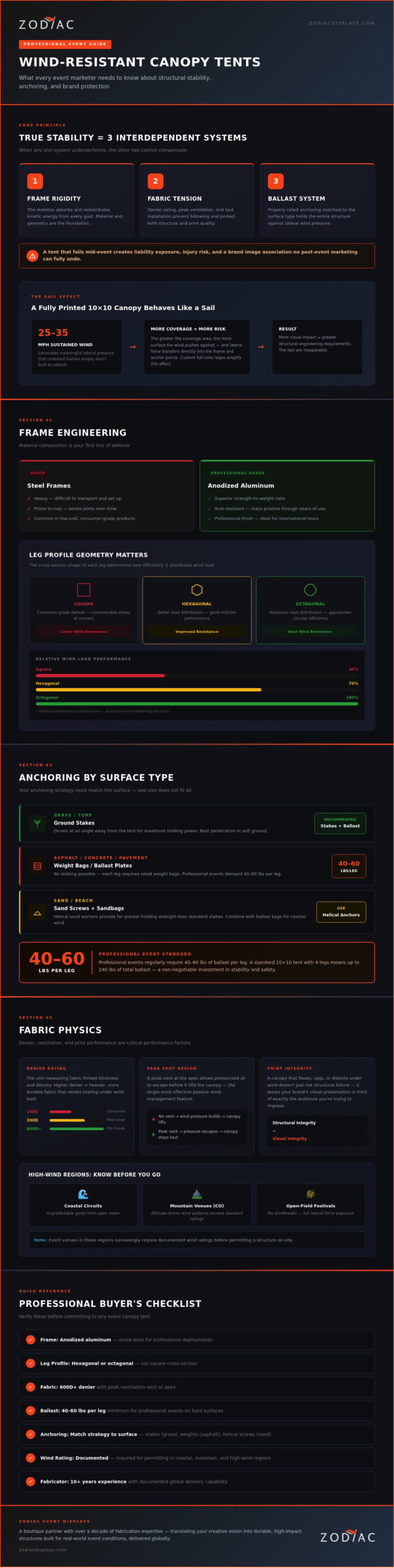
Wind resistance isn’t a single feature you can check off a spec sheet. True structural stability is a engineered relationship between three interdependent systems: frame rigidity, fabric tension, and a properly rated ballast system. When any one of those systems underperforms, the other two can’t compensate. That’s the engineering reality that separates professional-grade event tents from the kind that make headlines for the wrong reasons.
The hidden cost of a collapse goes well beyond replacing hardware. A tent that buckles mid-event creates immediate liability exposure, potential injury risk to staff and attendees, and a brand image association that no amount of post-event marketing can fully undo. Event organizers who witness a structural failure don’t just remember the tent; they remember the brand attached to it. Understanding what to look for in a wind-resistant canopy tent is, at its core, a brand protection strategy.
The Psychology of Stability at Events
A rigid, commanding setup communicates competence before a single word is spoken. Attendees make split-second judgments about credibility, and a taut, perfectly tensioned canopy signals investment and professionalism. Contrast that with a visibly swaying frame or a canopy that ripples and billows under light wind: the “budget tent” look undermines trust instantly, regardless of what’s printed on the fabric.
Large branded surfaces introduce a specific aerodynamic challenge worth understanding. A fully printed 10×10 canopy doesn’t behave like an open-frame structure; it behaves like a sail. The greater the coverage area, the more surface area the wind has to push against, and the more lateral force transfers directly into the frame and anchor points. Custom graphics and full-color logos amplify this effect, which means the more visually impactful your branding, the more critical your structural engineering needs to be.
Wind Load and Structural Responsibility
In 2026 industry practice, wind load on a canopy tent is defined as the total force exerted by moving air on a structure’s projected surface area, measured in pounds per square foot and calculated against the tent’s geometry, height, and fabric coverage. For a standard 10×10 structure, even moderate sustained winds in the 25-35 mph range generate meaningful lateral pressure that untested frames simply aren’t built to absorb.
This matters acutely in high-wind regions. Coastal event circuits, mountain venues in Colorado, and open-field festivals regularly expose tents to conditions that exceed what most consumer-grade products are designed to handle. Event venues in these regions increasingly require documented wind ratings before permitting a structure on-site. Knowing what to look for in a wind-resistant canopy tent means understanding not just the product specs, but the regulatory environment of every market you’re activating in.
Your custom graphics represent a significant print investment. A canopy that flexes, sags, or distorts under wind pressure doesn’t just risk structural failure; it warps the visual presentation of your brand in real time, in front of exactly the audience you’re trying to impress. Structural integrity and visual integrity are inseparable.
The Engineering of Endurance: Frame Materials and Leg Geometry
When considering what to look for in a wind-resistant canopy tent, the frame’s material composition is your first line of defense. The skeleton of your display must do more than just hold up fabric; it must absorb and redistribute the kinetic energy of every gust. While steel frames are common in the recreational market due to their low cost, professional event marketers almost exclusively pivot toward high-grade aluminum. Steel is heavy and prone to rust, which can seize joints and weaken the structure over time. Anodized aluminum offers a superior strength-to-weight ratio and a polished, professional finish that remains pristine through years of international tours.
Wall thickness is the silent indicator of a tent’s true survival rating. Most “big box” tents utilize 1.5mm or thinner tubing, which can fold like paper under the leverage of a 10×10 canopy acting as a sail. Professional frames move into the 2.0mm to 2.5mm range. This extra thickness provides the rigidity needed to prevent the frame from bowing inward when the wind hits the side walls. Combined with internal cross-truss reinforcement, these thicker profiles ensure that the pressure is shared across the entire architecture rather than concentrating on a single stress point.
Aluminum Excellence for Modern Brands
Modern event strategy demands equipment that is both agile and indestructible. Anodized aluminum frames with a 2-inch leg diameter provide a massive, stable footprint that immediately signals quality to your audience. These frames don’t just look better; they’re designed for the endurance required for professional success. To keep these high-performance structures at peak readiness, it’s vital to maintain the moving parts. High-impact nylon or cast-aluminum joints should be kept clean of grit and salt to ensure they don’t weaken or seize, preserving the fluid setup and teardown your team relies on.
If you’re planning a complex tour and need a partner who understands these technical nuances, the team at Zodiac Event Displays can help you select the exact frame geometry your environment demands.
Geometric Stability: Hexagonal vs. Square
Geometry is the secret language of wind resistance. Traditional square legs have only four sides to manage lateral force, making them susceptible to buckling at the corners. Hexagonal and octagonal profiles increase the number of facets, which naturally dissipates stress around the leg rather than letting it build up on a single flat surface. This shape also provides more surface area for the internal sliding components, creating a tighter fit that eliminates the “frame rattle” common in cheaper models.
The center peak pole also plays a critical role in this geometric dance. A spring-loaded or reinforced peak pole maintains constant upward tension on the canopy, preventing water from pooling and, more importantly, stopping the fabric from flapping. While square legs are prone to twisting under lateral pressure, hexagonal profiles distribute torque across multiple facets to maintain structural alignment in high-velocity gusts. This precision engineering ensures your visual investment stays upright and impactful, regardless of the weather’s unpredictability.
Strategic Stability: Advanced Anchoring Systems and Ballast
A high-performance frame is only as effective as its connection to the earth. When investigating what to look for in a wind-resistant canopy tent, your anchoring strategy should be treated with the same level of technical scrutiny as the frame geometry itself. Even the most rigid aluminum structure becomes a liability if it isn’t properly ballasted against the lift generated by a 10×10 canopy. Professional event success depends on a ground game that accounts for surface type, wind velocity, and pedestrian safety simultaneously.
The “40lb Rule” serves as the industry’s baseline for professional safety. While recreational users might rely on thin metal pegs, seasoned event strategists know that most venues now require a minimum of 40 to 60 pounds of ballast per leg. This weight isn’t just a suggestion; it’s a calculated countermeasure against the physics of wind load. On grass, heavy-duty steel stakes driven at a 45-degree angle provide exceptional pull-out resistance, but on asphalt or concrete, you must transition to “dead weights” that use gravity alone to maintain structural integrity.
Professional Ballast Solutions
Aesthetics matter as much as endurance in a high-impact brand presentation. Interlocking iron weights are the gold standard for modern activations because they provide a clean, low-profile look that sandbags simply can’t match. These weights stack neatly around the hexagonal legs of your tent, creating a seamless visual transition from the hardware to the ground. This approach also minimizes trip hazards for your guests, keeping the focus on your brand rather than a cluttered setup. For maximum stability, guy lines should be deployed from the peak of the frame to secondary anchor points, using high-visibility tensioners that keep the canopy taut without creating an obstacle course for attendees.
Anchoring for High-Impact Signage
Your tent often serves as the hub for a larger ecosystem of visual tools. Integrating accessories like custom flag banners into your setup adds height and movement, but it also creates additional wind drag. These flags should be secured using specialized frame mounts that distribute the lateral force into the heavy-duty legs rather than pulling on the fabric. This synergy between the tent and its accessories ensures your entire display remains a cohesive, grounded unit.
For multi-day outdoor festivals, a rigorous safety checklist is your best defense against unpredictable shifts in weather. This includes:
- Daily Tension Checks: Confirming that guy lines haven’t loosened due to fabric stretch or ground settling.
- Weight Verification: Ensuring that ballast hasn’t shifted or been tampered with during high-traffic periods.
- Surface Assessment: Monitoring for soft ground or pooling water that could compromise stake depth.
When you understand what to look for in a wind-resistant canopy tent, you realize that stability is a proactive choice. It’s about choosing the right tools for the specific environment, ensuring your brand remains a steady, inviting presence regardless of the forecast.
Fabric Physics: Denier, Ventilation, and Print Performance
The fabric of your canopy is more than a shelter; it is the high-visibility canvas for your brand’s message. When evaluating what to look for in a wind-resistant canopy tent, the weight and weave of the material determine whether your graphics remain crisp or become a distorted, flapping mess in a breeze. 600D polyester is the benchmark for professional excellence. This specific denier rating indicates a thread weight that balances structural durability with a smooth surface for high-resolution printing. Lower-grade fabrics often stretch or “bleed” under the high tension required for wind resistance, but a 600D canopy maintains its shape and keeps your logos perfectly legible.
Visual integrity depends on ink bonding and UV resistance. Under the environmental stress of high-wind events, cheaper inks can crack or flake as the fabric flexes. Professional-grade canopies utilize advanced ink bonding processes that ensure your logo remains vibrant and intact, even after repeated deployments in harsh sunlight and gusty conditions. This endurance is a prerequisite for any brand that values a consistent, premium presentation across multiple event seasons.
The Visual Impact of High-Tension Fabric
Precision tensioning is the secret to a professional silhouette. A loose canopy is a liability. It creates constant flapping that generates distracting noise and accelerates mechanical wear on the fabric fibers. This repetitive motion can cause the material to fail prematurely at the stress points where it meets the frame. Professional canopies solve this through reinforced corners and double-stitched seams that allow the fabric to be pulled drum-tight without risking a blowout. This rigidity ensures your branding is always visible from across the event field, rather than being hidden in folds of sagging material. For the most resilient results, heat-transfer printing bonds the ink directly into the fibers, creating a vibrant finish that won’t crack or peel when the fabric flexes.
Ventilation and Airflow Strategies
Managing the “parachute effect” is a critical part of wind-resistant engineering. When a sudden updraft hits an enclosed tent, the pressure needs an escape route to prevent the entire structure from lifting. Peak-mounted wind vents are the most effective solution; they allow internal air pressure to release while maintaining the shade and weather protection your team needs. Strategic design ensures these vents are integrated without disrupting your visual flow. If your activation requires full enclosures, mesh sidewalls offer a brilliant middle ground. These panels allow air to flow through the branded perimeter, significantly reducing the lateral load on the frame while still providing a clear, professional boundary for your event space.
By prioritizing these fabric physics, you protect the long-term vibrancy of your graphics and the structural safety of your setup. If you are ready to elevate your outdoor presence with a structure engineered for visual excellence, explore the custom options at Zodiac Event Displays today.
Elevating Your Presence: How Zodiac Event Displays Engineers High-Impact Tents
Zodiac Event Displays operates at the intersection of geometric precision and creative vision. We don’t just supply equipment; we fabricate specialized environments that protect your brand’s integrity and your team’s safety. Our boutique approach ensures that every detail, from the leg profile to the ink bond, is scrutinized for both visual excellence and structural endurance. Based in Denver, we’ve spent over a decade mastering the art of high-impact displays that can withstand the erratic shifts of mountain weather and the relentless demands of global tours.
Knowing what to look for in a wind-resistant canopy tent is a critical skill for any event strategist. However, the most successful brands recognize that structural stability is just one part of a larger ecosystem. We specialize in integrating your core structure with complementary tools like custom flags, backwall displays, and inflatables to create a cohesive, grounded presence. Our fabrication mastery allows us to move seamlessly from your initial creative concept to global delivery, ensuring your brand looks as commanding in a coastal breeze as it does in a high-altitude gust.
Your Partner in Professional Growth
We act as a strategic extension of your creative team. Rather than providing a one-size-fits-all solution, we consult on the specific environmental challenges of your upcoming tour. Whether you’re navigating the corrosive salt air of a beach activation or the high-velocity winds of the Great Plains, we guide you toward the hardware and anchoring strategies that ensure your presentation remains flawless. This partnership approach prioritizes long-term success over transactional sales. By investing in sustainable, high-quality hardware that exceeds standard requirements, you reduce long-term event costs and eliminate the anxiety of equipment failure.
Next Steps for Your Brand
Your visual investment deserves the protection of world-class engineering and the flair of high-end design. If you’re ready to upgrade your presence and secure your spot as a leader in the field, we invite you to explore our custom event tents to see how we blend durability with vibrant, large-format graphics. Our team is ready to help you navigate the complexities of outdoor activations with confidence and precision. Reach out to our Denver-based experts for a personalized branding consultation and discover how we can help your brand stay grounded while your professional impact reaches new heights.
Your Brand Deserves a Foundation That Holds
Knowing what to look for in a wind-resistant canopy tent ultimately comes down to three non-negotiable pillars: a precision-engineered frame built from high-grade aluminum, an anchoring strategy calibrated to your specific surface and environment, and a high-denier fabric system that keeps your graphics taut and vibrant under real-world pressure. Cut corners on any one of those, and the other two can’t save you.
The brands that consistently command attention at outdoor events aren’t just investing in print; they’re investing in the structural confidence that lets great design do its job. That distinction separates a commanding presence from a costly liability.
With over a decade of fabrication expertise, a boutique approach to every build, and global delivery capabilities that support activations anywhere your tour takes you, Zodiac Event Displays is ready to be the strategic partner your outdoor presence deserves. Elevate your brand with a wind-resistant custom tent from Zodiac Event Displays and step into every event with the confidence that your setup is built to hold.
Frequently Asked Questions: What to Look for in a Wind-Resistant Canopy Tent
How much wind can a professional 10×10 canopy tent actually handle?
A properly engineered professional-grade 10×10 tent with adequate ballast and correct anchoring can typically handle sustained winds in the 35 to 45 mph range, though this varies significantly by frame specification and fabric coverage. Consumer-grade tents often lack published wind ratings entirely, which is a red flag. Always request documented wind-load testing data from your supplier before committing to a structure for high-exposure events.
Keep in mind that a fully printed canopy behaves more like a sail than an open frame, which reduces effective wind tolerance compared to a bare structure. Environmental factors like gusts, terrain channeling, and proximity to buildings can spike localized wind speeds well above the ambient forecast. When conditions are forecast to exceed your tent’s rated threshold, the safest decision is always to take it down.
What is the best way to anchor a tent on concrete or asphalt?
On hard surfaces where stakes aren’t an option, purpose-built ballast weights are your primary defense. Interlocking iron or cast-iron plate weights are the professional standard; they stack cleanly around the tent legs and provide dense, low-profile mass that sandbags can’t replicate. A minimum of 40 pounds per leg is the baseline for most professional events, with many venues requiring 60 pounds per leg for fully printed structures.
Supplement the leg weights with guy lines tensioned to secondary anchor points wherever the venue permits. If the surface has existing anchor rings or bollards nearby, use them. The goal is triangulated stability: weight pressing down on the legs combined with lateral tension lines pulling outward keeps the frame locked in position even when sudden gusts create upward lift on the canopy.
Is a steel frame or an aluminum frame better for high-wind conditions?
Aluminum is the clear choice for professional outdoor events. High-grade anodized aluminum delivers a superior strength-to-weight ratio, which matters both for structural performance and for the logistics of touring activations. Steel frames are heavier, prone to rust that can seize joints over time, and generally built to lower tolerances than professional aluminum alternatives.
The critical spec to check isn’t just the material but the wall thickness. Professional aluminum frames in the 2.0mm to 2.5mm range hold their geometry under lateral pressure in ways that thinner profiles simply can’t. Pair that with a hexagonal or octagonal leg profile rather than a traditional square, and you get a frame that distributes wind-induced torque across multiple facets instead of concentrating stress at vulnerable corners.
Do wind vents in the canopy really make a difference?
Yes, peak-mounted wind vents make a measurable structural difference. Without a pressure release point, a sudden updraft has nowhere to go, and the trapped air turns your canopy into a parachute. A well-designed peak vent allows that internal pressure to escape rapidly, dramatically reducing the upward lift force transferred into the frame and anchor points during gusts.
The key is vent placement and sizing. A vent that’s too small won’t release pressure fast enough to matter; one that’s poorly positioned can disrupt the visual flow of your branding. Quality fabricators integrate vents into the peak design so they function as an aerodynamic feature rather than an aesthetic compromise, keeping your structure grounded without sacrificing the clean silhouette your brand presentation demands.
How much weight should I use for each leg of my event tent?
The professional baseline is 40 to 60 pounds of ballast per leg, but that range isn’t one-size-fits-all. A lightly branded tent in a sheltered urban plaza sits at the lower end of that range. A fully printed structure on an open festival field in a coastal or high-altitude environment pushes toward the upper end or beyond. Always treat the 40-pound figure as a floor, not a target.
Check your venue’s specific requirements before the event day. Many professional venues and event organizers now mandate documented ballast compliance as part of the permitting process, particularly for structures with full fabric coverage. Arriving with inadequate weight isn’t just a safety risk; it can result in your setup being denied access to the event floor entirely.
Can I leave my branded canopy tent up overnight in windy weather?
This decision should be driven by forecast data and your tent’s documented wind rating, not convenience. Even a professionally rated structure faces compounding risk overnight when conditions can shift without warning and no one is present to monitor or respond. Most professional event guidelines recommend taking down or fully securing structures when sustained winds are forecast to exceed 25 mph for extended periods.
If overnight setup is unavoidable, add supplemental guy lines, verify that all ballast is at maximum rated weight, and remove or roll up any sidewall panels that could catch wind. A fully enclosed tent left unattended in gusting conditions is significantly more vulnerable than a bare frame. The cost of a careful teardown is always lower than the cost of a collapse and the brand damage that follows.
What fabric denier is best for outdoor event tents?
600D polyester is the professional benchmark for what to look for in a wind-resistant canopy tent. This denier rating indicates a thread weight that holds its shape under the high tension required for wind resistance while still providing a smooth, receptive surface for large-format, high-resolution printing. Lower-denier fabrics stretch under tension, which distorts your graphics and accelerates wear at the seam points.
Beyond denier, ask about the ink-bonding process. Heat-transfer printing that bonds ink directly into the fiber structure is far more durable than surface-applied alternatives, which can crack or peel as the fabric flexes through repeated deployments. UV resistance is equally important; a canopy that fades after a single summer season isn’t protecting your print investment, regardless of how well the frame performs.
How do I prevent my tent from “parachuting” in sudden gusts?
Preventing the parachute effect is a layered strategy. Peak wind vents are the first line of defense, releasing internal pressure before it can generate dangerous lift. Proper ballast keeps the legs anchored against the upward force, and correctly tensioned guy lines add lateral resistance that stops the frame from rocking and amplifying that lift into a full structural failure.
Fabric tension itself also plays a role. A drum-tight canopy presents less surface area for wind to get underneath compared to a loose, sagging one. Reinforced corners and double-stitched seams allow the fabric to be pulled to proper tension without risking a blowout at the stress points. If mesh sidewalls are appropriate for your activation, deploying them instead of solid panels reduces lateral wind load on the frame significantly, giving gusts less surface area to push against.

 Previous reading