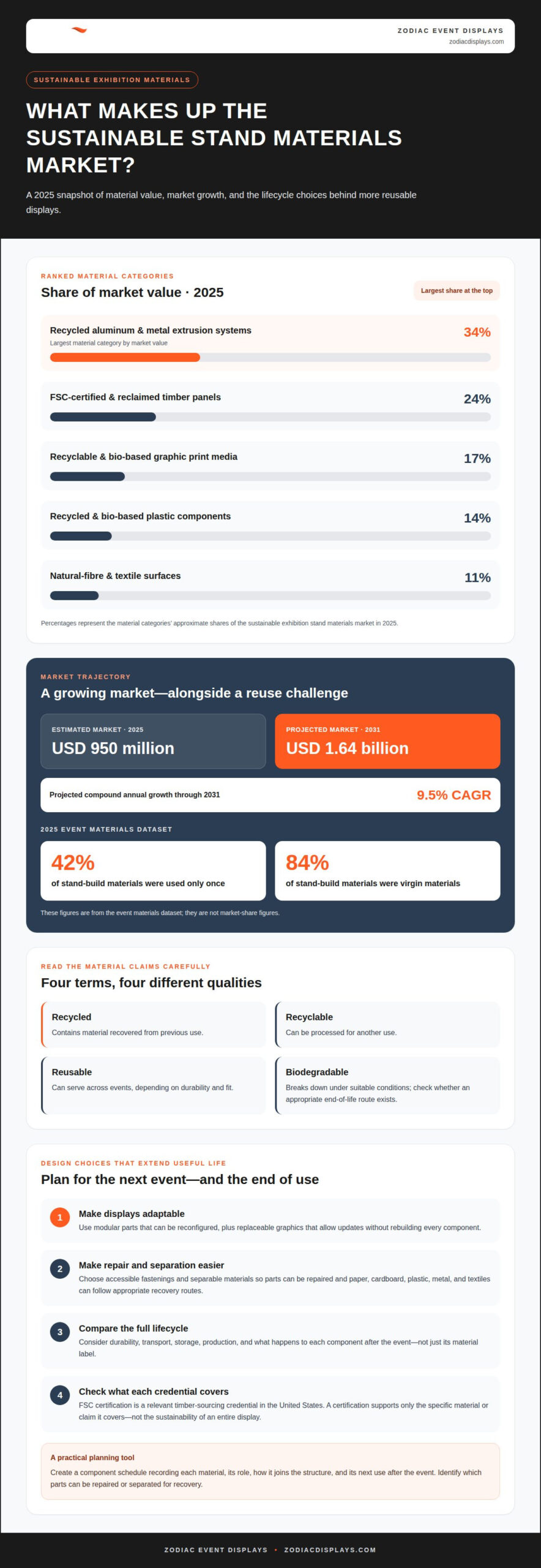
The global sustainable exhibition stand materials market was estimated at USD 950 million in 2025 and is projected to reach USD 1.64 billion by 2031, growing at a 9.5% CAGR through 2031. That momentum reflects a practical shift: the materials behind a striking display matter not only for how it looks, but also for how often it can be reused and what happens to it afterward.
Choosing sustainable event display materials can help reduce waste, use resources more thoughtfully, and create a polished presence on the show floor. But a material’s label alone does not determine its environmental impact. Durability, adaptability, production, and end-of-life options all matter.
Here, you’ll get a clear view of the market’s size, the environmental benefits and trade-offs to consider, and the greener practices reshaping exhibitions. We’ll also explore bamboo displays and giveaways, so you can see how material choices can support both memorable branding and more thoughtful events.
Key Takeaways
- See how renting, reusing, and recycling exhibition components can help reduce single-use waste.
- Learn which material and design choices can support lower-impact displays across their lifecycle.
- Find practical ways to assess supplier sustainability and bring greater carbon transparency to event projects.
- Explore bamboo displays and giveaways, and how thoughtful material choices can keep promotional items useful beyond the show.
1. What is the size of the global sustainable exhibition stand materials market?
The global sustainable exhibition stand materials market was estimated at USD 950 million in 2025. It is projected to reach USD 1.64 billion by 2031, growing at a 9.5% CAGR through 2031. Material selection is changing alongside that growth, with more focus on reuse, recyclability, and responsible sourcing.
There’s room to improve the event materials lifecycle. In the 2025 event materials dataset, 42% of stand-build materials were used only once, while 84% were virgin. Reusing a display across exhibitions, repairing worn components, or renting larger equipment can reduce reliance on new materials. The best option depends on durability, transport, storage, and whether the next event can use the same components.
Market value is spread across several material types. Recycled aluminum and metal extrusion systems accounted for about 34% in 2025; FSC-certified and reclaimed timber panels accounted for about 24%. Recyclable and bio-based graphic print media represented 17%, while recycled and bio-based plastic components accounted for 14%. Natural-fibre and textile surfaces made up 11%.
Recycled, recyclable, reusable, and biodegradable describe different qualities. Recycled materials contain recovered content; recyclable materials can be processed for another use; reusable items can serve across events; biodegradable materials break down under suitable conditions. Cardboard displays can be recycled or composted, while recycled paper can serve for flyers and brochures.
In the United States, FSC certification is a relevant sourcing credential for timber. For other components, review material composition and end-of-life information. A certification supports only the specific material or claim it covers, so do not treat one label as proof that an entire display is sustainable.
Design for reuse with modular parts that can be reconfigured, replaceable graphics, and accessible fastenings that make repairs easier. Keep materials separable at the end of use so paper, cardboard, plastic, metal, and textiles can follow appropriate recovery routes rather than going to landfill. Planning for the full lifecycle makes recycling decisions clearer.
2. Environmental benefits of sustainable exhibition materials
Material choices influence an exhibition’s environmental impact from production through disposal. Recycled aluminum uses 95% less energy than virgin aluminum production, making reclaimed content a meaningful consideration for display structures. Transport matters too: lighter components can reduce the weight moved between fabrication, storage, and event venues.
Xanita board weighs 75% less than MDF, which can reduce transportation-related carbon emissions. Its inner section is made from recycled paper fibres and can be repulped. For a display, pairing a lighter board with replaceable graphic panels can support easier transport and updates without rebuilding every component.
Museum exhibition design offers useful principles for trade shows. The Museum Exhibition Materials Pledge encourages resiliency, adaptability, disassembly, and reuse. Applied to stands, these principles mean choosing components that can be separated for repair, reconfigured for a new floor plan, or used at another exhibition instead of discarded after one installation.
Material selection can also include sustainable timber products, recycled graphics materials, eco-friendly printing substrates, and low-impact flooring. Acoustic Byssus is described as 100% renewable, recyclable, and biodegradable. These examples show why a conscious material choice should consider performance and end-of-life options, not just the first impression on the show floor.
A practical exhibition design and construction toolkit starts with a component schedule. Record each material, its role, how it joins the structure, and its next use after the event. Then identify parts that can be repaired or separated for recovery. LED lighting can also reduce operational energy use, with LEDs using up to 75% less energy than traditional bulbs. For a branded display format, explore banner stand options.
3. How are trade shows becoming more sustainable?
Trade show sustainability depends on choices across the supply chain, not just on display materials. In the United States, businesses can compare suppliers and printers based on their materials and production practices. Review published environmental information, material details, and end-of-life guidance to understand what each supplier’s claims cover.
Carbon transparency makes project impacts easier to assess. Look for information on relevant stages, such as material sourcing, production, printing, transport, and disposal. A clear account explains what a carbon claim covers and what it leaves out. Without that context, broad claims such as “lower carbon” can be difficult to interpret or compare.
The Museum Exhibition Materials Pledge emphasizes supply-chain responsibility alongside environmental performance. It calls for preference for products from manufacturers that uphold human rights in their operations and supply chains. It also encourages public disclosures about material ingredients and environmental impacts. These details help buyers consider social equity and environmental effects together.
Compare supplier proposals using the same criteria, including material composition, recycled content, reuse plans, printing substrates, and recovery routes. Ask whether a biodegradable component has a suitable end-of-life route where the event takes place. “Biodegradable” alone does not explain where or under what conditions a material breaks down.
Supply-chain transparency can show whether sustainability claims apply to a specific project. The pledge calls for publicly available Design for Freedom supplier questionnaires or similar disclosures. Review these alongside project-level carbon information rather than relying on a general sustainability statement. This helps make decisions more responsible while keeping claims specific and useful.
4. Bamboo displays and giveaways
Bamboo offers a plant-based alternative for selected exhibition components and promotional items. It can be harvested within 3-5 years, while hardwoods take decades to mature. Bamboo can reach maturity in roughly four years, making it an appealing material to consider when planning a display. Its growth timeline alone, however, doesn’t describe a product’s complete footprint or lifecycle.
For exhibition stands, bamboo may suit accents, sign holders, or other components where its appearance supports the design. The right application depends on the component’s function, expected handling, and how it will be reused or recovered. Pairing bamboo details with reusable frames or interchangeable graphics can refresh the look across events without rebuilding every element.
Giveaways also benefit from a lifecycle-first approach. Bamboo items can offer a reusable alternative to disposable promotional products, while biodegradable options may suit items intended for short-term use. The page describes bamboo as 100% biodegradable, but disposal conditions and local waste systems affect what happens after an attendee takes an item home. Choose useful objects that attendees are likely to keep, rather than novelty pieces with a short life.
Plan the materials as a coordinated set. Pair bamboo accents with recyclable cardboard packaging, print only the information attendees need, and provide digital details for longer product explanations. For lighting, LED fixtures use up to 75% less energy than traditional bulbs. That can help reduce display energy use, while transport, manufacturing, and end-of-life decisions still influence overall emissions.
A practical review starts with the intended use: identify which parts need to be durable, which can be reused, and how each item will be handled after the exhibition. Bamboo isn’t automatically the best choice for every component; its role should match the display’s design and recovery plan. For a polished branded presentation, explore display options that can complement a considered material mix.
Zodiac Event Displays
Zodiac Event Displays helps turn event branding goals into coordinated displays, giving exhibitors a practical next step after considering materials, reuse, and environmental impact. Its Event Tents, Backwall Displays, Custom Flags, and Inflatables can help create a clear, consistent presence across an event space.
Work with the team when shaping a display concept and bringing its visual elements together. The right combination depends on your venue, audience, messaging, and plans for using the display beyond one event. Sharing these priorities helps guide a solution that fits the project and keeps the presentation polished and purposeful.
For support with your event display plans, contact the Zodiac Event Displays team.
Make your next display choice more intentional
Turn sustainability priorities into a practical brief. Decide what the display needs to communicate, which components could serve future events, and what should happen to each material afterward. This makes sustainable event display materials part of a coherent brand experience rather than an afterthought.
Zodiac Event Displays offers Event Tents, Backwall Displays, and Custom Flags to help create a distinctive event presence. Share your goals, visual direction, and plans for future use with the team to start a focused conversation about your display needs.
Start planning your event display with Zodiac Event Displays, and take your next idea forward with purpose.
Frequently Asked Questions
What is the size of the global sustainable exhibition stand materials market?
The global market was estimated at USD 950 million in 2025 and is projected to reach USD 1.64 billion by 2031, with a 9.5% CAGR through 2031. These figures describe sustainable exhibition stand materials, not the entire events industry. Market estimates can vary with which materials, applications, and regions are included in the definition.
How are trade shows becoming more sustainable?
Trade shows can reduce material use with digital signage, QR codes, and digital brochures, while printing only the quantities needed. Organizers can plan waste sorting with clear bin instructions and suitable recycling or composting facilities. Exhibitors can choose reusable structures and considered graphics to make stands adaptable, then review supplier disclosures for information about material sourcing and project impacts.
What materials are sustainable for event displays and signage?
Options include recycled aluminum structures, reclaimed or sustainably sourced timber, recycled PET fabric, and recyclable or bio-based graphic media. Recycled paper can work for printed handouts, while cardboard may suit temporary displays. The right choice depends on the component’s purpose, expected use, printing requirements, and end-of-life route. Assess the full display rather than relying on a claim about one material.
What are the most durable eco-friendly materials for trade show booths and event displays?
Recycled aluminum can be useful for structural components, and modular construction can help a booth adapt to different layouts. Durability depends on how components are made, transported, assembled, and maintained, so material alone does not establish how long they will last. For busy events, prioritize repairable parts, replaceable graphics, and connections that let components be separated.
What sustainable alternatives to PVC are available for banners and signs?
Consider recyclable or bio-based graphic media, recycled PET fabric, natural-fibre textiles, or cardboard for suitable sign formats. The best option depends on whether a sign needs to be flexible, freestanding, or reusable across events. Consider how it will be printed and recovered afterward, too. Water-based inks are another printing consideration, but they are not a substitute for PVC as a substrate.
How much do sustainable event display materials cost compared with conventional materials?
There is no single reliable cost comparison for every display. Expenses depend on material selection, design complexity, print requirements, fabrication, shipping, and whether components can be reused or repaired. A reusable structure may require a different upfront investment than a single-use display, and replacement graphics can affect later project expenses. Compare the whole project and its intended lifecycle, not just the material price.

 Previous reading