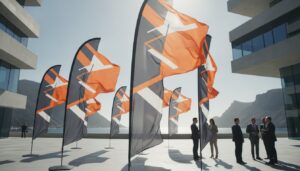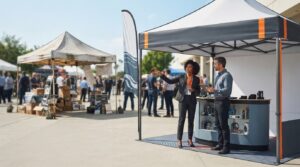



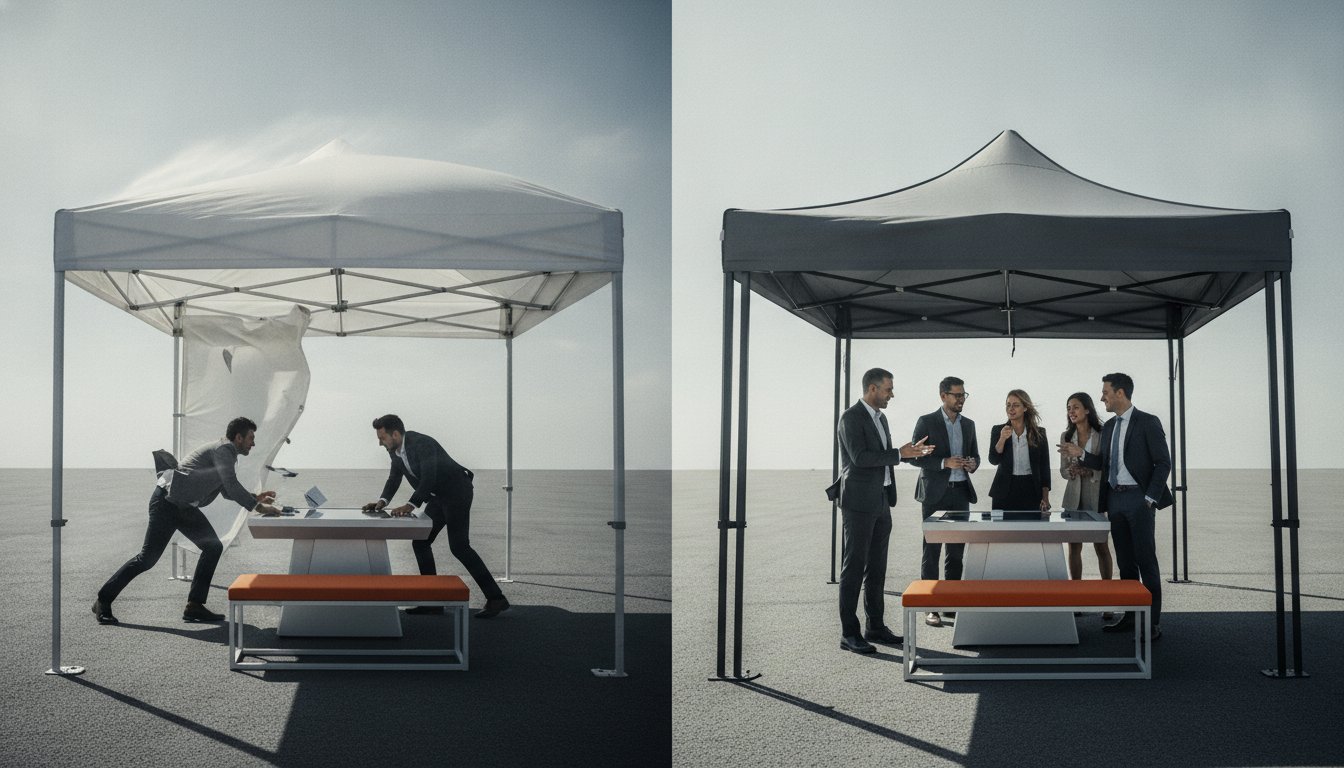
Imagine a sudden afternoon gust catching your custom canopy and lifting it like a sail; it’s a nightmare scenario that risks both your equipment and your professional reputation. Most event planners assume weight alone is the answer, but the real battle of pop up tent vs frame tent for wind resistance is won through engineering and material tensile strength. You’ve worked tirelessly to build a visual presence that commands attention, so the last thing you need is a weather cancellation that compromises your brand’s safety or visibility.
We believe your outdoor setup should be a fortress of reliability, not a liability waiting to happen. This 2026 guide pulls back the curtain on the structural secrets and advanced anchoring strategies that define true durability in the field. You’ll gain a clear understanding of wind limits, a master checklist for securing your site, and the confidence to choose the right hardware for your next high-stakes event. From aluminum alloy grades to the latest ANSI E1.21-2024 compliance standards, we’re here to ensure your presentation remains as bold and steady as your vision.
Key Takeaways
- Master the physics of uplift to keep your canopy grounded and prevent it from becoming an airborne liability during unpredictable gusts.
- Evaluate the critical structural differences between a pop up tent vs frame tent for wind resistance to ensure your hardware matches the specific demands of your event geography.
- Discover how to maximize brand visibility while minimizing risk by utilizing mesh sidewalls and strategic soft signage to reduce lateral wind pressure.
- Align your setup with 2026 safety standards and digital compliance tracking to protect your professional reputation and avoid costly site removals.
- Learn to implement a professional wind management plan that transforms your tent into a secure, high-impact fortress for any weather scenario.
The Physics of Wind Resistance: Why Your Event Tent Is a Sail
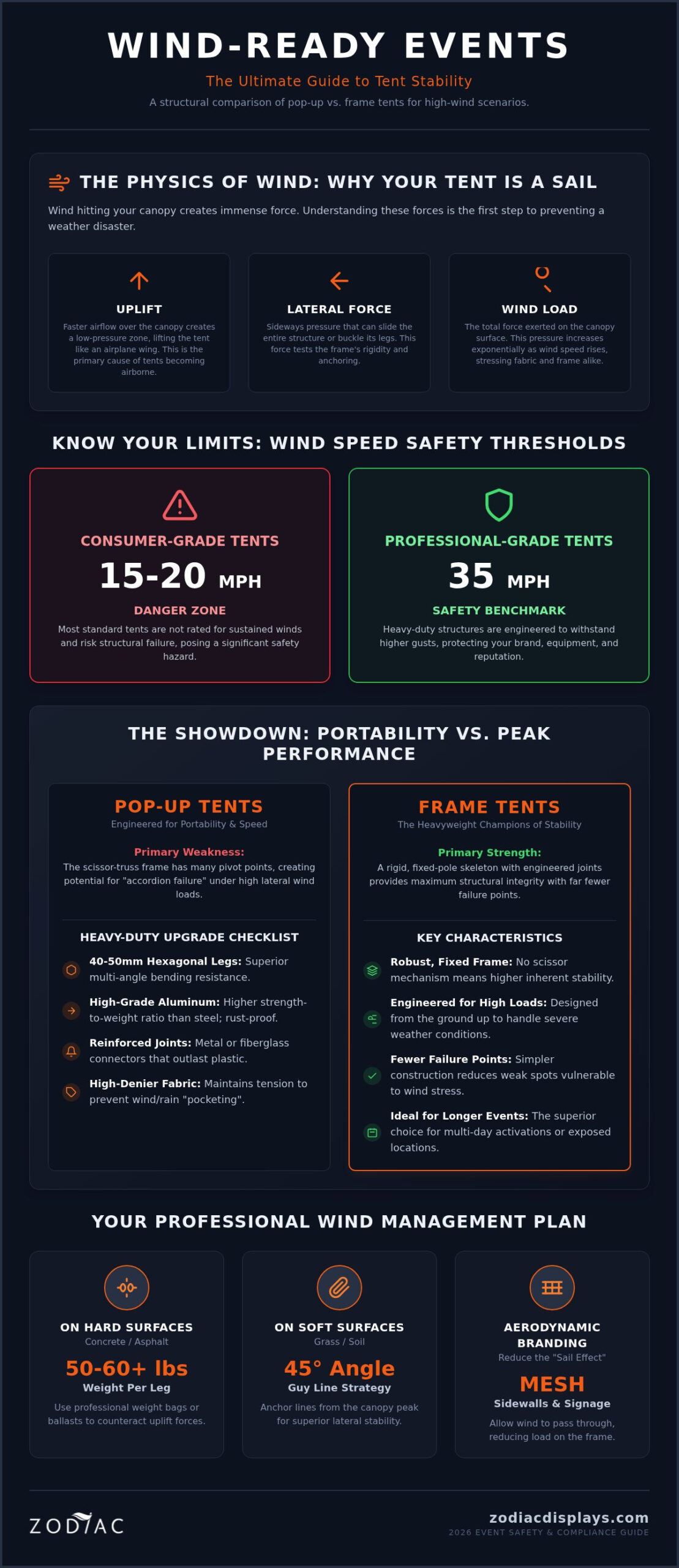
A custom canopy is more than a branding tool; it’s a structural participant in the environment. Understanding The Physics of Wind Resistance starts with recognizing that your tent is essentially a giant sail. When wind hits the tight weave of professional branded polyester, it doesn’t just pass through. It creates a massive amount of wind load, where the force exerted on the structure increases exponentially as velocity rises. This pressure can quickly turn a beautiful display into a safety hazard if the hardware isn’t up to the task.
Air density also plays a surprising role in how your setup performs. In Denver, the thin mountain air at a mile high actually exerts less force at 20 mph than the heavy, moisture-rich air found at sea level. However, mountain gusts are notoriously unpredictable and sharp. This nuance is vital when debating a pop up tent vs frame tent for wind resistance, as your choice must account for how local geography transforms a simple breeze into a structural test. Thinner air doesn’t mean you can relax; it means you need to prepare for the sudden, high-velocity snaps common in the Mountain West.
Drag, Lift, and Lateral Force
Lateral force is the sideways pressure that tries to slide your tent across the pavement or buckle the legs under the strain. As air flows over the peak of the canopy, it moves faster than the air underneath, creating a low-pressure zone. This generates lift, similar to an airplane wing. If your anchoring isn’t precise, the uplift effect will literally take your brand for a flight. Professional designs focus on wind-shedding, using specific peak angles and fabric tension to help air roll off the structure rather than getting trapped inside the canopy’s interior.
The Critical Threshold: When Wind Becomes Dangerous
There is a massive divide between a light breeze and a dangerous gust. Most consumer-grade tents are designed for backyard shade and often fail when sustained winds reach 15 to 20 mph. Professional-grade heavy-duty custom canopies are a different breed entirely. These structures are built to withstand a 35 mph benchmark, providing a safety net for your equipment and your audience. Understanding these thresholds is the first step in moving from a temporary setup to a permanent-feeling fortress that protects your professional reputation.
Pop Up Tents: Engineered Portability vs. Peak Gusts
The convenience of a collapsible frame is undeniable for fast-paced activations. However, the scissor truss system that enables this portability creates multiple pivot points where stress can accumulate. In high-wind scenarios, these joints are the front line of defense. When wind force exceeds the structural integrity of these connections, you risk the “accordion” failure, where the frame buckles inward on itself. Choosing the right hardware is a decision between a disposable shelter and a professional asset. When evaluating a pop up tent vs frame tent for wind resistance, the engineering of these joints determines whether your brand stands tall or folds under pressure.
Anatomy of a Heavy-Duty Pop Up
For 2026 events, the industry standard has shifted toward 40mm or 50mm hexagonal legs. Unlike traditional square legs that can bend easily along their flat faces, the multi-faceted hexagonal geometry provides superior resistance to bending from every angle. We prioritize high-grade aluminum over brittle, thin-walled steel because it offers a higher strength-to-weight ratio and won’t rust after a rainy weekend. To ensure longevity, look for reinforced fiberglass or aluminum joints. These materials handle the friction of repeated setups far better than cheap plastic alternatives. High-denier fabric is equally critical; it maintains tension to prevent “pocketing,” where wind or rain pools in the canopy and adds dangerous weight to the frame.
Optimizing Pop Up Stability
Stability isn’t just about the frame; it’s about how you anchor it to the earth. Professional weight bags or sandballasts are mandatory for any activation on hard surfaces like concrete or asphalt. Industry standards recommend a minimum of 50 to 60 lbs of weight per leg for a 10×10 setup in winds reaching 25 to 30 mph. Ballast serves as the primary defense against uplift by providing the necessary downward force to counteract the aerodynamic lift generated by your canopy. On grass, guy line strategies are your best friend. Anchoring lines at a 45-degree angle from the peak provides lateral stability that weights alone can’t match. If you’re ready to upgrade your event presence, explore our heavy-duty event tents designed for maximum endurance.
Frame Tents: The Heavyweight Champions of Event Stability
When your activation spans multiple days or faces the relentless gusts of a mountain festival, you need a structure that acts as a permanent fixture. Frame tents represent the pinnacle of event stability. Unlike their collapsible counterparts, these structures rely on a rigid external skeleton that doesn’t compromise for the sake of a quick setup. The debate of pop up tent vs frame tent for wind resistance often ends here; if the forecast looks grim, the frame tent is your safest bet for protecting both your brand and your guests. While they require more labor and a longer installation window, the trade-off is a fortress-like presence that commands respect on any event floor.
One of the most significant advantages of this style is the completely unobstructed interior. Without a center pole or a complex web of scissor trusses overhead, you have a blank canvas for high-impact branding. You can easily integrate hanging signs or massive backwall displays without fighting for space. This architectural freedom allows for a more sophisticated guest experience, as the structure feels like a premium boutique rather than a temporary shelter. It’s the choice for those who view their event presence as a long-term investment in visual excellence.
Structural Integrity of Rigid Frames
The secret to a frame tent’s endurance lies in its slip-fit or bolted joints. These connections create a singular, unified body that distributes wind load across the entire structure rather than concentrating it at a few pivot points. Because the frame is fixed, it’s far less prone to the “parachute effect” that can plague pop-ups. We utilize heavy-duty ratchets instead of simple nylon ropes to maintain tension. These professional-grade straps ensure the canopy remains drum-tight, which is essential for shedding wind and preventing the fabric from flapping or tearing during a storm.
Anchoring Strategies for Maximum Security
Even the strongest frame is only as reliable as its connection to the ground. For soft surfaces, the 45-degree rule for staking remains the gold standard. Driving stakes into the earth at an angle away from the tent provides the maximum possible hold against lateral forces. On concrete or asphalt, professional ballasting is non-negotiable. For 2026 events, compliance with ANSI E1.21-2024 standards requires precise weight calculations based on the expected wind load of your specific geography. You can even integrate custom flags into your setup by using dedicated bracket mounts that don’t compromise your primary tent anchors, maintaining both visibility and safety in one cohesive design.
Aerodynamic Branding: How Customization Affects Wind Load
Your branding choices dictate how your structure interacts with the environment. A full backwall display acts as a giant sail, catching every gust and transferring that energy directly into the frame. When weighing the benefits of a pop up tent vs frame tent for wind resistance, you must consider how these customized additions transform the aerodynamic profile of your setup. While a frame tent provides superior rigidity for massive graphics, any structure becomes vulnerable if the branding isn’t engineered for airflow. Strategic design turns a potential liability into a high-impact, weather-ready fortress.
The key to maintaining stability lies in permeability. Mesh sidewalls are the ultimate solution for balancing brand visibility with safety. These fabrics allow air to flow through the material, significantly reducing the lateral load on your hardware. Half-walls and railing covers offer a similar advantage, providing a clear boundary for your activation while letting the wind pass underneath the canopy peak. This prevents the pressure buildup that leads to the “parachute effect” discussed in previous sections.
Strategic Wall Placement
You should never close off three sides of your tent in a high-wind scenario. This creates a high-pressure trap for air, inviting catastrophic uplift. Instead, keep at least two sides open to allow wind a clear exit path. Be mindful of the “tunnel effect,” where wind accelerates through narrow openings between adjacent booths. This concentrated force can buckle even heavy-duty legs. If you require large-format event signage, incorporate precision wind-slits to bleed off pressure without sacrificing the legibility of your custom graphics.
Visual Impact vs. Structural Safety
Designing for the “Denver Breeze” requires a strategic approach to visual excellence. High-impact trade show graphics remain stunning on mesh when you utilize high-contrast palettes and bold, clean typography. You can also turn your furniture into a safety feature; weighted custom table cloths provide a low-center-of-gravity ballast that helps keep your footprint secure. When placing custom flags, such as teardrop or feather designs, ensure they’re positioned to complement airflow rather than acting as additional drag on your primary frame. Strategic branding ensures your presence is both beautiful and bulletproof. If you’re ready to engineer a setup that stands out and stands strong, start your custom project with Zodiac today.
Choosing Your Fortress: The Zodiac Approach to Wind-Ready Branding
Every event presents a unique set of environmental challenges, and a one-size-fits-all approach to hardware often leads to structural failure. At Zodiac Event Displays, we operate as a creative consultancy that prioritizes both visual impact and structural endurance. We understand that the decision between a pop up tent vs frame tent for wind resistance isn’t just about the budget; it’s about the specific geography of your activation. From the sharp, unpredictable gusts of a Denver festival to the sustained winds of a coastal trade show, we engineer solutions that safeguard your professional reputation and your equipment.
Our commitment to fabrication excellence means we only provide premium hardware and high-performance soft signage. We focus on heavy-duty aluminum alloys and high-denier fabrics that maintain their integrity long after consumer-grade alternatives have buckled. This dedication to quality ensures that your brand remains visible and secure, allowing you to focus on guest engagement rather than weather monitoring. With over a decade of industry experience and global delivery capabilities, we bring a seasoned strategist’s perspective to every project, ensuring your setup is as resilient as it is beautiful.
Your Wind Resistance Checklist
Preparation is the ultimate defense against the elements. Follow this strategic three-step process to ensure your next outdoor activation remains steady and professional:
- Step 1: Assess the Environment. Analyze the specific terrain and weather patterns of your venue. Grass allows for deep staking at 45-degree angles, while concrete requires a more rigorous ballast strategy to prevent sliding or uplift.
- Step 2: Select the Right Architecture. Choose your frame based on the duration and intensity of the event. While a pop up tent vs frame tent for wind resistance offers faster setup for single-day shows, a rigid frame tent is the heavyweight champion for multi-day festivals where endurance is non-negotiable.
- Step 3: Calculate Your Ballast. Align your anchoring with 2026 safety standards. Ensure you have a minimum of 50 to 60 lbs of weight per leg for standard 10×10 setups, utilizing professional sandballasts or concrete weights to counteract aerodynamic lift.
Partnering for Professional Growth
Zodiac acts as an essential extension of your own creative team, guiding you through the complex process of designing high-impact branded assets. We believe that a well-executed presentation is the cornerstone of brand pride, and that pride shouldn’t be compromised by a sudden change in the weather. We help you transition from the emotional hook of a bold design to the logical necessity of structural safety, creating a seamless journey from concept to completion. Our goal is to provide you with the confidence that your display will stand firm, allowing your brand to shine regardless of the forecast. Connect with a Zodiac specialist today to design your wind-ready display and elevate your event presence to a new level of reliability.
Mastering the Mountain Breeze: Your Path to Event Endurance
Your event presence is a bold declaration of your brand’s vision and professionalism. As you’ve discovered, the choice between a pop up tent vs frame tent for wind resistance isn’t merely a matter of convenience; it’s a strategic decision that impacts both safety and visibility. By prioritizing high-grade aluminum hardware and mastering the physics of airflow through mesh customization, you transform a temporary shelter into a reliable fortress that commands respect on any event floor.
Zodiac Event Displays brings over a decade of Denver-based fabrication experience to your creative team. We combine a sustainable design philosophy with the heavy-duty hardware required for high-stakes international events. Whether you’re activating at a local festival or a global trade show, our global delivery capabilities ensure your vision arrives intact and ready to perform. It’s time to move beyond the fear of the forecast and embrace the pride of a perfectly executed presentation.
Elevate your brand with a high-impact, wind-resistant display from Zodiac Event Displays and step into your next activation with absolute confidence. Your brand deserves a stage that stands as strong as your ambition.
Frequently Asked Questions
How much wind can a 10×10 custom canopy tent actually handle?
Most professional-grade 10×10 custom canopies are engineered to withstand sustained winds of 30 to 35 mph when properly anchored. The specific wind rating depends heavily on the frame architecture and the quality of the ballast used. While a standard pop-up might struggle beyond this threshold, a heavy-duty frame tent can often handle gusts up to 75 mph. Always monitor local weather alerts to ensure your setup remains safe for your guests and staff.
Is a steel frame or an aluminum frame better for high winds?
High-grade aluminum is the superior choice for high-wind environments due to its exceptional strength-to-weight ratio and natural resilience. Unlike steel, which can become brittle and prone to rust, professional aluminum frames utilize hexagonal leg geometry to resist bending under intense pressure. This structural durability is a critical factor when comparing a pop up tent vs frame tent for wind resistance. Aluminum provides the endurance needed for unpredictable mountain weather without the excessive weight of industrial steel.
Do I need a permit for a frame tent at my outdoor event?
Permit requirements vary by municipality, but most jurisdictions require official approvals for temporary structures exceeding 400 square feet. For 2026 events, many organizers must comply with updated safety regulations like Chapter 31 of the 2025 California Fire Code, which governs anchorage and egress. You should always consult with your local fire marshal or event coordinator early in the planning process. Staying ahead of digitized compliance tracking ensures your brand activation proceeds without legal interruptions.
What is the best way to anchor a tent on a concrete parking lot?
Professional ballasting is the only reliable way to secure a structure on hard surfaces where staking is impossible. You should use a minimum of 50 to 60 lbs of weight per leg for a standard 10×10 setup to counteract aerodynamic lift. Options include rubber-coated weights, sandbags, or specialized water barrels. Ensuring these weights are directly attached to the frame’s lower leg provides the low center of gravity necessary for maximum stability during sudden gusts.
Can I leave my custom pop-up tent up overnight?
We don’t recommend leaving standard pop-up tents unattended overnight due to the risk of sudden, destructive wind gusts. These collapsible structures are designed for quick activations rather than long-term exposure to the elements. If your event spans multiple days, a frame tent is a much safer investment for your brand. Its rigid architecture handles sustained environmental stress far more effectively. If you must leave a pop-up, lower the height to minimize the sail effect.
What happens to my tent warranty if it is damaged by wind?
Most manufacturer warranties cover defects in materials and workmanship but exclude damage caused by environmental factors like wind or storms. These incidents are typically classified as “Acts of God” rather than hardware failures. This is why investing in professional-grade equipment and proper anchoring is so vital for your brand’s protection. We focus on providing the most durable hardware available to minimize the risk of damage, ensuring your high-impact investment serves you for years to come.
How do sidewalls change the wind rating of my branded tent?
Sidewalls act like massive sails that capture wind and exponentially increase the lateral load on your frame. While they offer excellent branding space, they can lower the safe wind threshold of your setup if they aren’t managed correctly. To maintain a high wind rating, we suggest using mesh sidewalls that allow air to pass through while keeping your graphics visible. This strategic choice is a key factor in the pop up tent vs frame tent for wind resistance debate.
Are inflatable event displays more wind-resistant than traditional tents?
Inflatable event displays offer a unique advantage because they flex and shed wind rather than resisting it with a rigid frame. However, their high surface area means they require substantial anchoring to prevent them from lifting off the ground. When properly secured with heavy-duty ballasts, inflatables can be exceptionally resilient in gusty conditions. They provide a high-impact, vibrant alternative for brands looking to stand out while maintaining a safe and stable footprint during outdoor activations.
 Previous reading