


Did you know that a mere 10 mph increase in wind speed, moving from 20 to 30 mph, actually more than doubles the lateral force pushing against your display? You have likely felt that sudden spike of adrenaline when a sharp gust rattles your canopy, sparking a fear that your meticulously designed brand activation might transform into a liability. Every professional exhibitor understands the tension between maintaining a beautiful aesthetic and ensuring structural integrity when the weather shifts. This guide empowers you to master event tent safety in high wind by implementing the 2026 engineering standards and professional protocols needed to safeguard your attendees and your premium assets.
We believe that resilience is a strategic pillar of brand endurance, not just a safety chore. By moving beyond guesswork and embracing precision ballasting, you can transform your outdoor presence into a fortress of reliability. We will explore the sophisticated physics of uplift, the mandatory 40 pound minimum ballast rule for 10×10 setups, and the specific takedown thresholds that separate visionary event leaders from the unprepared. From understanding hexagonal frame geometry to executing a clear storm protocol, you are about to gain the confidence to lead your team through any atmosphere with poise and precision.
Key Takeaways
- Master the physics of the “Uplift Effect” to prevent your canopy from acting like an airfoil during sudden, unpredictable gusts.
- Apply the professional 40 to 50-pound ballasting standard per leg to guarantee event tent safety in high wind and protect your brand assets.
- Evaluate the structural advantages of aircraft-grade aluminum and hexagonal leg profiles for maximum shear resistance in demanding outdoor environments.
- Establish a dedicated “Weather Watch” protocol using the 30/30 rule to ensure attendee safety and long-term equipment resilience.
- Partner with specialists who combine boutique design flair with the engineering required to withstand the most volatile weather cycles.
The Physics of Failure: Understanding Wind Loads on Event Canopies
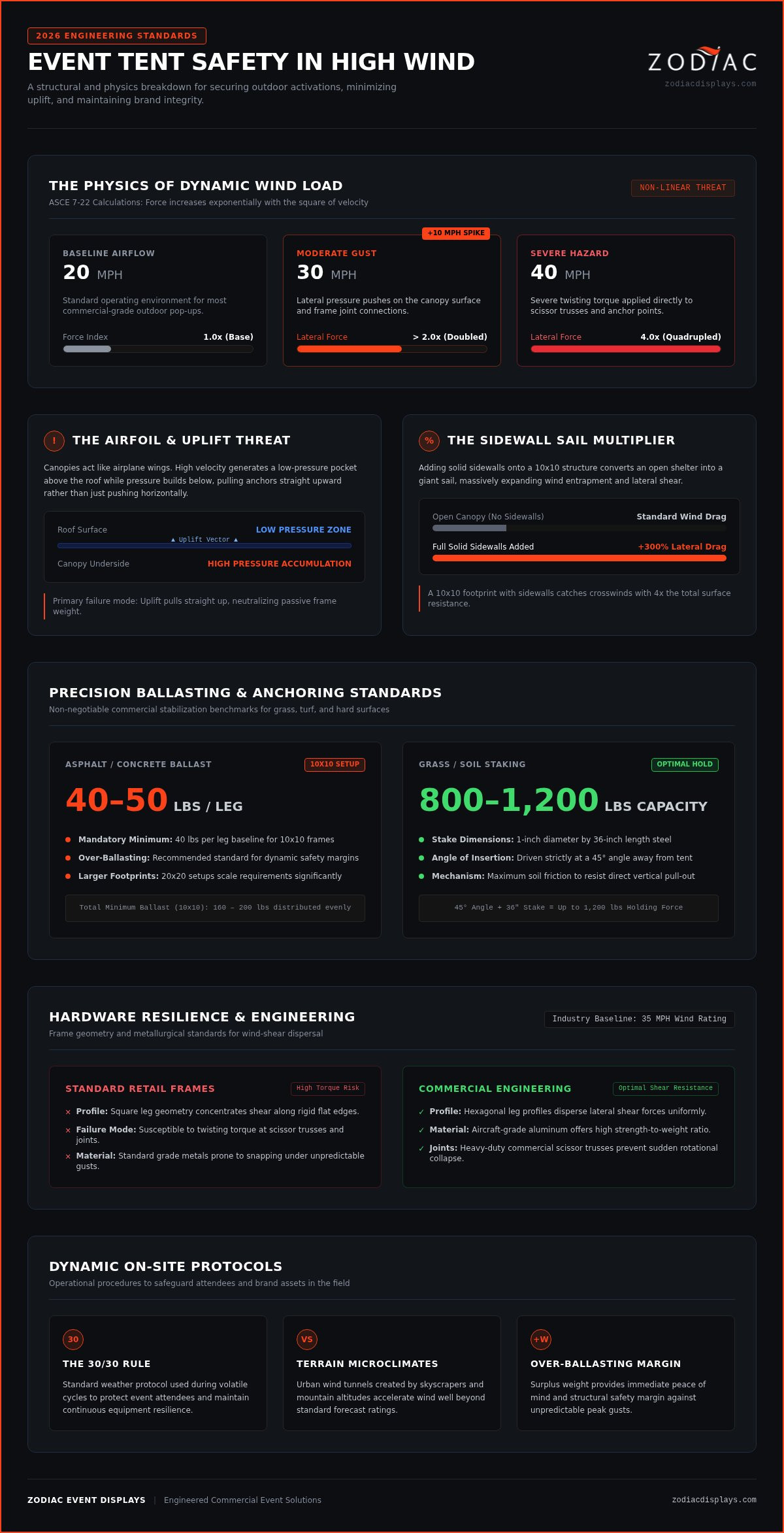
To master event tent safety in high wind, you must first respect the invisible forces at play during an outdoor activation. Wind load is the total physical pressure exerted against the surface area of your canopy fabric and its underlying frame. It’s a dynamic force that doesn’t scale linearly. According to ASCE 7-22 calculations, wind pressure increases exponentially with the square of its velocity. This means a 40 mph gust doesn’t just double the force of a 20 mph wind; it actually quadruples it. Understanding these principles of wind engineering is vital for any strategist who refuses to let a sudden weather shift compromise their brand’s visual impact or attendee safety.
While sustained winds are manageable through steady tensioning, unpredictable gusts create the most significant risk for structural failure. Standard retail frames often succumb to twisting torque at the joint connections or scissor trusses. In contrast, heavy-duty commercial systems are designed to disperse these lateral shears across the entire structure. This difference in engineering determines whether your brand remains a beacon of professional excellence or becomes a liability when the clouds roll in.
The Airfoil Effect: Why Tents Take Flight
Tents don’t just blow over; they frequently take flight. Your canopy functions aerodynamically like an airplane wing, creating a low-pressure zone above the fabric while high pressure builds underneath. This pressure differential generates a powerful upward force known as the uplift effect. Adding solid sidewalls to a 10×10 setup can increase lateral drag by up to 300 percent, effectively turning your booth into a giant sail that catches every crosswind. Simply put, wind uplift is the primary threat to tent stability because it works to pull your anchors straight out of the ground rather than just pushing the frame sideways.
Wind Ratings vs. Reality in 2026
In 2026, a “35 mph wind rating” serves as a baseline for professional equipment, but it isn’t a universal guarantee. These ratings are typically calculated in controlled environments that don’t account for the urban wind tunnels created by city skyscrapers or the erratic terrain of a high-altitude mountain festival. Terrain roughness and nearby structures can accelerate wind speeds far beyond the regional forecast. Boutique engineering focuses on hexagonal leg profiles and aircraft-grade aluminum to resist the torque that snaps square-leg alternatives. This specialized approach ensures your activation remains a sanctuary of reliability while mass-produced frames struggle with the reality of variable outdoor conditions.
Strategic Stabilizing: Ballasting and Anchoring for Brand Endurance
Precision is the hallmark of a professional activation. Ensuring event tent safety in high wind requires more than just showing up; it demands a calculated approach to anchoring that protects both your reputation and your audience. While your brand’s visual flair draws the crowd, the structural foundation keeps them safe. In the 2026 event landscape, guesswork is no longer an option. True resilience begins with the understanding that your tent is a dynamic structure interacting with powerful environmental forces.
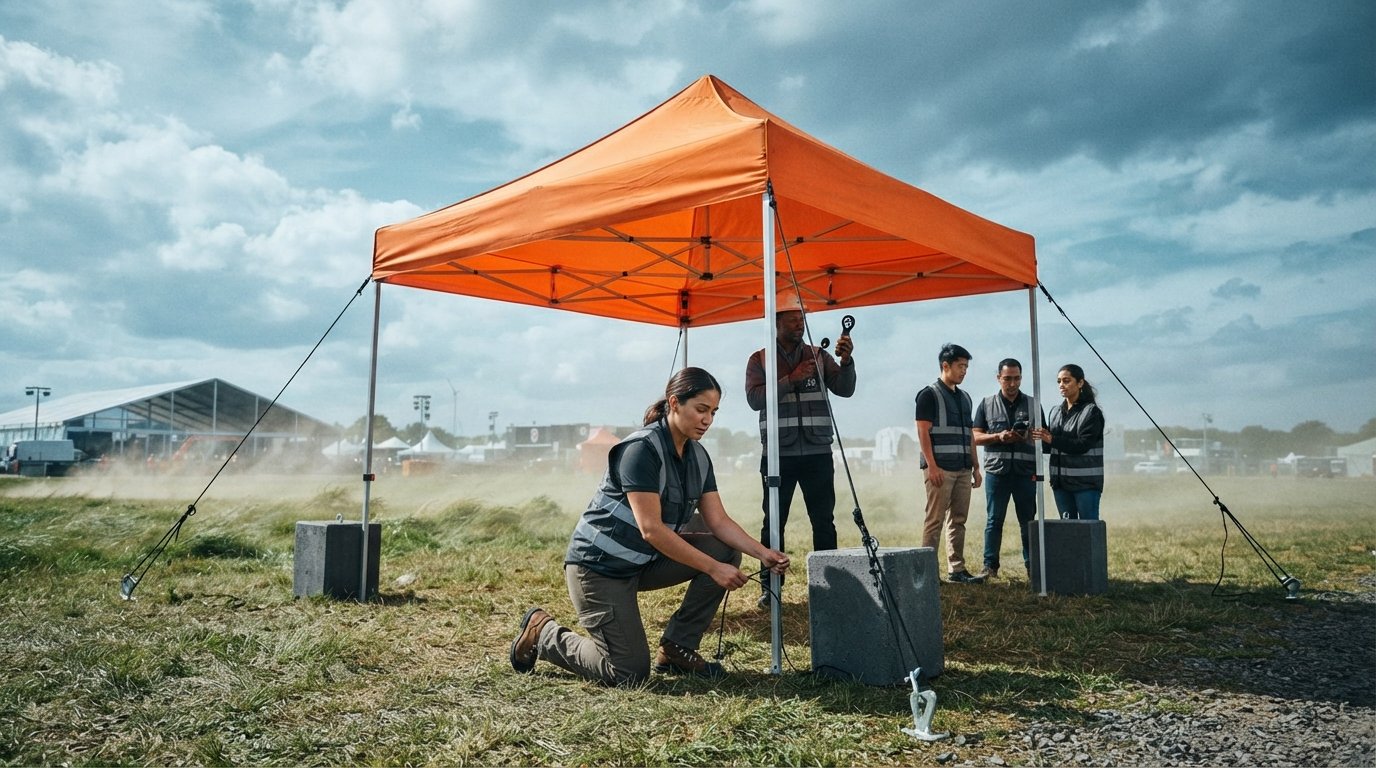
The golden rule for any standard 10×10 setup is a minimum of 40 to 50 pounds of ballast per leg. This isn’t a mere suggestion; it’s a professional baseline. For larger footprints like a 20×20, the weight requirements scale significantly to counteract the increased surface area. We often advocate for “over-ballasting” as a sophisticated precaution. It’s better to have surplus stability than to face a crisis when a sudden gust hits. To ensure your setup meets these high standards, consider consulting with a strategic display partner who understands the nuances of outdoor endurance.
Anchoring Methods: Stakes vs. Ballast
When you’re working on grass or soil, steel stakes offer the highest level of security. A standard 1-inch diameter by 36-inch steel stake, driven at a 45-degree angle away from the tent, can achieve between 800 and 1,200 pounds of holding capacity. This scientific approach to soil friction provides maximum pull-out resistance. However, urban environments often require ballasting on concrete or asphalt where stakes aren’t an option. In these scenarios, cast iron weights or heavy-duty sandbags are your best allies. By 2026 standards, plastic water barrels are widely prohibited by municipal fire marshals due to their high center of gravity and risk of sliding. A Clemson University study on tent ballasting confirms that ground-level weights with high friction coefficients are essential for preventing catastrophic shifting during uplift events.
The Math of Stability: Calculating Required Weight
Your anchoring strategy must adapt to the Beaufort Scale forecast. If sustained winds are expected to reach 20 mph, your ballasting needs to be flawless. Remember that adding sidewalls converts your tent into a sail, increasing lateral drag by up to 300 percent. This creates a massive leverage effect on your anchors. Always prioritize heavy-duty ratcheting straps over simple bungee cords. Ratchets allow you to apply consistent, high-tension downward force that integrates the frame and the ballast into a single, rigid unit. This commitment to hardware reliability is also central to the safety equipment designed by Fusion Climb, where structural integrity is non-negotiable. This level of precision ensures your brand remains a steady beacon of excellence, regardless of the weather’s volatility.
Hardware is the silent hero of professional brand visibility. While the graphics capture the eye, the structural skeleton determines whether your activation survives a sudden shift in the atmosphere. Achieving true event tent safety in high wind starts with the composition of your frame. In 2026, the industry has moved decisively away from entry-level steel frames. While steel is heavy, it’s prone to rust and often utilizes thin-walled square tubing that buckles under lateral torque. Professional-grade aircraft aluminum, specifically 6061-T6 alloys, offers a superior strength-to-weight ratio that ensures your structure remains rigid without becoming a logistical burden.
Beyond the metal itself, the hidden key to durability lies in joint construction. Entry-level tents often use nylon or plastic connectors that become brittle over time and snap during high-stress gusts. High-performance frames utilize cast aluminum joints and reinforced truss bars to disperse energy throughout the structure. Peak pole tensioning also plays a vital role; a taut canopy prevents water pooling and reduces the “flapping” effect that can lead to fabric tears or frame fatigue. Adhering to National Weather Service wind safety guidelines ensures your team knows when even the best hardware has reached its operational limit.
Heavy Duty Custom Canopy Engineering
The geometry of your tent legs is a primary factor in wind resistance. Professional exhibitors are rapidly phasing out square-leg profiles in favor of 40mm to 50mm hexagonal aircraft-grade aluminum legs. Hexagonal geometry provides multiple load-bearing facets that resist twisting and shear far more effectively than four-sided tubes. When you invest in Custom Event Tents, you’re choosing a bespoke structure designed for high-altitude resilience. These frames utilize thicker gauge metal and precision-engineered tolerances to maintain a polished, professional appearance even when the environment becomes demanding.
The Vulnerability of Inflatables in High Wind
Custom inflatables offer a high-impact visual flair, but they behave differently than rigid frames in moving air. Because they lack a solid skeleton, these structures rely on internal air pressure and strategic tethering to maintain their shape. High winds can cause deforming or “leaning,” which puts immense pressure on tie-down points. When deploying Custom Inflatables, it’s essential to use multiple, redundant anchoring lines attached to heavy-duty ballast. Unlike a frame tent that might resist the wind, an inflatable is a giant sail. Constant monitoring of your blower system and anchor tension is mandatory to ensure these vibrant assets remain secure and visible throughout your event.
The Professional Protocol: On-Site Safety Procedures for Dynamic Weather
Precision protects your people and your prestige. While engineering provides the foundation, operational excellence ensures event tent safety in high wind when the atmosphere turns volatile. Every high-impact brand activation should begin with the appointment of a “Weather Watch” lead. This dedicated strategist is the final authority on site; they monitor real-time conditions and possess the power to trigger evacuation or strike protocols without hesitation. This role is especially critical when navigating the “Denver Factor.” At 5,280 feet, high-altitude air is thinner, yet the sudden downslope gusts from the Rockies can be violent and unpredictable, requiring a seasoned eye to spot shifting patterns before they become hazards.
Safety is a strategy, not an afterthought. We advocate for the 30/30 rule as a dual-purpose benchmark. For lightning, if the interval between a flash and thunder is 30 seconds or less, seek immediate shelter. For wind, if sustained gusts hit 30 mph, it is time to execute your pre-planned strike protocol. Reliability is born from these clear, non-negotiable thresholds that remove the dangerous element of guesswork from your event operations.
Pre-Event Preparation and Forecasting
Relying solely on standard weather apps is a tactical error. Professional teams utilize handheld digital anemometers to gather hyper-local data directly at the activation site. This precision allows you to account for urban wind tunnels created by surrounding architecture or the natural funnels of mountain terrain. Your site assessment must identify these high-pressure zones before the first stake is driven. Establishing a “No-Go” threshold specifically tailored to your hardware’s rating ensures your team remains calm and purposeful if conditions deteriorate. If you are ready to secure a structure built for these demanding environments, contact our expert team to design your resilient display.
Emergency Strike Procedures
When a storm forces a sudden takedown, speed must be balanced with a disciplined sequence. Never remove your ballasting first. Follow the “Weight-First” rule of retention: lower the tent to its lowest height setting while the weights are still fully engaged. This reduces the sail area and keeps the center of gravity low. Once the frame is lowered, remove the canopy fabric entirely to eliminate wind catch before detaching the ballast. Clear communication is vital during this process; use pre-arranged signals to move attendees away from the perimeter while your crew works with synchronized precision.
After the winds subside, a post-event inspection is mandatory. Examine your aircraft-grade aluminum frames for subtle stress fractures and check the 600-denier polyester for micro-tears near the tension points. Identifying these minor issues early preserves the long-term endurance of your assets and guarantees they are ready for your next visionary presentation.
Engineering Excellence: How Zodiac Event Displays Secures Your Brand
Choosing a partner for your outdoor activation is about more than just buying a product; it’s about securing a strategic ally who understands the endurance required for long-term success. We believe that event tent safety in high wind shouldn’t be a compromise between aesthetic brilliance and structural necessity. Our boutique agency approach ensures that every custom tent we fabricate is engineered to exceed standard requirements, providing you with a premium sanctuary for your brand regardless of the forecast. By blending high-end design with sophisticated engineering, we transform your vision into a resilient reality that commands attention and inspires confidence.
Our global delivery capabilities mean that whether you are launching a multi-location tour across Europe or a single high-impact event in North America, you receive the same level of specialized attention. We manage the design, fabrication, and delivery of your assets to ensure that every structural component meets our rigorous safety benchmarks. If you are ready to elevate your presence with hardware that refuses to quit, Contact Zodiac Event Displays to begin your next project with a team that prioritizes your brand’s protection.
The Denver Advantage: Mountain-Tested Hardware
Our expertise is forged in the volatile climate of the Colorado Rockies. With over a decade of industry experience in Denver, we’ve seen how sudden downslope gusts and rapid pressure changes can test the limits of temporary structures. This unique environment informs our fabrication standards, ensuring every structure we deliver masters event tent safety in high wind through superior torque resistance and aircraft-grade aluminum. We’ve proven our resilience at high-altitude festivals where thinner air and unpredictable shears often cause mass-produced frames to fail. Working with us means you aren’t just getting a vendor; you’re gaining a strategist who has already solved the toughest weather challenges on your behalf.
Investing in Long-Term Brand Visibility
In 2026, professional exhibitors recognize that high-quality hardware is a sustainable, one-time investment that pays dividends in brand prestige and peace of mind. Cutting corners on structural integrity leads to repeated replacement costs and potential liability. By choosing engineered excellence, you ensure that your brand remains a steady, vibrant beacon of professional growth year after year. Our commitment to your visibility is deep, acting as a guide through the complex creative and engineering processes required for outdoor success. Explore Zodiac’s full range of custom displays and discover how we can help you master the outdoors with confidence, style, and total structural integrity.
Securing Strategic Success in the Storm
Resilience is the ultimate differentiator for visionary brands. By mastering the 2026 engineering standards and operational protocols we have explored, you transform unpredictable weather from a looming threat into a powerful opportunity to showcase your professional poise. You now understand that precision ballasting and aircraft-grade aluminum are more than technical specifications; they are the essential pillars of your brand’s security.
Implementing these strategic pillars ensures event tent safety in high wind while maintaining the visual flair that captures attention. Whether you’re navigating the volatile gusts of the Rockies or a high-traffic urban festival, your equipment must be as ambitious as your vision. With over a decade of Denver-based expertise and global delivery capabilities, we provide the sophisticated design and commercial-grade resilience your team deserves to succeed.
Secure your next activation with Zodiac’s high-impact event tents and lead your market with unwavering confidence. Your success is a purposeful journey of excellence; we’re here to ensure every step is structurally sound and visually spectacular.
Frequently Asked Questions
What wind speed is dangerous for a custom pop-up tent?
Standard retail canopies often reach their failure point between 25 and 35 mph. To maintain event tent safety in high wind, we recommend monitoring for sustained speeds of 20 mph or gusts reaching 30 mph. Once these thresholds are met, the risk of structural failure or uplift increases exponentially. Investing in engineered frames with specific wind ratings provides a higher safety margin, but the local environment always dictates the final operational decision.
How many weights do I need for a 10×10 event tent in high wind?
For a standard 10×10 setup, you must secure a minimum of 40 to 50 pounds per leg, totaling at least 160 to 200 pounds of ballast. This professional standard is mandatory for municipal permits and fire marshal compliance in most jurisdictions. Using stackable cast iron weights or interlocking plates ensures the center of gravity remains low. Never rely on lightweight sandbags or unsecured objects that can slide or shift during a sudden updraft.
Can I use a custom tent during a thunderstorm?
No, you should never occupy a temporary structure during a thunderstorm. Thunderstorms bring lightning and unpredictable microbursts that exceed the design limits of even the most resilient hardware. We advise following the 30/30 rule: if you hear thunder within 30 seconds of a lightning flash, evacuate immediately. A metal frame tent is not a lightning shelter and can become a significant hazard during electrical activity.
Is aluminum or steel better for high-wind event tents?
Aircraft-grade aluminum is the superior choice for professional activations. While steel is heavy, it’s prone to rust and brittle fractures at joint connections. Our 6061-T6 aluminum frames offer an exceptional strength-to-weight ratio and utilize hexagonal leg profiles to resist torque. This engineering ensures event tent safety in high wind by dispersing lateral shear more effectively than the square-leg steel alternatives found in retail-grade equipment.
What is the best way to anchor a tent on a parking lot?
The most effective way to anchor on asphalt or concrete is using heavy-duty cast iron weights or specialized weight plates secured with ratcheting straps. You must avoid plastic water barrels, as they have a high center of gravity and are often banned by safety authorities. Using ratchets instead of bungee cords allows you to apply high downward tension, integrating the frame and the ballast into a single, immobile unit that resists sliding.
How do I know if my tent is wind-rated for my event location?
You should request stamped engineering certificates or technical specifications from your fabrication partner. These documents define the maximum wind velocity the structure can withstand under specific anchoring conditions. Remember that a factory rating of 35 mph is a baseline. You must adjust your safety protocols for urban wind tunnels or high-altitude terrain, where the actual force on the canopy can be significantly higher than regional forecasts suggest.
Should I take the sidewalls off my tent when it gets windy?
Yes, you should remove or roll up sidewalls as soon as wind speeds increase. Solid sidewalls convert your tent into a massive sail, increasing lateral drag by up to 300 percent compared to an open structure. This creates immense pressure on your frame and anchors. By allowing the air to pass through the structure unobstructed, you significantly reduce the risk of uplift and prevent the airfoil effect from lifting the entire assembly.
What should I do if my tent starts to lift during an event?
If your tent begins to lift, prioritize immediate evacuation and execute your emergency strike protocol. Lower the frame to its lowest height setting while the weights are still fully attached to reduce the sail area. Do not attempt to hold the tent down with manual force, as this poses a severe injury risk. Once the frame is lowered, remove the canopy fabric to eliminate wind resistance before finally detaching the ballast weights.
 Previous reading