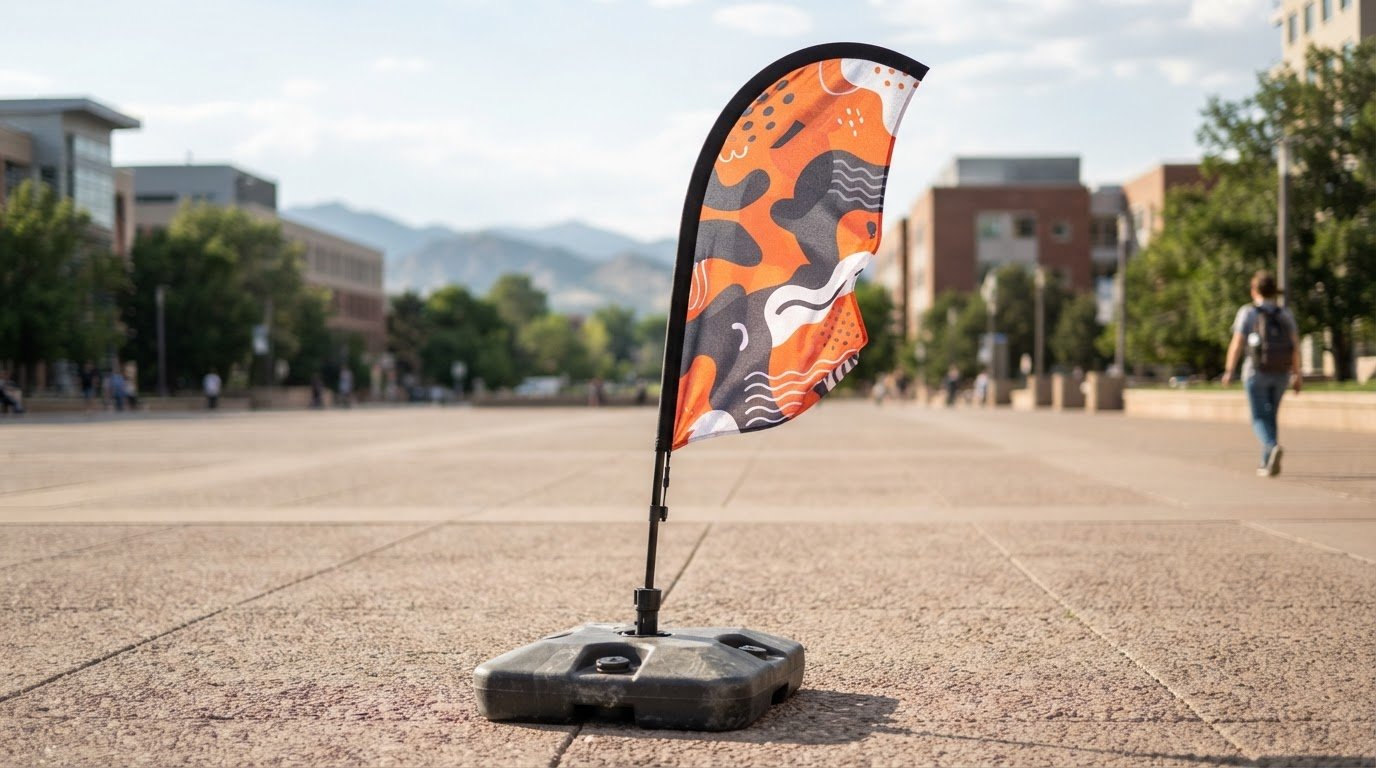
The stand’s footprint matters as much as its pole. Wind resistant outdoor flag stands should be chosen to suit the flag’s size, the display location, and the way the base is secured; one outdoor banner stand footprint is 36 by 36 inches. A broader base can help you assess how much ground space your setup needs, but it’s only one part of the decision.
A taller pole can give a flag more presence, but height alone doesn’t determine whether a stand is suitable. Base style, water or sand ballast, and packed dimensions all affect how practical it is to use, move, and ship.
This guide explains how to weigh those details before choosing an outdoor flag stand. You’ll learn how adjustable pole height affects a display, how its footprint influences placement, which shipping specifications matter, and when a water- or sand-weighted base may suit your setup. The aim is to plan for the setting, not just the appearance.
Key Takeaways
- Choose pole height to suit your flag’s dimensions and the visibility you want, rather than assuming a taller stand is always the better fit.
- Plan for transport as well as placement: packed dimensions and shipping specifications can affect how easily a stand fits your event logistics.
- Match the base style to the surface and setup, and consider how water or sand ballast affects stability and handling.
- Look beyond the stand’s label when judging wind performance; construction, anchoring method, flag size, and display conditions all play a role.
Adjustable pole height
Pole height affects how a flag catches the air and rises above nearby displays. An adjustable crossbar can help position the fabric, but it does not establish a stand’s wind rating. Match the pole and flag as a system, then consider the ground fixing and local exposure. A taller pole creates a larger visual profile and places greater demands on its base during gusts.
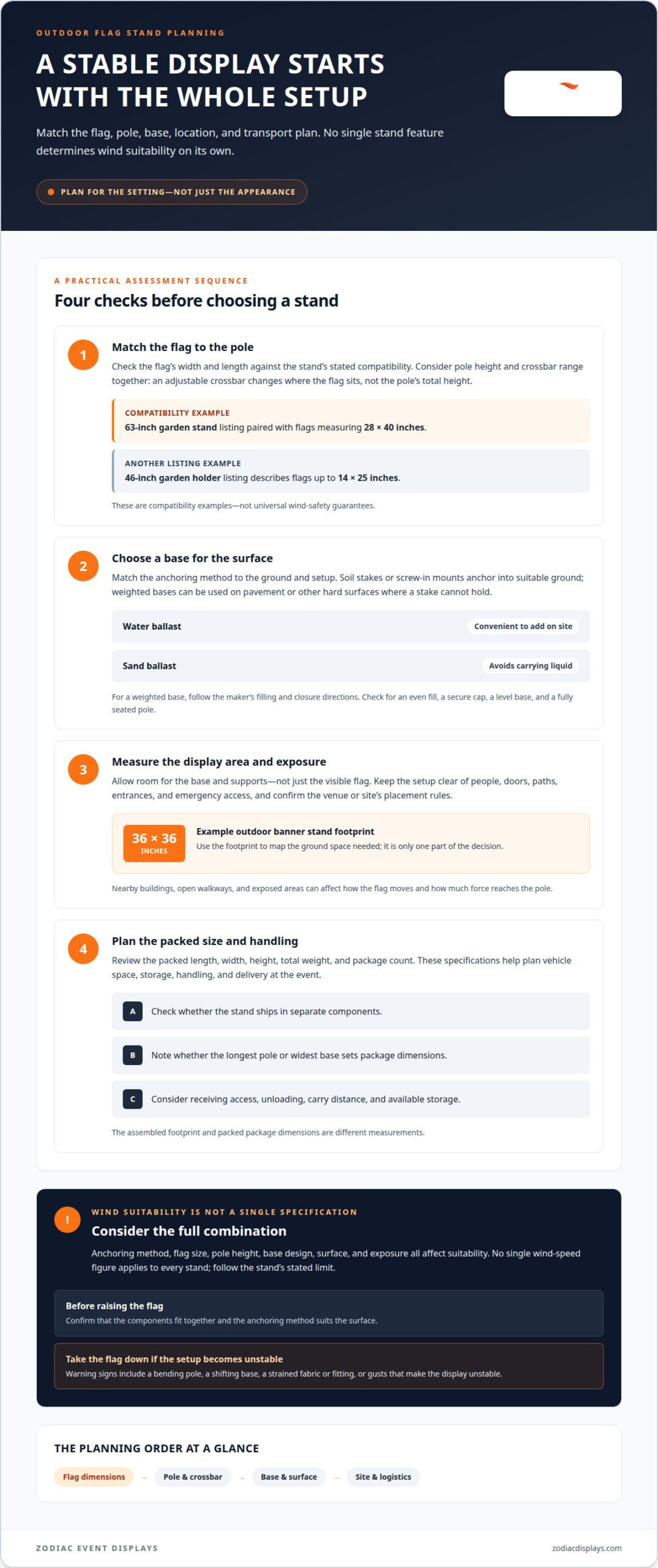
There isn’t one safe flag size for every stand. Match the flag dimensions and pole height to the stand’s stated compatibility, and consider how the base is secured. For example, one 63-inch garden stand listing pairs with flags measuring 28 by 40 inches. A 46-inch garden holder listing describes flags up to 14 by 25 inches. These examples show why compatibility matters, not a universal wind-safety guarantee.
Check both the pole’s total height and its crossbar range. A 10-foot in-ground flagpole listing, for instance, describes an adjustable crossbar. That feature changes where the flag sits, not the pole’s overall height. Before selecting a setup, compare the flag’s width and length with the stand’s supported dimensions. Then consider whether the display will sit near a building, an open walkway, or another exposed area. Those surroundings can affect how the fabric moves and how much force reaches the pole.
Take the flag down when gusts make the pole bend, the base shift, or the fabric strain against its fittings. Wind-driven movement can loosen an anchor, topple a stand, or send a detached part toward people or property. Don’t wait for visible damage; remove the flag when conditions make the display unstable.
For a practical setup, assess the flag first, then the pole, crossbar, and base. A large flag on a tall pole creates a different load from a small garden flag on a short holder. Confirm that the components fit together and that the anchoring method suits the surface. Matching them carefully helps prevent a striking display from becoming a hazard as the wind rises.
Stand footprint and shipping specifications
A stand needs room to sit securely and enough clearance for people, doors, and nearby displays. One outdoor banner stand has a 36-by-36-inch footprint, a useful example when mapping a display area. Measure the usable ground space, not just the visible flag area. Include room around the base so passersby won’t brush against the stand or its supports.
Local restrictions depend on the installation site. A venue may set its own placement rules, while public spaces can have different requirements for sidewalks, entrances, or access routes. A stand that fits beside a booth, for example, may obstruct a walkway elsewhere. Confirm the site’s rules and keep the setup clear of paths, doors, and emergency access.
Shipping specifications help you plan how a stand will move from storage to an event. Review the packed length, width, height, total weight, and package count. These details affect vehicle space, handling, and storage after delivery. If the stand ships in separate components, note whether its longest pole or widest base determines the package dimensions. Don’t assume the assembled footprint matches the packed size.
Before arranging transport, compare the specifications with the event’s delivery process. Check whether the receiving area accepts large packages, where shipments can be unloaded, and how far they must be carried to the display location. A narrow entryway or limited storage can affect which setup is practical. Keep the packed dimensions with the event plan so the team can coordinate space and handling.
For a practical decision, match three measurements: the stand’s footprint, the available display area, and the packed package dimensions. Then consider access routes and site rules. This planning also helps coordinate a flag display with other event display options, so each element has a clear place before setup begins.
Water- or sand-weighted base
A water- or sand-weighted base adds ballast without driving a stake into the ground. Its wind performance depends on the base design, fill, flag size, pole height, and exposure. No single wind-speed figure applies to every stand. Follow the stand’s stated limit and take the flag down before conditions exceed it.
Water can be convenient to add at the display site, while sand avoids carrying liquid and may suit locations with limited water access. Follow the base maker’s filling and closure directions. A loose cap, leaking seam, or uneven fill can reduce stability. Keep the base level on a firm surface, and seat the pole fully in its socket before raising the flag.
For soil, a ground stake or screw-in mount anchors directly into the ground. Choose a style suited to the surface and secure it properly rather than relying on shallow insertion. On pavement or another hard surface, a weighted base avoids trying to drive a stake where it cannot hold. Soil condition, surface type, flag area, and pole leverage all affect which mounting method is suitable.
Portable weighted bases are easier to move between event locations, but their resistance depends on the ballast and ground contact. Ground-mounted stands transfer force into the soil and can hold firmly when properly installed in suitable ground. Neither design is automatically safer in every setting. A large flag at an exposed site places different demands on its support than a small flag beside a sheltered entrance.
Before setup, match the base to the location, then inspect its fill, closure, level, and pole connection. Keep the display away from busy paths if movement could create a hazard. Take the flag down if the stand shifts, the pole strains, or gusts make the setup unstable. These visible signs call for action, whatever the base type.
What types of outdoor flag stands are most wind resistant?
No stand type is best in every setting. Wind resistance depends on the anchoring method, flag size, pole height, and surface. Compare these factors together. For example, a stake designed for soil won’t install the same way on paved ground, where a weighted base may be more suitable.
For soil, consider stands with multiple ground prongs or spikes. More contact points can help anchor the base if the prongs enter firm ground securely. One listed garden stand uses a four-prong base. Treat that as an anchoring feature, not a guarantee of a particular wind-speed rating. Ground conditions and flag area still matter.
A five-spike garden stand listed for 12-by-18-inch flags offers another example of a multi-point design. Compare the intended flag size with the stand’s compatibility, then consider how exposed the location is. A stand designed around a small garden flag may not suit a larger banner. Don’t infer strength from spike count alone.
On hard surfaces, a weighted base avoids relying on soil penetration. A solid round anti-tip base is another design example, but its label alone doesn’t establish wind performance. Consider the base’s contact with the surface, pole fit, and the amount of fabric exposed to gusts. Follow the stand’s stated setup guidance.
To compare options, start with the installation surface, then match the anchor style to that surface. Next, compare flag dimensions, pole height, and the stand’s stated compatibility. Finally, plan for changing conditions: remove the flag if the pole strains or the base shifts. For a broader event setup, explore coordinated display options alongside your stand choice.
Zodiac Event Displays: Custom Flags
Zodiac Event Displays creates custom flags for outdoor event marketing. Turn to the team when you’re planning a display and want flag design and fabrication coordinated with your broader presentation. Share the event setting, intended placement, and visual priorities so the design can reflect how your message should appear on site.
For a unified event presence, custom flags can sit alongside banner stands, event tents, or backwall displays. Zodiac Event Displays manages projects from creative design and fabrication through delivery, helping connect the visual details across your display materials. If you’re ready to plan custom flags for an upcoming event, contact Zodiac Event Displays.
Plan a Display That Fits the Setting
Start planning your outdoor display by deciding where it will stand and how people will experience it. Let the setting guide the visual plan, from flag artwork to the surrounding event environment. Wind resistant outdoor flag stands are one part of a successful presentation; clear messaging and coordinated display elements help the overall setup feel intentional.
Zodiac Event Displays offers Custom Flags, Event Tents, and Backwall Displays to support a cohesive event presence. Choose elements that suit your space and message, then bring them together around your goals. A well-planned display gives your brand a confident, recognizable presence while keeping practical setup needs in view.
Contact Zodiac Event Displays to discuss your next custom display, and take the next step toward a presentation that feels distinctly yours.
Frequently Asked Questions
Which materials and base designs make a flag stand stable in high winds?
A well-matched metal pole and secure base are essential, and the right combination depends on the site and flag. On a lawn, a stand with ground-penetrating prongs suits soil, while a weighted base is more practical on a patio. Check that the pole fits firmly into its socket and that the stand’s stated flag compatibility matches your fabric dimensions.
How should you secure an outdoor flag stand against strong gusts?
Set the stand on an even surface and assemble each connection according to its instructions. For a stake-style stand, press the full anchoring section into suitable ground; for a weighted base, close the fill opening and seat the pole securely. Keep the setup clear of foot traffic, inspect it before display, and take the flag down if the stand shifts or parts loosen.
What are the best wind-resistant outdoor flag stands for residential use?
For a residential lawn, choose a stand designed for soil and your flag’s dimensions. For a porch or paved entrance, select a compatible weighted-base design. A small garden flag usually needs a different setup from a tall promotional banner. Consider storage, too: a stand that can be disassembled may be easier to put away when not in use.
How much do durable outdoor flag stands for windy conditions cost?
Wind resistance depends on anchoring, flag size, pole height, and the surface, not the label alone.

 Previous reading